October 13, 2026
Musculoskeletal Ultrasound in St Helens: A Patient’s Guide

Could the best scan for your symptoms be different from the one you expected? If you’re considering musculoskeletal ultrasound St Helens, this guide will help you understand what the scan can assess, what to expect at an appointment and how imaging may fit into your care.
You’ll also find practical ways to prepare and learn about Ready Health’s local pathway for patients in and around St Helens.
Key Takeaways
- Learn which symptoms and soft-tissue concerns a musculoskeletal ultrasound may help assess, and where its limits matter.
- Understand the appointment process and how the imaging professional guides you through the scan.
- Compare ultrasound with MRI and X-ray to understand why the choice depends on the clinical question.
- Explore a local route to musculoskeletal ultrasound St Helens through Ready Health’s partner-provided imaging service.
- Prepare useful questions for a clinician and understand how an assessment can help shape your next steps.
Table of Contents
- Musculoskeletal ultrasound in St Helens: what the scan is for
- What happens during a musculoskeletal ultrasound appointment?
- Musculoskeletal ultrasound, MRI or X-ray: which imaging approach fits?
- Choosing a musculoskeletal ultrasound pathway near St Helens
- Access musculoskeletal ultrasound through Ready Health
Musculoskeletal ultrasound in St Helens: what the scan is for
If pain or restricted movement is affecting your day, you may be wondering whether a scan could clarify what is happening. A musculoskeletal ultrasound is one imaging option. Whether it is useful depends on the area being assessed and the clinical question your clinician wants to answer.
Musculoskeletal ultrasound uses sound waves to create images of selected muscles, tendons, ligaments and joints beneath your skin. The imaging professional moves a small probe over the area, using gel to help it make contact with your skin. The images can help a clinician assess particular soft tissues, but the scan is only one part of understanding your symptoms. It does not provide a diagnosis on its own.
You can read a general overview of medical ultrasonography to learn how ultrasound is used in healthcare. Ready Health arranges ultrasound investigations through scan partners. The clinic is in Standish, Wigan, and serves patients from St Helens and nearby communities, including Shevington, Standish Lower Ground, Boar's Head, Wrightington, Appley Bridge, Chorley, Skelmersdale, Orrell, Ashton-in-Makerfield, Bolton, Leigh, Preston and Southport. Find out more about the ultrasound scan service.
What can a musculoskeletal ultrasound help assess?
The scan may help assess selected soft tissues, including muscles and tendons, ligaments and parts of a joint. For example, if you have discomfort near a tendon or pain when moving a joint, imaging may help a clinician examine the relevant area.
Suitability depends on your symptoms and what the clinician needs to find out. Not every cause of pain or injury can be seen on ultrasound. The images need to be considered alongside your history and examination findings.
When might a clinician consider ultrasound imaging?
A clinician may consider imaging after asking about your symptoms and examining the affected area. Be ready to explain where you feel discomfort, when it began and which movements affect it. These details help the clinician decide whether ultrasound could add useful information or whether another assessment or imaging approach may be more appropriate.
A private GP consultation gives you an opportunity to discuss your symptoms and possible next steps. This clinical assessment keeps the focus on the question that needs answering, rather than choosing a scan without context.
For people looking for a musculoskeletal ultrasound in St Helens, the local pathway can include clinician-led assessment followed by partner-provided imaging where appropriate. The scan contributes information to that wider assessment. Your clinician can consider the findings alongside your symptoms and discuss what they may mean for your care.
What happens during a musculoskeletal ultrasound appointment?
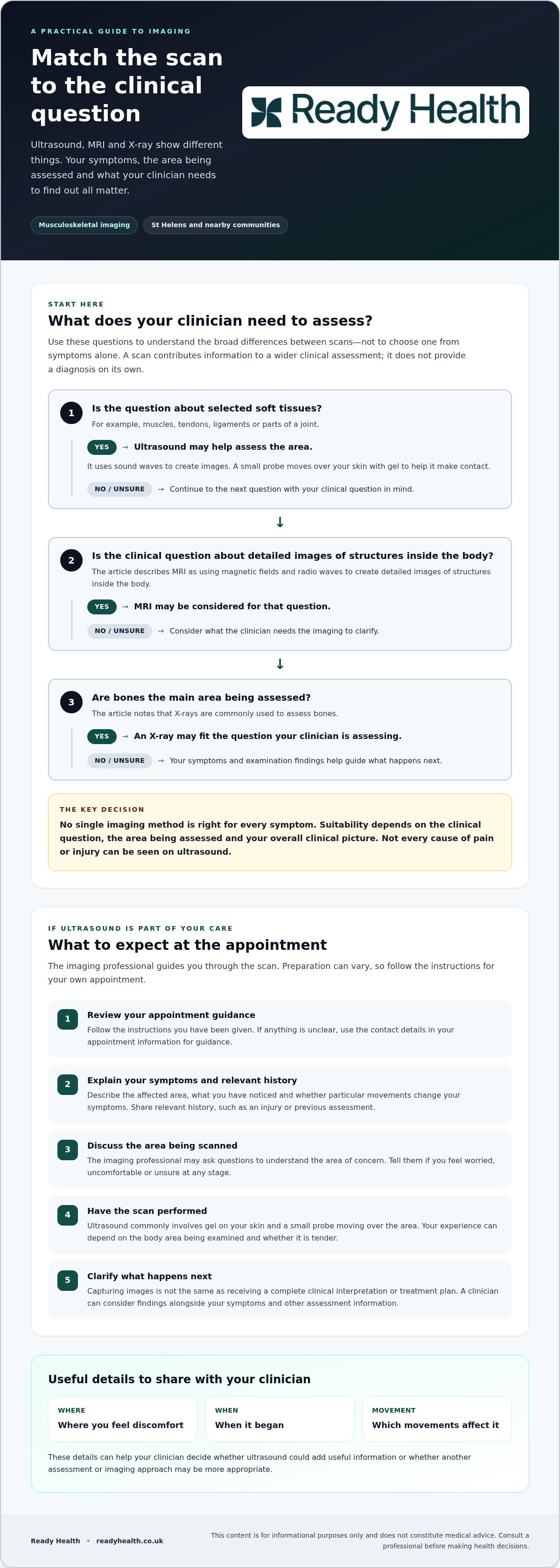
Knowing the broad steps can make an imaging appointment feel more manageable. The process depends on the area being assessed and the instructions for your appointment. The imaging professional will guide you through the scan and explain what they need you to do.
- Before your appointment, review your guidance. Follow the appointment-specific instructions you’ve been given. Preparation can vary, so don’t assume advice for another type of scan applies to yours. If anything is unclear, use the contact details in your appointment information for guidance.
- Explain your symptoms and relevant history. Be ready to describe which area is affected, what you’ve noticed and whether particular movements change your symptoms. Share relevant clinical history, such as an injury or previous assessment. Bring a referral or other information about the area if you have it.
- Discuss the area being scanned. The imaging professional will guide you through the scan and may ask questions to understand the area of concern. This helps focus the examination on the clinical question. Tell them if you’re worried, uncomfortable or unsure about what is happening at any stage.
- Have the scan performed. Ultrasound commonly involves placing gel on your skin and moving a small scanning probe over the area. The probe sends and receives sound waves to create images. Your experience can depend on the part of the body being examined and whether it is tender. The What is Musculoskeletal Ultrasound? guide explains the general imaging process.
- Clarify what happens next. Capturing images is not the same as receiving a complete clinical interpretation or treatment plan. The findings need to be considered alongside your symptoms and other assessment information. A clinician can explain the next step in your care, which may include discussing the findings or considering another assessment.
It’s reasonable to feel unsure about what to expect, especially if you haven’t had ultrasound imaging before. You can help the appointment run smoothly by describing your concern clearly and sharing relevant information you already have. The imaging professional will guide you through the scan, so you don’t need to know what to do in advance.
Ready Health arranges ultrasound investigations through scan partners, alongside clinician appointments and referrals. If you’re considering a musculoskeletal ultrasound in St Helens, a clinician-led discussion can help you understand whether imaging may fit your situation and what steps could follow. You can book an appointment to discuss your needs.
Musculoskeletal ultrasound, MRI or X-ray: which imaging approach fits?
Different scans create images in different ways, so they can help answer different clinical questions. Ultrasound uses sound waves to produce images of selected soft tissues and can show structures in real time as the probe moves. MRI uses magnetic fields and radio waves to create detailed images of structures inside the body, while X-rays are commonly used to assess bones.
The most suitable scan depends on the clinical question, the area being assessed and your overall clinical picture. No single imaging method is right for every symptom. This comparison explains the broad differences, but it is not a way to select a scan based on symptoms alone.
How ultrasound differs from MRI and X-ray
Each method has strengths and limits. The table summarises their general roles. The usefulness of a particular scan depends on what the clinician needs to assess.
| Imaging method | General purpose and strengths | Limitations to consider |
|---|---|---|
| Ultrasound | Uses sound waves to show selected soft tissues, such as tendons and muscles. Images can be viewed in real time. | It doesn’t show every structure or explain every cause of pain. Its suitability depends on the area and clinical question. |
| MRI | Uses magnetic fields and radio waves to create detailed images of structures inside the body, including many soft tissues. | It may be considered when a broader or different view is needed. Whether it is appropriate depends on clinical assessment. |
| X-ray | Creates images commonly used to assess bones and their alignment. | It provides different information from soft-tissue imaging, so it may not answer questions about some muscles or tendons. |
Why the scan choice should follow clinical assessment
Your symptoms are one part of the decision. A clinician may also consider your medical history, examination findings and the precise area causing concern. For example, discomfort around a joint could involve different structures, and the best way to investigate it depends on what needs to be understood.
After assessing you, a clinician may recommend ultrasound, MRI, X-ray, another form of assessment or no imaging. A scan is most useful when it is chosen to address a defined clinical question, rather than simply because it is available or familiar. If you’re considering musculoskeletal ultrasound in St Helens, discussing your symptoms with a clinician can help establish whether ultrasound may be relevant.
Ready Health arranges ultrasound investigations through scan partners, alongside clinician appointments and referrals. Explore the ultrasound scan service to understand the local pathway. The aim is to connect the imaging choice with your assessment and the next steps in your care.
Choosing a musculoskeletal ultrasound pathway near St Helens
Choosing an imaging pathway starts with the reason for the scan, not simply the name of the test. If you’re considering musculoskeletal ultrasound St Helens, use a discussion with a clinician to clarify what you want to understand and how imaging could inform your care.
Questions to clarify before arranging imaging
These questions can help you focus the conversation. You don’t need to choose the scan yourself. The aim is to understand the clinical reasoning and what the options may mean for you.
- What question is the proposed scan intended to help answer?
- How does the imaging decision relate to my symptoms and examination?
- Could details from a previous assessment help inform the next step?
- If the scan doesn’t clarify the issue, what might be considered afterwards?
- Who can explain the findings and discuss what they mean for my care?
If you’ve already had an assessment, share what you were told and bring relevant information if you have it. If not, you can still discuss your symptoms with a clinician. Referral arrangements depend on the pathway and your circumstances, so you can discuss the appropriate next step as part of your clinical assessment.
Understanding the local care pathway
A clear pathway connects your symptoms, clinical assessment and any investigation being considered. In a discussion about musculoskeletal ultrasound St Helens, explain what you hope the scan will clarify and raise any concerns about the process. This keeps the conversation centred on your needs rather than imaging alone.
Clinician appointments support discussion of your symptoms and whether imaging may be appropriate. They can also help you understand how findings might inform further assessment or care. The investigation is one step, so it’s useful to understand how questions about the result and follow-up fit into your overall plan.
You can explore the ultrasound investigations service as you consider your options. Before an appointment, note when your symptoms occur, what affects them and what you’d like to ask. These notes can help you explain your concerns clearly.
A Ready Health clinician can discuss your symptoms and possible next steps with you.
Access musculoskeletal ultrasound through Ready Health
If you’re weighing up whether imaging is a useful next step, a clinician can help frame the question around your symptoms and what you hope to understand. You don’t need to arrive with a diagnosis. A clear account of how the issue affects you can help guide the discussion.
How clinician support can fit around imaging
During an appointment, you can discuss when your symptoms began, what changes them and any previous assessment. A clinician can consider this information when discussing whether imaging may be appropriate or whether another approach could be more useful.
Scan findings are considered alongside your symptoms and clinical assessment, rather than in isolation. If you need broader guidance about discussing a health concern with a GP, Ready Health’s Private GP Wigan guide may help you prepare for that conversation.
Your next step for local imaging
Before arranging an investigation, consider what you’d like help understanding and note any questions you want to raise. You can explore Ready Health’s ultrasound investigations service and discuss your circumstances with a clinician.
A considered conversation can help you move forward with greater clarity.
Take a clear next step for your health
Choosing to investigate ongoing symptoms can feel like a significant decision. You don’t need to have all the answers before speaking with a clinician. Start with what you’ve noticed and what you’d like help understanding. That gives you a practical foundation for discussing whether imaging may be appropriate.
If you’re considering musculoskeletal ultrasound St Helens, book an appointment with Ready Health to discuss your symptoms and possible imaging pathway. A clinician can help you consider the next steps in light of your circumstances.
Frequently Asked Questions
What can a musculoskeletal ultrasound show?
A musculoskeletal ultrasound may show selected soft tissues, including tendons, muscles, ligaments and parts of joints. For example, a clinician may request imaging to examine a particular tendon after an assessment. The scan cannot show every structure or explain every source of pain. What it can assess depends on the body area and the question being investigated, so your clinician will consider the images alongside your symptoms.
Is a musculoskeletal ultrasound painful?
A musculoskeletal ultrasound is not usually described as painful, but pressure from the probe may feel uncomfortable if the area is already tender. Tell the imaging professional if you feel discomfort so they can guide you through the examination. Your experience may depend on the location being scanned and your symptoms. If you’re concerned about pain or movement, mention this before the scan begins.
Do I need a referral for a musculoskeletal ultrasound?
Whether you need a referral depends on the imaging pathway and your circumstances. If a clinician has already assessed you, keep any referral or relevant notes available. If you haven’t had an assessment, you can discuss your symptoms with a clinician, who can help consider whether imaging may be appropriate.
How long does a musculoskeletal ultrasound take?
The appointment length can vary according to the area being examined and the purpose of the scan. Follow the information provided for your specific appointment rather than relying on a general estimate. Allow time to discuss the area of concern and follow the imaging professional’s guidance. If you need to plan around work, travel or other commitments, use your appointment details to plan.
Can an ultrasound diagnose the cause of joint or tendon pain?
An ultrasound may provide useful information about selected tissues, but it doesn’t diagnose every cause of joint or tendon pain by itself. A clinician needs to interpret the images in context, including your symptoms, history and examination findings. For example, pain near a tendon may have causes that aren’t visible on ultrasound. Your clinician can explain what the findings suggest and whether further assessment may be needed.
What happens if my ultrasound does not explain my symptoms?
If the scan doesn’t clarify your symptoms, it doesn’t mean your experience isn’t real or that no further steps are possible. A clinician can review the result alongside your history and examination, then discuss whether another assessment, a different imaging approach or a review of your care may be helpful. Keep track of changes in your symptoms and share them during follow-up discussions.
Can I access musculoskeletal ultrasound in St Helens through Ready Health?
Yes. Ready Health arranges ultrasound investigations through scan partners for patients from St Helens. The clinic is based in Standish, Wigan, and is CQC-regulated. A clinician can discuss your symptoms and whether imaging may be suitable, helping you understand the pathway and possible next steps.
Book an appointment with Ready Health to discuss your symptoms and possible next steps.
This content is for informational purposes only and does not constitute medical advice. Consult a healthcare professional before making decisions about your health.

Article by
Shamir Patel
Shamir Patel is a UK-based Clinical Pharmacist and Independent Prescriber with a specialist focus on ADHD and weight management.
He is the Registered CQC Manager at Ready Health Medical Clinic, where he leads the development and delivery of safe, patient-centred services across ADHD assessment and treatment, weight loss programmes, and general medical care.
With a career spanning nearly three decades since qualifying in 1995, Shamir brings extensive clinical and operational experience across both community pharmacy and private healthcare.
He also serves as Deputy Superintendent Pharmacist and Lead Prescriber at PillSorted. He oversees high-volume prescribing services. He focuses on GLP-1 weight loss treatments and clinical governance.
Shamir is a SCOPE-accredited obesity specialist and has a strong interest in improving access to evidence-based ADHD care. He is known for his structured, guideline-driven approach, aligning his clinical practice with NICE recommendations and regulatory standards set by the GPhC and CQC.
Alongside his clinical work, Shamir is actively involved in mentoring prescribing pharmacists, developing standard operating procedures, and contributing to service innovation within digital and community healthcare settings. His work reflects a commitment to safe prescribing, patient education, and improving outcomes through practical, accessible care.
Disclaimer
The information on this website is provided for general educational and informational purposes only and is not intended as medical advice, diagnosis, or treatment. Articles reflect general guidance and may not be suitable for your individual circumstances. You should always seek advice from a qualified healthcare professional before starting, stopping, or changing any treatment, medication, or healthcare plan. While we aim to keep our content accurate and up to date, Ready Health makes no guarantees about the completeness, accuracy, or suitability of the information provided. Reliance on any information on this site is entirely at your own risk. If you have concerns about your health, please book an appointment with a suitably qualified clinician. In an emergency, contact 999 or attend your nearest A&E department.
Frequently asked questions
What can a musculoskeletal ultrasound help assess?
The scan may help assess selected soft tissues, including muscles and tendons, ligaments and parts of a joint. For example, if you have discomfort near a tendon or pain when moving a joint, imaging may help a clinician examine the relevant area. Suitability depends on your symptoms and what the clinician needs to find out. Not every cause of pain or injury can be seen on ultrasound. The images need to be considered alongside your history and examination findings.
When might a clinician consider ultrasound imaging?
A clinician may consider imaging after asking about your symptoms and examining the affected area. Be ready to explain where you feel discomfort, when it began and which movements affect it. These details help the clinician decide whether ultrasound could add useful information or whether another assessment or imaging approach may be more appropriate. A private GP consultation gives you an opportunity to discuss your symptoms and possible next steps. This clinical assessment keeps the focus on the question that needs answering, rather than choosing a scan without context. For people looking for a musculoskeletal ultrasound in St Helens, the local pathway can include clinician-led assessment followed by partner-provided imaging where appropriate. The scan contributes information to that wider assessment. Your clinician can consider the findings alongside your symptoms and discuss what they may mean for your care. Knowing the broad steps can make an imaging appointment feel more manageable. The process depends on the area being assessed and the instructions for your appointment. The imaging professional will guide you through the scan and explain what they need you to do. It’s reasonable to feel unsure about what to expect, especially if you haven’t had ultrasound imaging before. You can help the appointment run smoothly by describing your concern clearly and sharing relevant information you already have. The imaging professional will guide you through the scan, so you don’t need to know what to do in advance. Ready Health arranges ultrasound investigations through scan partners, alongside clinician appointments and referrals. If you’re considering a musculoskeletal ultrasound in St Helens, a clinician-led discussion can help you understand whether imaging may fit your situation and what steps could follow. You can book an appointment to discuss your needs. Different scans create images in different ways, so they can help answer different clinical questions. Ultrasound uses sound waves to produce images of selected soft tissues and can show structures in real time as the probe moves. MRI uses magnetic fields and radio waves to create detailed images of structures inside the body, while X-rays are commonly used to assess bones. The most suitable scan depends on the clinical question, the area being assessed and your overall clinical picture. No single imaging method is right for every symptom. This comparison explains the broad differences, but it is not a way to select a scan based on symptoms alone.
What can a musculoskeletal ultrasound show?
A musculoskeletal ultrasound may show selected soft tissues, including tendons, muscles, ligaments and parts of joints. For example, a clinician may request imaging to examine a particular tendon after an assessment. The scan cannot show every structure or explain every source of pain. What it can assess depends on the body area and the question being investigated, so your clinician will consider the images alongside your symptoms.
Is a musculoskeletal ultrasound painful?
A musculoskeletal ultrasound is not usually described as painful, but pressure from the probe may feel uncomfortable if the area is already tender. Tell the imaging professional if you feel discomfort so they can guide you through the examination. Your experience may depend on the location being scanned and your symptoms. If you’re concerned about pain or movement, mention this before the scan begins.
Do I need a referral for a musculoskeletal ultrasound?
Whether you need a referral depends on the imaging pathway and your circumstances. If a clinician has already assessed you, keep any referral or relevant notes available. If you haven’t had an assessment, you can discuss your symptoms with a clinician, who can help consider whether imaging may be appropriate.
How long does a musculoskeletal ultrasound take?
The appointment length can vary according to the area being examined and the purpose of the scan. Follow the information provided for your specific appointment rather than relying on a general estimate. Allow time to discuss the area of concern and follow the imaging professional’s guidance. If you need to plan around work, travel or other commitments, use your appointment details to plan.
Can an ultrasound diagnose the cause of joint or tendon pain?
An ultrasound may provide useful information about selected tissues, but it doesn’t diagnose every cause of joint or tendon pain by itself. A clinician needs to interpret the images in context, including your symptoms, history and examination findings. For example, pain near a tendon may have causes that aren’t visible on ultrasound. Your clinician can explain what the findings suggest and whether further assessment may be needed.
What happens if my ultrasound does not explain my symptoms?
If the scan doesn’t clarify your symptoms, it doesn’t mean your experience isn’t real or that no further steps are possible. A clinician can review the result alongside your history and examination, then discuss whether another assessment, a different imaging approach or a review of your care may be helpful. Keep track of changes in your symptoms and share them during follow-up discussions.
Can I access musculoskeletal ultrasound in St Helens through Ready Health?
Yes. Ready Health arranges ultrasound investigations through scan partners for patients from St Helens. The clinic is based in Standish, Wigan, and is CQC-regulated. A clinician can discuss your symptoms and whether imaging may be suitable, helping you understand the pathway and possible next steps. Book an appointment with Ready Health to discuss your symptoms and possible next steps. This content is for informational purposes only and does not constitute medical advice. Consult a healthcare professional before making decisions about your health.

Related articles...

Oct 12, 2026
Private Consultation for Acid Reflux in Bolton: What to ExpectAre recurring episodes of heartburn or acid coming back into...

Oct 12, 2026
Muscle imbalances: What they are and why measuring each side of your body mattersYour body is not perfectly symmetrical. It is normal for...

Oct 11, 2026
Pregnancy Ultrasound Scan in Bolton: What to Consider Before BookingIf you’re considering a private ultrasound scan in Bolton, start...