October 8, 2026
Private Assessment for Bloating and Gas in Wigan: What to Expect

What if understanding persistent bloating starts with your symptom pattern, not an automatic test? If you’re considering a private diagnosis for bloating and gas Wigan, a GP can discuss what you’ve noticed and whether further investigation may be appropriate.
Recurring symptoms can disrupt everyday life, and it’s understandable to want clear answers without unnecessary tests. This guide explains what to expect from a private GP assessment, what may happen next and when to seek urgent medical help.
Key Takeaways
- Learn how a GP may distinguish the feeling of bloating from visible abdominal swelling, and why symptoms alone don’t confirm one cause.
- Understand how private diagnosis for bloating and gas Wigan may begin with your symptom history, with an examination or tests considered when appropriate.
- See how constipation, food patterns and irritable bowel syndrome may be explored during an individual assessment.
- Prepare for your appointment by noting when symptoms occur, bowel changes, medicines and questions you want to discuss.
- Recognise warning signs that may need urgent medical attention, so you can choose a suitable next step.
Table of Contents
Bloating and gas in Wigan: when a GP assessment may help
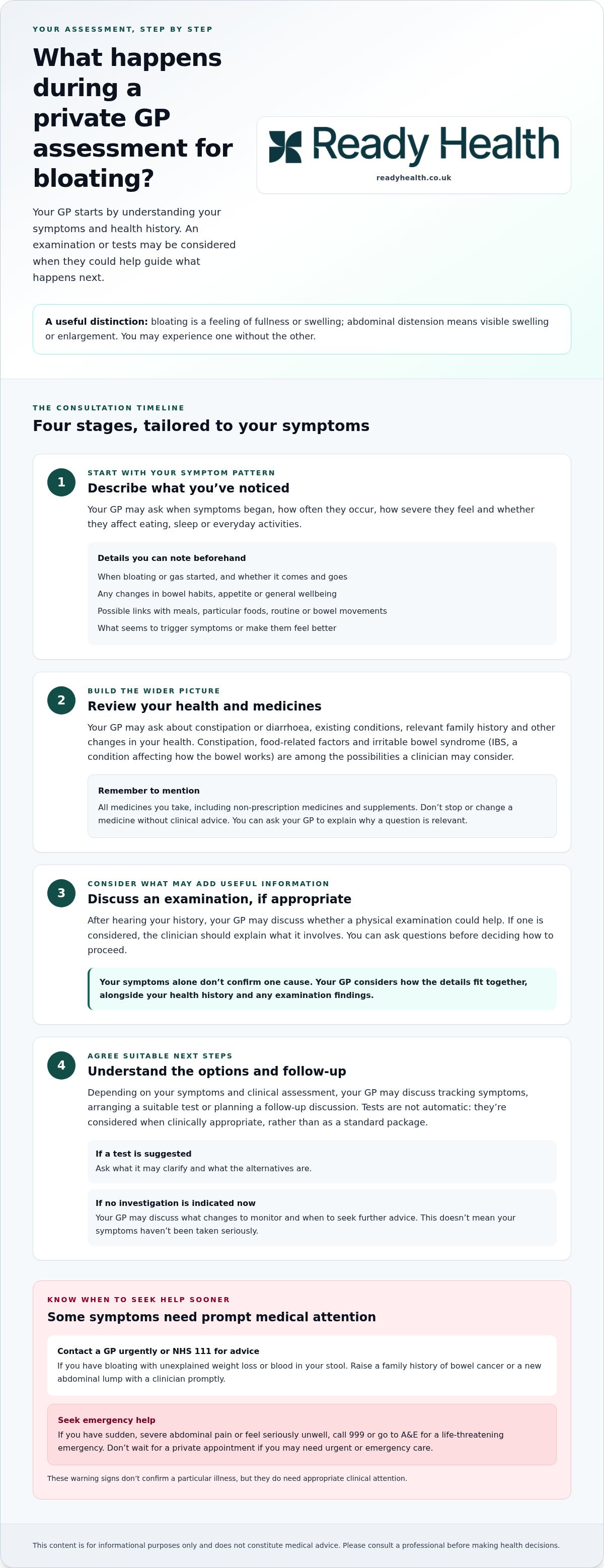
Bloating is a feeling of fullness or swelling in your tummy; abdominal distension is visible swelling or enlargement. You might feel bloated without seeing a change in your abdomen, or notice that it looks larger than usual. The terms can overlap, but describing what you experience helps a clinician understand your concern.
Gas and bloating have several possible explanations. Constipation, food-related factors and irritable bowel syndrome (IBS), a condition affecting how the bowel works, are among the possibilities a clinician may consider. Symptoms alone don’t identify the cause. For a general overview, see What is bloating?
A GP discussion may help if symptoms keep returning, persist, change or interfere with eating, sleeping or everyday activities. You don’t need to decide for yourself whether a test is required. An assessment can help establish what is happening and whether further steps are appropriate. A private diagnosis for bloating and gas Wigan begins with discussing your symptoms, rather than assuming a particular cause.
What details make bloating and gas worth discussing?
Describe the pattern as clearly as you can. Note when symptoms began, how often they occur, how uncomfortable they feel and whether they’re becoming more frequent or severe. A short record can help you recall details, but it doesn’t need to be perfect.
Consider whether symptoms seem to follow meals, particular foods, changes in your routine or bowel movements. Tell the GP about changes in your bowel habits and any other symptoms, even if they seem unrelated. These details help a clinician decide what to explore, but don’t prove a diagnosis on their own.
- When did the bloating or gas start, and is it constant or does it come and go?
- Have you noticed a change in your bowel habits, appetite or general wellbeing?
- Does anything seem to trigger the symptoms or make them feel better?
Arrange a routine GP appointment if symptoms persist or recur, are getting worse or affect your usual activities. Mention new or unexplained changes, particularly if they occur alongside bloating. A clinician can help decide how promptly you should be assessed.
When should you seek urgent medical advice?
Some symptoms need prompt medical attention rather than a routine appointment. Contact a GP urgently or NHS 111 for advice if you have bloating with unexplained weight loss or blood in your stool. Raise a family history of bowel cancer or a new abdominal lump with a clinician promptly.
If you have sudden, severe abdominal pain or feel seriously unwell, seek emergency help. Call 999 or go to A&E for a life-threatening emergency. Don’t wait for a private appointment if you may need urgent or emergency care. These warning signs don’t confirm a particular illness, but they do need appropriate clinical attention.
How a private GP in Wigan assesses bloating and gas
An assessment usually follows a clear sequence: your GP asks about your symptoms and health, considers whether an examination may be useful, then discusses possible next steps with you. The process is individual. You may not need an examination or tests, and the aim is to explore what makes sense for your symptoms.
Any investigation depends on your symptoms, health history and the clinician’s overall assessment. A test isn’t automatic just because you have bloating or gas. Your GP will consider the information you share and explain the reasoning behind any suggested next step.
What might the GP ask about your symptoms?
Your GP may ask when the symptoms began, how they vary, how severe they feel and whether they affect eating, sleep or everyday activities. They’ll want to understand any changes in your bowel habits, such as constipation or diarrhoea, and whether symptoms seem linked to meals or other patterns. The Causes and diagnosis of gas and bloating explains why a clinician considers the full symptom picture.
Your wider health history matters too. Tell the GP about existing conditions, relevant family history and all medicines you take, including non-prescription medicines and supplements. Don’t stop or change a medicine without clinical advice. These details may help the clinician assess possible explanations and decide whether further review is appropriate.
You may also be asked sensitive questions about bowel habits, appetite or other changes in your health. These questions are a routine part of understanding the whole picture, not a judgement. If you’re unsure why something is relevant, ask the GP to explain.
What happens after the initial discussion?
After hearing your history, the GP may discuss whether a physical examination could add useful information. If an examination is considered, the clinician should explain what it involves. You can ask questions before deciding how to proceed.
Depending on your symptoms and the clinical assessment, next steps might include keeping track of symptoms, arranging a suitable test or planning a follow-up discussion. Tests may help investigate a particular possibility, but they’re considered when clinically appropriate rather than ordered as a standard package. Your GP can explain what a suggested investigation may clarify and what the alternatives are.
If no immediate investigation is indicated, that doesn’t mean your symptoms haven’t been taken seriously. The clinician may discuss what changes to monitor and when to seek further advice. Share any changes in your symptoms or new concerns with a clinician.
For a broader overview of what a private GP consultation may involve, see this private GP appointment guide. Ready Health offers private GP consultations in Standish, Wigan, including in-clinic and virtual appointments. You can book a private GP consultation.
Possible causes and tests: how a Wigan GP considers the options
Bloating and gas can arise for different reasons, and similar symptoms don’t necessarily have the same explanation. A clinician considers how your symptoms fit together, along with your health history and any examination findings. The examples below are possibilities to discuss, not a way to diagnose yourself.
Why similar symptoms can have different explanations
Constipation, food-related factors and irritable bowel syndrome (IBS), a condition affecting bowel function, may all be considered. Clues can overlap, so one symptom or food association alone may not confirm a cause. Your GP will look at the wider pattern and consider whether other explanations need to be explored.
- Constipation: A clinician may ask how often you pass stools, whether they’re hard or difficult to pass, and whether your bowel habits have changed. These details can guide assessment, but don’t confirm constipation by themselves.
- Food-related factors: Your GP may explore whether symptoms seem to follow particular meals or ingredients, and whether the pattern is consistent. A suspected link is useful to discuss, but it doesn’t necessarily mean you need to cut foods out.
- IBS: The clinician may ask about abdominal discomfort, bloating and changes in bowel habits over time. These symptoms can occur for other reasons too, so a GP considers your full history before reaching a conclusion.
The NHS explains when to see a GP for bloating and outlines common causes. This can help you recognise when to seek advice, but it can’t determine what is causing your own symptoms. A possible explanation becomes a diagnosis only after appropriate clinical assessment.
When might blood tests or scans be considered?
Tests aren’t automatic. Your GP may recommend a blood test if your history or clinical findings suggest it could help investigate a particular concern. The choice depends on what the clinician is assessing, and no single blood test can identify every possible cause of bloating.
Imaging, such as an ultrasound scan, may be considered if it could answer a specific clinical question. It isn’t a routine test for everyone with gas or bloating. Ready Health offers ultrasound scans. If a scan is appropriate, your clinician can explain what it may show and how the result could inform the next step.
Ready Health also offers private blood tests, which may form part of an investigation when clinically indicated. The right test depends on your individual assessment. For general information about the process, see this private blood test guidance. Your GP should discuss why a test is being suggested and what follow-up may be needed.
A private diagnosis for bloating and gas Wigan should be guided by the overall clinical picture, not by a default set of tests. The aim is to discuss plausible explanations and agree proportionate next steps with you.
Prepare for a private bloating assessment in Standish or Wigan
A little preparation can help you make good use of your appointment. You don’t need to arrive with a diagnosis or a perfect symptom diary. A few clear notes about what you’ve noticed can help your GP understand the pattern and discuss suitable next steps.
What to note before your appointment
Before your consultation, write down when the symptoms began, how often they occur and whether anything has changed. Note any bowel changes and possible links with meals or your routine, such as whether symptoms seem to follow eating or happen at a particular time of day. Treat these as observations to share, not proof of a cause.
- Symptom timeline: Note when bloating or gas first appeared, how it has varied and how it affects your day.
- Bowel changes: Record changes you’ve noticed, including how often you go and whether passing stools has become difficult.
- Medicines: Bring a current list of prescribed and non-prescription medicines, including supplements. Include any recent changes if you can.
- Previous information: Take relevant test results or letters you already have, if available.
- Your questions: Jot down anything you’d like to ask about possible investigations, follow-up or managing symptoms.
You don’t need to start a restrictive diet before speaking with a GP. Avoid cutting out foods based only on a suspected connection, as this may make it harder to understand your usual pattern. Your notes are there to support a clinical discussion, not to make you responsible for diagnosing yourself.
Choosing an in-clinic or virtual consultation
Ready Health offers in-clinic GP consultations in Standish and virtual consultations. The right format depends on your symptoms, what you need to discuss and whether the clinician considers an examination useful. A virtual appointment may not suit every assessment, and the GP can discuss whether another approach is needed.
Neither format can promise a particular diagnosis, test or referral. The clinician will use the information available to discuss appropriate next steps with you. If testing is recommended, ask what the test is intended to investigate and how the result may inform your care. Ready Health’s blood testing services may be relevant, while your GP’s assessment guides whether a specific test is suitable.
Preparing these notes can make a private diagnosis for bloating and gas Wigan easier to discuss, without needing to reach conclusions in advance. If you’re ready to talk through your symptoms, book a private GP consultation with Ready Health.
Book a private GP consultation for bloating and gas in Wigan
If bloating or gas keeps affecting your comfort or routine, a GP consultation gives you space to explain what you’ve noticed and discuss suitable next steps. The aim is to understand your concerns and agree a considered way forward, not to assume a diagnosis or order tests automatically.
What a consultation can help you clarify
Your symptom history gives the clinician context: when the problem started, how it has changed, what seems to affect it and whether you’ve noticed other changes. Sharing relevant health information, medicines and previous results can help the GP consider possible explanations and decide what questions or examination may be useful.
You can also discuss what an investigation might clarify, if one is considered. Any test, follow-up or referral depends on your symptoms and the clinician’s judgement. There may not be an immediate answer from one appointment, but you can ask what the current assessment suggests, what to monitor and what should prompt further advice.
It’s reasonable to ask questions, even if you’re unsure whether a detail matters. You could ask why a test is being suggested, what its limitations are, or what the next step would be if symptoms continue. A clear discussion can help you understand the plan and feel more prepared to make decisions with your clinician.
Arrange your appointment with Ready Health
Ready Health is based in Standish, Wigan, and offers private GP consultations. If you’re considering a private diagnosis for bloating and gas Wigan, an appointment gives you the opportunity to discuss your symptoms with a clinician and explore appropriate next steps. Any recommendations depend on your symptoms and clinical assessment.
You can book an in-clinic consultation or choose a virtual GP consultation. Notes about your symptom pattern, bowel changes, medicines and questions can help you explain what’s been happening. The clinician can then discuss what may be useful to explore and whether further assessment is appropriate.
Ready Health serves patients in Standish, Wigan, Shevington, Standish Lower Ground, Boar’s Head, Wrightington, Appley Bridge, Chorley, Skelmersdale, Orrell, Ashton-in-Makerfield, Bolton, Leigh, Preston, Southport and St Helens.
Ready to discuss your symptoms? Book a private GP consultation with Ready Health in Standish, Wigan.
Take a considered next step for your digestive health
Persistent bloating can leave you second-guessing what to eat, how to plan your day or whether to seek help. You don’t need to work out the cause alone. A conversation with a GP gives you space to explain what’s changed, ask questions and understand which next steps may be suitable for you.
If you’re considering a private diagnosis for bloating and gas Wigan, Ready Health’s CQC-regulated clinic in Standish offers a setting to discuss your concerns with a clinician. Recommendations depend on your symptoms and clinical assessment, so you can focus on understanding the reasoning behind your care rather than anticipating a particular test or outcome.
Ready to talk through your symptoms? Book a private GP consultation and take a calm, informed step towards deciding what to do next. You deserve to have your concerns heard and your questions answered.
Frequently Asked Questions
Can a private GP diagnose the cause of bloating and gas?
A private GP can assess your symptoms and may identify a likely cause or recommend further investigation. The clinician considers your health history, symptom pattern and any relevant examination findings rather than relying on one symptom alone. Sometimes more information or follow-up is needed before the cause becomes clearer. You can ask what the assessment suggests and what might help resolve any remaining uncertainty.
What tests might a GP consider for persistent bloating?
A GP may consider blood tests if your symptoms and history make them relevant. These could include tests for anaemia, inflammation or coeliac disease, an immune reaction to gluten. Each test is chosen to investigate a particular possibility, rather than as a general screen for every cause. Your clinician can explain what a proposed test looks for and what its result can and can’t show.
Is bloating always caused by food intolerance?
No. Food intolerance is one possible explanation, but bloating can also relate to bowel habits, digestive conditions or other factors. A perceived link with a meal is useful to discuss, but it doesn’t confirm an intolerance. Avoid removing several foods from your diet without professional guidance, especially if this could limit your nutrition. Tell your GP what you’ve noticed and ask whether further assessment may be appropriate.
When should I seek urgent help for bloating and abdominal pain?
Seek urgent medical advice if bloating occurs with unexplained weight loss, blood in your stool or a new abdominal lump. Contact NHS 111 or an urgent GP service for advice about concerning symptoms. Sudden, severe abdominal pain or a life-threatening emergency needs emergency care, not a routine private appointment: call 999 or go to A&E. If you’re unsure how urgent your symptoms are, seek clinical advice promptly.
Can I have a virtual GP consultation about bloating and gas in Wigan?
Yes, Ready Health offers virtual GP consultations, which may suit a discussion about your symptoms and health history. A remote appointment may not meet every clinical need, particularly if the GP considers an examination necessary. Ready Health is based in Standish, Wigan, and serves local patients. The clinician can discuss whether a virtual consultation is appropriate for your concerns and what to do if an in-person assessment is needed.
Should I keep a symptom diary before seeing a GP?
A brief symptom diary can be useful, but it doesn’t need to be detailed or time-consuming. Note when symptoms occur, what you were doing beforehand and whether you noticed a bowel change. Include days when symptoms don’t happen, as this can help show how they vary. Bring your notes if helpful, but don’t delay seeking medical advice just to complete a diary.
Does everyone with bloating need blood tests or an ultrasound?
No. Depending on your symptoms and clinical assessment, a GP may recommend no tests, one test or further investigation. Blood tests and ultrasound answer different clinical questions, and neither is a universal check for every cause of bloating. If a test is suggested, ask what the clinician is looking for, what the result could mean and whether you’ll need a follow-up discussion.
Disclaimer: This content is for informational purposes only and does not constitute medical advice. Consult a qualified healthcare professional before making decisions about your health.

Article by
Shamir Patel
Shamir Patel is a UK-based Clinical Pharmacist and Independent Prescriber with a specialist focus on ADHD and weight management.
He is the Registered CQC Manager at Ready Health Medical Clinic, where he leads the development and delivery of safe, patient-centred services across ADHD assessment and treatment, weight loss programmes, and general medical care.
With a career spanning nearly three decades since qualifying in 1995, Shamir brings extensive clinical and operational experience across both community pharmacy and private healthcare.
He also serves as Deputy Superintendent Pharmacist and Lead Prescriber at PillSorted. He oversees high-volume prescribing services. He focuses on GLP-1 weight loss treatments and clinical governance.
Shamir is a SCOPE-accredited obesity specialist and has a strong interest in improving access to evidence-based ADHD care. He is known for his structured, guideline-driven approach, aligning his clinical practice with NICE recommendations and regulatory standards set by the GPhC and CQC.
Alongside his clinical work, Shamir is actively involved in mentoring prescribing pharmacists, developing standard operating procedures, and contributing to service innovation within digital and community healthcare settings. His work reflects a commitment to safe prescribing, patient education, and improving outcomes through practical, accessible care.
Disclaimer
The information on this website is provided for general educational and informational purposes only and is not intended as medical advice, diagnosis, or treatment. Articles reflect general guidance and may not be suitable for your individual circumstances. You should always seek advice from a qualified healthcare professional before starting, stopping, or changing any treatment, medication, or healthcare plan. While we aim to keep our content accurate and up to date, Ready Health makes no guarantees about the completeness, accuracy, or suitability of the information provided. Reliance on any information on this site is entirely at your own risk. If you have concerns about your health, please book an appointment with a suitably qualified clinician. In an emergency, contact 999 or attend your nearest A&E department.
Frequently asked questions
What details make bloating and gas worth discussing?
Describe the pattern as clearly as you can. Note when symptoms began, how often they occur, how uncomfortable they feel and whether they’re becoming more frequent or severe. A short record can help you recall details, but it doesn’t need to be perfect. Consider whether symptoms seem to follow meals, particular foods, changes in your routine or bowel movements. Tell the GP about changes in your bowel habits and any other symptoms, even if they seem unrelated. These details help a clinician decide what to explore, but don’t prove a diagnosis on their own. Arrange a routine GP appointment if symptoms persist or recur, are getting worse or affect your usual activities. Mention new or unexplained changes, particularly if they occur alongside bloating. A clinician can help decide how promptly you should be assessed.
When should you seek urgent medical advice?
Some symptoms need prompt medical attention rather than a routine appointment. Contact a GP urgently or NHS 111 for advice if you have bloating with unexplained weight loss or blood in your stool. Raise a family history of bowel cancer or a new abdominal lump with a clinician promptly. If you have sudden, severe abdominal pain or feel seriously unwell, seek emergency help. Call 999 or go to A&E for a life-threatening emergency. Don’t wait for a private appointment if you may need urgent or emergency care. These warning signs don’t confirm a particular illness, but they do need appropriate clinical attention. An assessment usually follows a clear sequence: your GP asks about your symptoms and health, considers whether an examination may be useful, then discusses possible next steps with you. The process is individual. You may not need an examination or tests, and the aim is to explore what makes sense for your symptoms. Any investigation depends on your symptoms, health history and the clinician’s overall assessment. A test isn’t automatic just because you have bloating or gas. Your GP will consider the information you share and explain the reasoning behind any suggested next step.
What might the GP ask about your symptoms?
Your GP may ask when the symptoms began, how they vary, how severe they feel and whether they affect eating, sleep or everyday activities. They’ll want to understand any changes in your bowel habits, such as constipation or diarrhoea, and whether symptoms seem linked to meals or other patterns. The Causes and diagnosis of gas and bloating explains why a clinician considers the full symptom picture. Your wider health history matters too. Tell the GP about existing conditions, relevant family history and all medicines you take, including non-prescription medicines and supplements. Don’t stop or change a medicine without clinical advice. These details may help the clinician assess possible explanations and decide whether further review is appropriate. You may also be asked sensitive questions about bowel habits, appetite or other changes in your health. These questions are a routine part of understanding the whole picture, not a judgement. If you’re unsure why something is relevant, ask the GP to explain.
What happens after the initial discussion?
After hearing your history, the GP may discuss whether a physical examination could add useful information. If an examination is considered, the clinician should explain what it involves. You can ask questions before deciding how to proceed. Depending on your symptoms and the clinical assessment, next steps might include keeping track of symptoms, arranging a suitable test or planning a follow-up discussion. Tests may help investigate a particular possibility, but they’re considered when clinically appropriate rather than ordered as a standard package. Your GP can explain what a suggested investigation may clarify and what the alternatives are. If no immediate investigation is indicated, that doesn’t mean your symptoms haven’t been taken seriously. The clinician may discuss what changes to monitor and when to seek further advice. Share any changes in your symptoms or new concerns with a clinician. For a broader overview of what a private GP consultation may involve, see this private GP appointment guide. Ready Health offers private GP consultations in Standish, Wigan, including in-clinic and virtual appointments. You can book a private GP consultation. Bloating and gas can arise for different reasons, and similar symptoms don’t necessarily have the same explanation. A clinician considers how your symptoms fit together, along with your health history and any examination findings. The examples below are possibilities to discuss, not a way to diagnose yourself.
When might blood tests or scans be considered?
Tests aren’t automatic. Your GP may recommend a blood test if your history or clinical findings suggest it could help investigate a particular concern. The choice depends on what the clinician is assessing, and no single blood test can identify every possible cause of bloating. Imaging, such as an ultrasound scan, may be considered if it could answer a specific clinical question. It isn’t a routine test for everyone with gas or bloating. Ready Health offers ultrasound scans. If a scan is appropriate, your clinician can explain what it may show and how the result could inform the next step. Ready Health also offers private blood tests, which may form part of an investigation when clinically indicated. The right test depends on your individual assessment. For general information about the process, see this private blood test guidance. Your GP should discuss why a test is being suggested and what follow-up may be needed. A private diagnosis for bloating and gas Wigan should be guided by the overall clinical picture, not by a default set of tests. The aim is to discuss plausible explanations and agree proportionate next steps with you. A little preparation can help you make good use of your appointment. You don’t need to arrive with a diagnosis or a perfect symptom diary. A few clear notes about what you’ve noticed can help your GP understand the pattern and discuss suitable next steps.
Can a private GP diagnose the cause of bloating and gas?
A private GP can assess your symptoms and may identify a likely cause or recommend further investigation. The clinician considers your health history, symptom pattern and any relevant examination findings rather than relying on one symptom alone. Sometimes more information or follow-up is needed before the cause becomes clearer. You can ask what the assessment suggests and what might help resolve any remaining uncertainty.
What tests might a GP consider for persistent bloating?
A GP may consider blood tests if your symptoms and history make them relevant. These could include tests for anaemia, inflammation or coeliac disease, an immune reaction to gluten. Each test is chosen to investigate a particular possibility, rather than as a general screen for every cause. Your clinician can explain what a proposed test looks for and what its result can and can’t show.
Is bloating always caused by food intolerance?
No. Food intolerance is one possible explanation, but bloating can also relate to bowel habits, digestive conditions or other factors. A perceived link with a meal is useful to discuss, but it doesn’t confirm an intolerance. Avoid removing several foods from your diet without professional guidance, especially if this could limit your nutrition. Tell your GP what you’ve noticed and ask whether further assessment may be appropriate.
When should I seek urgent help for bloating and abdominal pain?
Seek urgent medical advice if bloating occurs with unexplained weight loss, blood in your stool or a new abdominal lump. Contact NHS 111 or an urgent GP service for advice about concerning symptoms. Sudden, severe abdominal pain or a life-threatening emergency needs emergency care, not a routine private appointment: call 999 or go to A&E. If you’re unsure how urgent your symptoms are, seek clinical advice promptly.
Can I have a virtual GP consultation about bloating and gas in Wigan?
Yes, Ready Health offers virtual GP consultations, which may suit a discussion about your symptoms and health history. A remote appointment may not meet every clinical need, particularly if the GP considers an examination necessary. Ready Health is based in Standish, Wigan, and serves local patients. The clinician can discuss whether a virtual consultation is appropriate for your concerns and what to do if an in-person assessment is needed.
Should I keep a symptom diary before seeing a GP?
A brief symptom diary can be useful, but it doesn’t need to be detailed or time-consuming. Note when symptoms occur, what you were doing beforehand and whether you noticed a bowel change. Include days when symptoms don’t happen, as this can help show how they vary. Bring your notes if helpful, but don’t delay seeking medical advice just to complete a diary.
Does everyone with bloating need blood tests or an ultrasound?
No. Depending on your symptoms and clinical assessment, a GP may recommend no tests, one test or further investigation. Blood tests and ultrasound answer different clinical questions, and neither is a universal check for every cause of bloating. If a test is suggested, ask what the clinician is looking for, what the result could mean and whether you’ll need a follow-up discussion. Disclaimer: This content is for informational purposes only and does not constitute medical advice. Consult a qualified healthcare professional before making decisions about your health.

Related articles...

Oct 07, 2026
Private Ultrasound Scan in Wigan: Your Guide to Choosing and BookingIf you’re considering a private ultrasound scan in Wigan, start...

Oct 06, 2026
Private Dermatologist Consultation in Leigh for Excessive SweatingIf you’re looking for a private dermatologist consultation Leigh patients...

Oct 05, 2026
Low Testosterone Symptoms: When to See a Doctor in WiganCould reduced libido or persistent tiredness point to low testosterone,...