October 31, 2026
Private Mental Health Assessment in St Helens: Your First Visit

A private mental health assessment in St Helens begins with arranging an appointment and explaining what has been troubling you. Your first visit is usually a conversation about your experiences, their effect on daily life and what you hope to understand.
This guide explains how to arrange an assessment, what to consider when choosing an assessor, how private findings may inform a discussion with your GP, and what to weigh before deciding on your next step.
Key Takeaways
- Before booking, check the assessor’s qualifications, relevant professional registration and experience with your concerns.
- A private report can help inform conversations with your GP, but NHS decisions about care are made separately.
- Ask how the assessment findings, any diagnosis and possible follow-up will be explained and documented.
- Consider the assessment’s scope, cost and limits so you can decide whether it fits your needs and next steps.
Table of Contents
- What qualifications and registrations should a private mental health assessor in England have?
- Will a private assessment be accepted by the NHS or my GP in St Helens?
- What happens after a private mental health assessment, including diagnosis, treatment and follow-up?
- What risks or limitations should I consider before paying for a private mental health assessment
- Ready Health: Private GP Consultation (15 Minutes)
What qualifications and registrations should a private mental health assessor in England have?
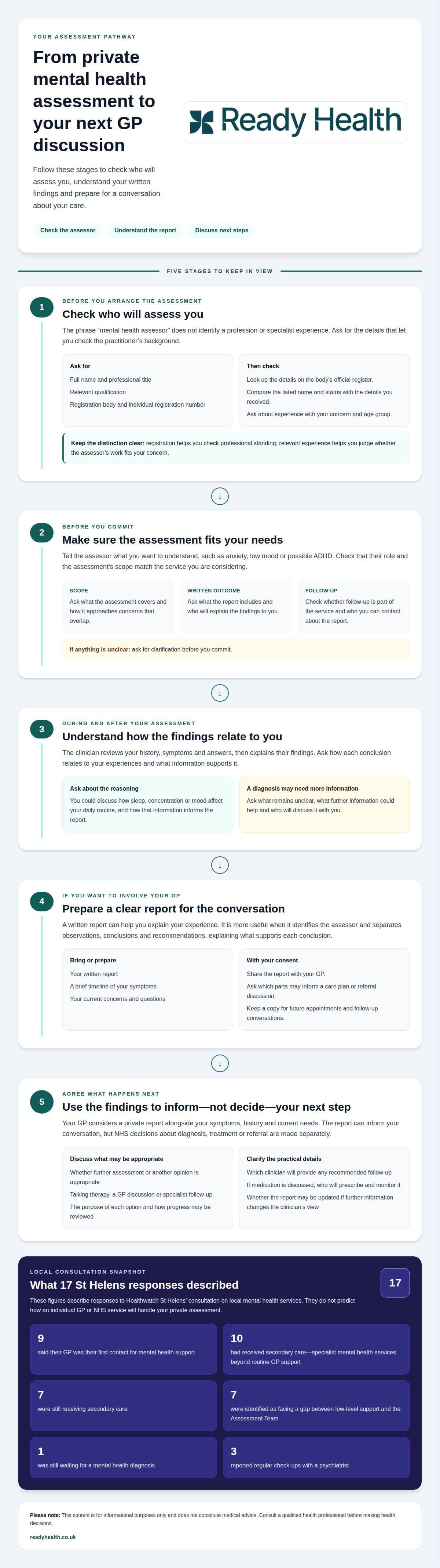
Start by asking who will conduct the assessment and what they are qualified to assess. The phrase “mental health assessor” does not identify their profession or specialist experience. Ask for their professional title, relevant qualification, registration body and registration number. This helps you understand who you will meet and whether their background fits your needs.
Different concerns call for different expertise. For example, you may want to discuss anxiety, low mood or possible ADHD. Ask whether the assessor regularly works with your main concern, and what the assessment covers. If ADHD is your focus, explore the online ADHD assessment pathway. Check that the clinician’s role and assessment scope match the service you’re considering.
Before booking, use these practical steps:
- Request the assessor’s full name and professional title.
- Ask which qualification supports their assessment work.
- Request their registration body and individual registration number.
- Look up the details on that body’s official register.
- Compare the listed name and status with the details provided.
- Ask about experience with your age group and concern.
A register entry and relevant specialist experience answer different questions. Registration helps you check a practitioner’s professional standing; experience helps you judge whether their work fits your concern. If you are seeking an adult assessment, ask about their experience assessing adults. If several concerns overlap, ask how they approach a complex history.
In St Helens and nearby areas, including Standish and Wigan, use these questions before arranging a private mental health assessment. Ask what the written outcome includes, who will explain it, and whether follow-up is part of the service. A clear answer should identify the assessor, the assessment’s purpose and the next steps. Ask for clarification before committing if anything is unclear.
Will a private assessment be accepted by the NHS or my GP in St Helens?
A private report can inform a conversation with your GP, but it does not determine NHS diagnosis, treatment or referral decisions. Your GP will consider the report alongside your symptoms, history and current needs. For example, an assessment describing low mood may help explain your experience, but it does not require an NHS clinician to reach the same conclusion.
In St Helens, Healthwatch St Helens received 17 responses to its consultation on local mental health services. Nine respondents said their GP was their first contact for mental health support. These responses show why a clear report can be useful during a GP discussion. They don’t establish how an individual GP or NHS service will handle a private assessment.
To prepare for a discussion about your report, take these steps:
- Ask for a written report explaining the assessment and findings.
- Check that it names the assessor and their professional role.
- Share it with your GP, with your consent, and explain your main concerns.
- Ask which parts can inform your care plan or referral discussion.
- Keep a copy for future appointments and follow-up conversations.
A written report is more useful when it separates observations, conclusions and recommendations, and explains what information supports each conclusion. Your GP can then ask about unclear points or consider other relevant factors. Bring a brief symptom timeline, your current concerns and a list of questions to the appointment.
Local experiences also vary. Ten of the 17 respondents had received secondary care, meaning specialist mental health services beyond routine GP support, and seven were still receiving it. Seven respondents were identified as facing a gap between low-level support and the Assessment Team. These figures describe consultation responses, not a route into NHS care. Use your private findings to explain your needs, then discuss the next appropriate step with your GP.
What happens after a private mental health assessment, including diagnosis, treatment and follow-up?
After the assessment, the clinician reviews your history, symptoms and answers, then explains their findings. Ask how each conclusion relates to your experiences and what information supports it. For example, discuss how sleep, concentration or mood affect your daily routine. This can help you understand the report and its recommendations.
An assessment may support a diagnosis, but sometimes more information is needed before reaching a conclusion. One St Helens respondent was still waiting for a mental health diagnosis. This illustrates that an assessment may identify questions requiring further review. Ask what remains unclear, what information could help, and who will discuss it with you.
Use the written outcome to agree practical next steps:
- Ask for a clear explanation of findings and recommendations.
- Discuss whether further assessment or another opinion is appropriate.
- Clarify which clinician will provide any recommended follow-up.
- Record agreed actions, such as arranging another appointment.
- Share relevant information with your GP if you want continuity.
Treatment depends on your concerns, assessment findings and preferences. Recommendations may include talking therapy, a GP discussion or specialist follow-up. Ask about the purpose of each option and how progress will be reviewed. If medication is discussed, ask who will prescribe it and monitor your care. A diagnosis alone does not determine every treatment choice.
Follow-up arrangements vary. In local consultation responses, three respondents reported regular check-ups with a psychiatrist. This reflects their experience, not a standard pathway for everyone. Before the assessment ends, clarify whether follow-up is included, who to contact about the report, and what to do if your needs change. Keep the report accessible for future appointments.
These accounts underline the value of confirming what happens next: 1 respondent was still waiting for a mental health diagnosis, while 3 respondents had regular check-ups with a psychiatrist. Ask whether the report will be updated if further information changes the clinician’s view, and whether you should arrange a review yourself. If recommendations are unclear, ask for them to be set out in plain language, including the person responsible for each action. Keep a note of questions and bring it to the next discussion.
What risks or limitations should I consider before paying for a private mental health assessment
A private assessment has a defined scope. Before booking, ask which concerns it covers and what the report includes. For example, an assessment focused on anxiety may not answer questions about ADHD, while more complex conditions like thought disorders often require specialised clinical support such as Pand Health. Explain your main reason for seeking help, then check that the proposed assessment addresses it.
Cost is another practical consideration. The total may depend on the assessment’s scope, the clinician’s time, a written report and follow-up appointments. Ask for the full charges before committing, and find out whether follow-up is included or billed separately. This helps you compare the complete service rather than only the initial appointment.
A private report does not settle every question about your care. Your GP and NHS services consider your circumstances separately. A report can support a conversation, but it does not guarantee a particular NHS referral, diagnosis or treatment. If NHS involvement matters to you, ask how to share the report with your GP and explain its findings.
Before paying, use this short checklist:
- Confirm the assessor’s professional role and relevant experience.
- Ask what happens if the findings need further investigation.
- Check who provides explanations after the appointment.
- Clarify how recommendations and follow-up are documented.
- Ask how your report can be shared with your GP.
Consider whether the assessment matches your immediate need. If you need urgent help, a scheduled private assessment isn’t an emergency response. Use appropriate urgent support instead. If you’re unsure which route fits, speak with a clinician before booking. For non-urgent concerns, you can book a consultation to discuss the right next step. A clear scope, written costs and follow-up plan help you make an informed decision.
Service gaps can also affect what happens after an assessment. 7 of the 17 respondents were identified as experiencing a gap in services because they were considered too complex for low-level care but not complex enough for the Assessment Team. This points to a possible mismatch between a person’s needs and the level of service available; it does not establish what will happen in an individual case. Before paying, ask who can help if the findings indicate needs beyond the assessor’s remit, and what next-step support is actually available.
Ready Health: Private GP Consultation (15 Minutes)
Ready Health’s Private GP Consultation (15 Minutes) can give you time to discuss a mental health concern with a GP. It may suit you if you want to talk through symptoms, share questions about an assessment report or consider what support to explore next. Bring relevant notes or recommendations so you can explain what matters most to you.
A GP consultation is a separate appointment from a specialist mental health assessment. You can use it to discuss your concerns and possible next steps, including whether further support may be appropriate. To arrange a consultation or explore services, visit Ready Health online.
Take your next step with confidence
Making space to address your mental wellbeing is a constructive step. If you’re considering a private mental health assessment in St Helens, you can begin by deciding what you most want help with right now. That intention can make it easier to start a calm, focused conversation.
You don’t need to have every answer before reaching out. If you’d like to talk through your options with Ready Health, contact the team about an assessment.
This content is for informational purposes only and does not constitute medical advice. Consult a healthcare professional before making health decisions.
Frequently Asked Questions
How do I book and prepare for a private mental health assessment in St Helens?
Choose an assessment service that matches your concern, then arrange an appointment directly with the provider. Before booking, clarify the assessment’s scope and what information to bring. To prepare, note when your concerns began, how they affect work, study or relationships, and any questions you want answered. Bring a current medication list and relevant previous reports, if available.

Article by
Shamir Patel
Shamir Patel is a UK-based Clinical Pharmacist and Independent Prescriber with a specialist focus on ADHD and weight management.
He is the Registered CQC Manager at Ready Health Medical Clinic, where he leads the development and delivery of safe, patient-centred services across ADHD assessment and treatment, weight loss programmes, and general medical care.
With a career spanning nearly three decades since qualifying in 1995, Shamir brings extensive clinical and operational experience across both community pharmacy and private healthcare.
He also serves as Deputy Superintendent Pharmacist and Lead Prescriber at PillSorted. He oversees high-volume prescribing services. He focuses on GLP-1 weight loss treatments and clinical governance.
Shamir is a SCOPE-accredited obesity specialist and has a strong interest in improving access to evidence-based ADHD care. He is known for his structured, guideline-driven approach, aligning his clinical practice with NICE recommendations and regulatory standards set by the GPhC and CQC.
Alongside his clinical work, Shamir is actively involved in mentoring prescribing pharmacists, developing standard operating procedures, and contributing to service innovation within digital and community healthcare settings. His work reflects a commitment to safe prescribing, patient education, and improving outcomes through practical, accessible care.
Disclaimer
The information on this website is provided for general educational and informational purposes only and is not intended as medical advice, diagnosis, or treatment. Articles reflect general guidance and may not be suitable for your individual circumstances. You should always seek advice from a qualified healthcare professional before starting, stopping, or changing any treatment, medication, or healthcare plan. While we aim to keep our content accurate and up to date, Ready Health makes no guarantees about the completeness, accuracy, or suitability of the information provided. Reliance on any information on this site is entirely at your own risk. If you have concerns about your health, please book an appointment with a suitably qualified clinician. In an emergency, contact 999 or attend your nearest A&E department.
Frequently asked questions
How do I book and prepare for a private mental health assessment in St Helens?
Choose an assessment service that matches your concern, then arrange an appointment directly with the provider. Before booking, clarify the assessment’s scope and what information to bring. To prepare, note when your concerns began, how they affect work, study or relationships, and any questions you want answered. Bring a current medication list and relevant previous reports, if available.

Related articles...

Oct 30, 2026
Cost of Wegovy privately near Preston and what prices includePrivate Wegovy prices near Preston vary, with the typical market...

Oct 29, 2026
Hypnotherapy for phobias in Preston and estimated sessionsA structured course of hypnotherapy for phobias in Preston may...

Oct 28, 2026
Private eating disorder support in LeighEating disorder support should respond to what you’re experiencing, not...