November 8, 2026
Private Mole Check in Skelmersdale: Prices and What to Expect

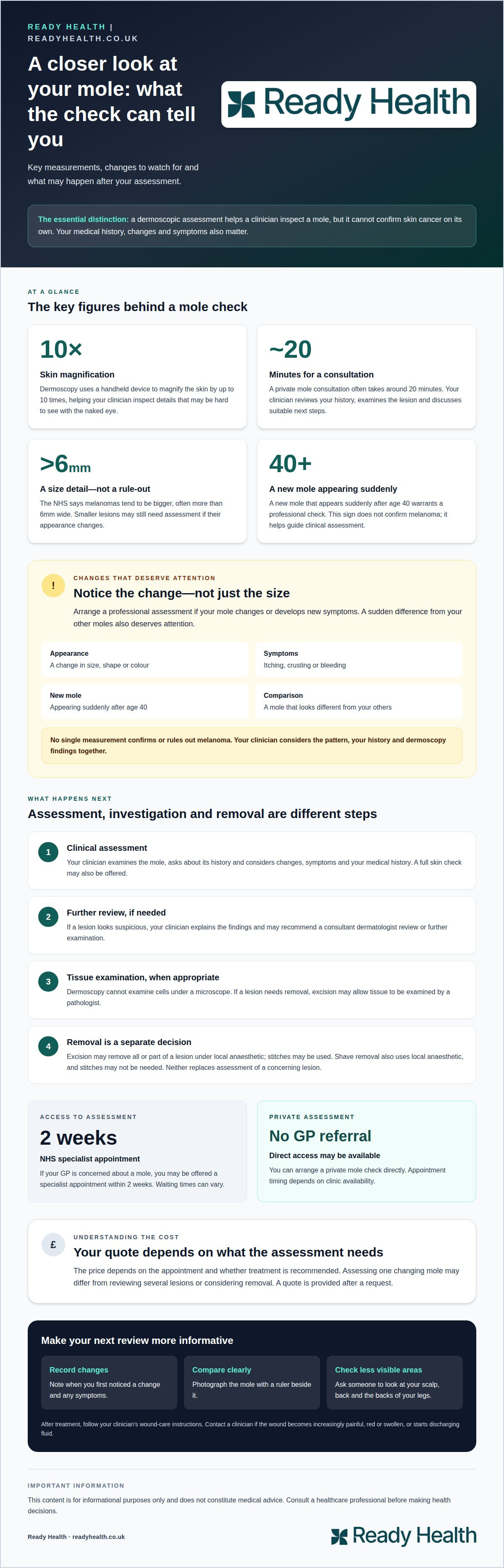
Could a closer look at a changing mole help you understand what to do next? In a private mole check in Skelmersdale, dermoscopy uses a handheld device to magnify the skin up to 10 times, helping a clinician assess a mole alongside your medical history. It’s a practical way to have a concern examined, but changes in size, shape or colour, or itching, crusting or bleeding, should prompt a professional assessment.
It’s understandable to want to know what the appointment involves and what it may cost before you book. The price depends on the assessment and whether treatment is recommended, with a quote provided after a request. This guide explains what dermoscopy and skin cancer screening can and can’t tell you, which changes need attention, and what to expect from consultation, treatment and aftercare. You’ll also learn how mole checks differ from mole removal, so you can approach the next step with a clearer picture.
Key Takeaways
- Learn what a dermoscopic mole assessment can show and why it may not provide a diagnosis on its own.
- Recognise mole changes that should prompt a professional review.
- Understand how an assessment differs from mole removal and what aftercare may involve.
- Find out what can affect the cost of a private mole check before requesting a quote.
Table of Contents
Can a mole assessment diagnose skin cancer?
A clinical assessment can identify features that may need further investigation, but dermoscopy alone cannot confirm skin cancer. The clinician considers the mole’s appearance, your medical history and any changes you’ve noticed.
Clinical assessment of moles and lesions
The clinician examines the mole or skin lesion that concerns you and asks about its history. They consider its size, shape and colour, along with symptoms such as itching, crusting or bleeding. A full skin check may also be offered when you present with a mole or lesion, helping identify other areas that may need assessment.
Dermoscopy during lesion checks
Dermoscopy uses a handheld device to magnify the skin by up to 10 times. This lets the clinician inspect details that may be difficult to see with the naked eye. The findings are considered alongside your medical history, not used alone to label a mole normal or cancerous. A dermoscopic assessment can guide next steps, but it does not provide a tissue diagnosis.
For a private assessment in Lancashire, you can arrange a check without a GP referral. Under NHS care, if your GP is concerned about a mole, you may be offered a specialist appointment within 2 weeks, although waiting times can vary. These routes differ in how you access assessment, but both focus on reviewing the concerning lesion.
There is no single accuracy figure that applies to every private mole check. Dermoscopy helps a clinician assess visible features, but it cannot examine cells under a microscope. If a lesion needs removal, excision may allow the tissue to be examined by a pathologist, a specialist who examines tissue. The assessment and any test results inform the next step.
Some areas are easy to miss during self-checks. Ask someone to look at your scalp, back and the backs of your legs, where visibility is limited. You can photograph a mole with a ruler beside it to make later changes easier to compare.
Removal is separate from a mole check and depends on the assessment. Excision may remove all or part of the lesion under local anaesthetic, which numbs the area, and stitches may be used to close the wound. Shave removal also uses local anaesthetic, and stitches may not be needed. Neither procedure replaces assessment of a changing or concerning lesion.
Warning signs that warrant a dermatologist check
Track changes in a mole’s size, shape or colour, and note any new symptoms. A sudden difference from your other moles also deserves attention.
Warning signs in moles
Arrange an assessment if a mole changes, becomes itchy, crusts or bleeds. A new mole appearing suddenly after age 40 also warrants a professional check. These signs don’t confirm melanoma, a type of skin cancer, but they help a clinician decide what needs closer examination.
Size alone can’t rule melanoma in or out. The NHS says melanomas tend to be bigger, often more than 6mm wide. Smaller lesions can still need assessment if their appearance changes. A consultant dermatologist considers the pattern, your history and dermatoscopy findings, rather than relying on a single measurement.
Follow-up for suspicious moles
If a lesion looks suspicious, the clinician explains the findings and recommends next steps. These may include a consultant dermatologist review or further examination. The aim is to clarify the concern, not to treat every unusual-looking mole as skin cancer. Other skin conditions, including basal cell carcinoma, a type of skin cancer that begins in cells at the bottom of the outer layer of skin, may also need clinical assessment.
You can arrange a private mole check directly, without a GP referral; appointment timing depends on clinic availability. If you’re waiting for an appointment, photograph the mole with a ruler beside it and note when you first noticed a change. That record can help show whether its appearance has altered between checks.
If you’re concerned about a changing mole, you can book an appointment to discuss the next step.
Consultation, treatment and aftercare
A private mole consultation often takes around 20 minutes. The clinician reviews your medical history, examines the lesion and discusses whether further assessment is suitable. Bring details of when you first noticed it and any changes or symptoms, such as bleeding or itching.
You can book a private mole check without a GP referral. For Skelmersdale, look for a private clinic offering dermatology assessment, where a clinician can review your concern and explain the next steps.
Which private clinics near Skelmersdale offer mole checks? Choose a clinic that provides assessment by a qualified skin specialist or consultant dermatologist. The consultation should explain what the examination can establish, what it cannot confirm, and how results will be communicated.
If a mole appears suspicious, the clinician explains the findings and recommended follow-up. A diagnosis may require further investigation rather than visual assessment alone. After a dermatologist review, a GP can explain the results and next steps, including whether monitoring, referral or treatment is appropriate.
A mole check and mole removal are separate decisions. The clinician assesses the lesion first, then considers whether removal is suitable and which method fits its appearance and location. If the lesion needs laboratory examination, the clinician can explain how this affects the treatment plan.
After treatment, follow the clinician’s wound-care instructions and keep the area clean as advised. If stitches are used, follow the guidance on wound review and stitch removal. Contact a clinician if the wound becomes increasingly painful, red or swollen, or starts discharging fluid.
If no concerning features are found, routine self-monitoring may be advised. Note any later changes and seek assessment if the mole changes in appearance or develops new symptoms. A clear record of the lesion’s appearance can support comparison at a future review.
Private mole check prices
Private mole check prices depend on what the appointment needs to cover. Assessing one changing mole differs from a consultation involving several lesions or a proposed removal. The key distinction is whether you’re paying for examination alone or a further procedure.
The cost depends on the assessment and any treatment involved. Factors include the number and location of lesions, whether removal is considered, the method used and any additional examination of removed tissue. A mole near the eye, for example, may require different planning from one on the arm.
Before arranging an appointment, describe your concern clearly. Note whether one mole or several need review, where each lesion is, and whether it has changed, bled or become itchy. These details help clarify whether you need an assessment, treatment or both.
Before proceeding with a procedure, clarify what the quoted cost covers. Ask whether it applies to the consultation only or includes a recommended procedure, local anaesthetic, wound closure and aftercare. If laboratory examination is proposed, ask whether it is included or charged separately. This helps you compare like with like, rather than relying on a headline figure alone.
Cost should not delay assessment of a changing lesion. A mole that develops an uneven border, alters in colour or begins bleeding deserves clinical attention. Sun exposure can contribute to skin damage; basal cell carcinoma, a type of skin cancer, is another condition a clinician may consider when examining a skin lesion.
Assessment needs vary from person to person. A clinician considers the lesion’s appearance, its site and your medical history before discussing suitable next steps. Mole removal is minor skin surgery, so the method and follow-up can affect the overall cost.
For a practical next step, review the clinic’s service prices and arrange a discussion about the assessment you need.
Ready Health
Ready Health can help you discuss a mole concern through a private GP consultation. If you’ve noticed a change or are unsure what it means, explain what you’ve observed and share your relevant medical history during the appointment.
Your GP can discuss appropriate next steps based on your concern. A consultation is a useful starting point for questions about a skin change, but it is not a specialist mole assessment or diagnosis. If you’re seeking a dermatologist’s opinion, tell the clinician so they can discuss appropriate options.
For a changing, bleeding or otherwise concerning mole, seek professional advice rather than relying on appearance alone. Contact Ready Health to discuss your concern and book a private GP consultation in Standish, Wigan.
Take the next step with confidence
If you’re considering a private mole check in Skelmersdale, note what has changed and when you first noticed it. This gives you a clear starting point for discussing your concern with a healthcare professional. If the mole is changing or worrying you, don’t delay seeking advice while trying to assess it yourself.
Ready Health can help you discuss your concern and the appropriate route for support. Contact Ready Health to ask about a mole check and take a considered next step.
Disclaimer: This content is for informational purposes only and does not constitute medical advice. Consult a healthcare professional before making health decisions.
Frequently Asked Questions
What is dermoscopy and skin cancer screening?
Dermoscopy is a close examination of the skin using a magnifying device. Screening means checking the skin for features that may need further investigation; it isn’t, by itself, a confirmed diagnosis. If a lesion needs a definitive diagnosis, a clinician may recommend tissue examination. A persistent or changing patch should be assessed rather than judged from a photograph alone.
How often should I check my moles?
Check your moles regularly and look for changes from their usual appearance. Choose a consistent time and use a mirror for areas you can see easily. Ask someone to help with your scalp, back or the backs of your legs. If you notice a new or changing mark, seek professional advice rather than waiting for your next routine check.
Can melanoma look different on darker skin?
Yes. Melanoma, a type of skin cancer, can appear on darker skin, and it may not look like a typical dark mole. Check areas that receive less sun too, including the palms, soles and skin beneath nails. A new, changing or unusual mark in these places deserves attention. If you’re unsure whether a spot is normal for you, ask a clinician to assess it.
How much does a private mole check cost in Skelmersdale?
The cost depends on what the appointment involves, such as the number of lesions assessed and whether further investigation or treatment is needed. A consultation and a removal procedure are different services, so clarify what the cost covers before deciding. Ask whether follow-up or laboratory examination would be charged separately if recommended.
What is included in a private mole check appointment?
An appointment commonly involves discussing your concern, reviewing relevant medical history and examining the mole or skin lesion. The clinician may explain whether it appears suitable for monitoring or needs further assessment. Before attending, note when you first noticed the mark and any changes or symptoms. This helps you give a clear account without relying on memory alone.
Do private mole checks include dermoscopy or photography?
Dermoscopy may be used to examine a mole more closely, but photography isn’t necessarily part of every appointment. If images are taken, ask how they support comparison over time and how you’ll receive any findings. You can also keep a dated photograph for personal tracking, but images can’t replace an in-person clinical assessment when a mark changes.
To discuss your next step, book a consultation with Ready Health.
Disclaimer: This content is for informational purposes only and does not constitute medical advice. Consult a healthcare professional before making health decisions.
Article by
Shamir Patel
Shamir Patel is a UK-based Clinical Pharmacist and Independent Prescriber with a specialist focus on ADHD and weight management.
He is the Registered CQC Manager at Ready Health Medical Clinic, where he leads the development and delivery of safe, patient-centred services across ADHD assessment and treatment, weight loss programmes, and general medical care.
With a career spanning nearly three decades since qualifying in 1995, Shamir brings extensive clinical and operational experience across both community pharmacy and private healthcare.
He also serves as Deputy Superintendent Pharmacist and Lead Prescriber at PillSorted. He oversees high-volume prescribing services. He focuses on GLP-1 weight loss treatments and clinical governance.
Shamir is a SCOPE-accredited obesity specialist and has a strong interest in improving access to evidence-based ADHD care. He is known for his structured, guideline-driven approach, aligning his clinical practice with NICE recommendations and regulatory standards set by the GPhC and CQC.
Alongside his clinical work, Shamir is actively involved in mentoring prescribing pharmacists, developing standard operating procedures, and contributing to service innovation within digital and community healthcare settings. His work reflects a commitment to safe prescribing, patient education, and improving outcomes through practical, accessible care.
Disclaimer
The information on this website is provided for general educational and informational purposes only and is not intended as medical advice, diagnosis, or treatment. Articles reflect general guidance and may not be suitable for your individual circumstances. You should always seek advice from a qualified healthcare professional before starting, stopping, or changing any treatment, medication, or healthcare plan. While we aim to keep our content accurate and up to date, Ready Health makes no guarantees about the completeness, accuracy, or suitability of the information provided. Reliance on any information on this site is entirely at your own risk. If you have concerns about your health, please book an appointment with a suitably qualified clinician. In an emergency, contact 999 or attend your nearest A&E department.
Frequently asked questions
What is dermoscopy and skin cancer screening?
Dermoscopy is a close examination of the skin using a magnifying device. Screening means checking the skin for features that may need further investigation; it isn’t, by itself, a confirmed diagnosis. If a lesion needs a definitive diagnosis, a clinician may recommend tissue examination. A persistent or changing patch should be assessed rather than judged from a photograph alone.
How often should I check my moles?
Check your moles regularly and look for changes from their usual appearance. Choose a consistent time and use a mirror for areas you can see easily. Ask someone to help with your scalp, back or the backs of your legs. If you notice a new or changing mark, seek professional advice rather than waiting for your next routine check.
Can melanoma look different on darker skin?
Yes. Melanoma, a type of skin cancer, can appear on darker skin, and it may not look like a typical dark mole. Check areas that receive less sun too, including the palms, soles and skin beneath nails. A new, changing or unusual mark in these places deserves attention. If you’re unsure whether a spot is normal for you, ask a clinician to assess it.
How much does a private mole check cost in Skelmersdale?
The cost depends on what the appointment involves, such as the number of lesions assessed and whether further investigation or treatment is needed. A consultation and a removal procedure are different services, so clarify what the cost covers before deciding. Ask whether follow-up or laboratory examination would be charged separately if recommended.
What is included in a private mole check appointment?
An appointment commonly involves discussing your concern, reviewing relevant medical history and examining the mole or skin lesion. The clinician may explain whether it appears suitable for monitoring or needs further assessment. Before attending, note when you first noticed the mark and any changes or symptoms. This helps you give a clear account without relying on memory alone.
Do private mole checks include dermoscopy or photography?
Dermoscopy may be used to examine a mole more closely, but photography isn’t necessarily part of every appointment. If images are taken, ask how they support comparison over time and how you’ll receive any findings. You can also keep a dated photograph for personal tracking, but images can’t replace an in-person clinical assessment when a mark changes. To discuss your next step, book a consultation with Ready Health. Disclaimer: This content is for informational purposes only and does not constitute medical advice. Consult a healthcare professional before making health decisions.

Related articles...

Nov 07, 2026
Fungal nail infection in St Helens: symptoms and treatment timeA fungal nail infection can make a nail brittle, discoloured...

Nov 06, 2026
Contraceptive implant fitting appointments in BoltonFor routine contraception in Bolton, your first step is to...

Nov 05, 2026
Private Skin Lesion Removal in Bolton: Options and PainChoosing a removal method depends on what the lesion is,...