October 23, 2026
Private X-ray in Bolton: Booking, Referrals and Results

Fast imaging is useful only when it answers the right clinical question. If you’re deciding how to get a private X-ray quickly in Bolton, start by speaking with a clinician about whether an X-ray is suitable and what area needs imaging, then follow the booking and referral steps for that scan. If your symptoms are new, severe or getting worse, contact your GP or NHS 111.
It’s understandable to want clear answers without unnecessary delays. This guide explains how to arrange a private X-ray quickly in Bolton, when a referral may be needed and what to expect at your appointment. You’ll also learn about reports and image access, so you can plan your next steps.
Key Takeaways
- Learn what to consider before booking, including whether an X-ray is likely to answer your clinical question.
- Understand how self-referral and GP referral pathways may differ, and what information helps move the process forward.
- Find out why report timing can vary and how the written report differs from access to the images themselves.
- Know what to expect at the appointment, including why you should tell the radiology team if you may be pregnant and remove metal items when asked.
- A private GP consultation can help you discuss your symptoms and whether imaging may be appropriate.
Table of Contents
Private X-ray booking in Bolton without a referral
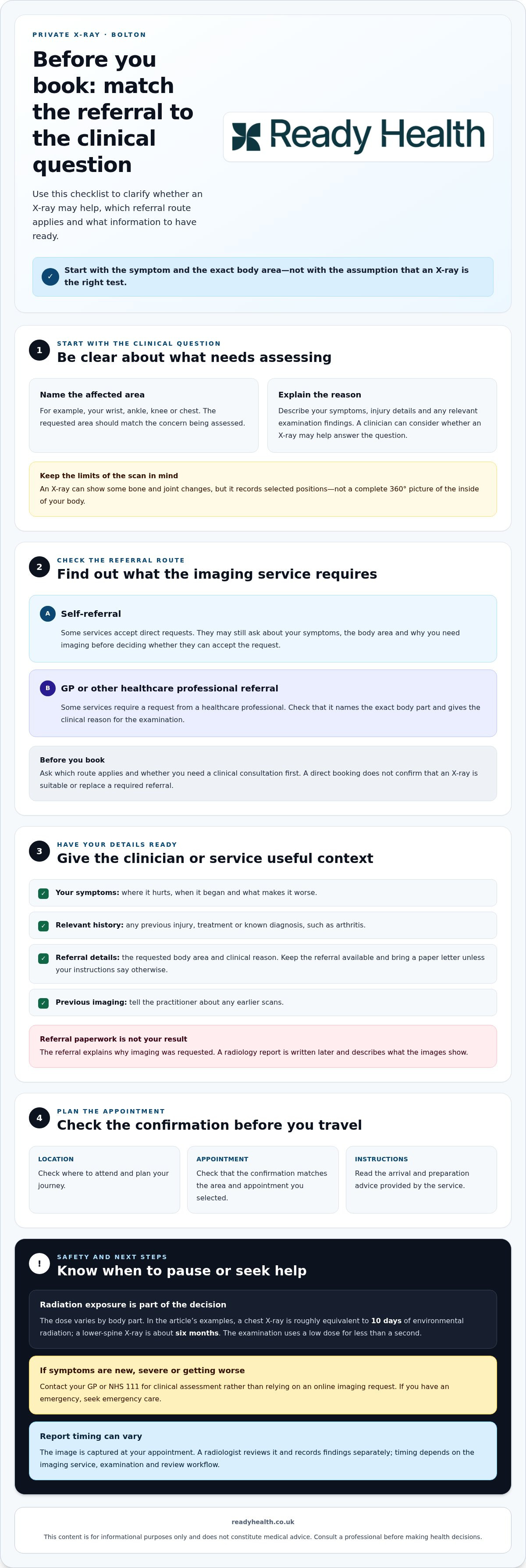
To explore how to get a private X-ray quickly in Bolton, first identify the body area and reason for imaging. A clinician uses your symptoms, injury details and examination to decide whether an X-ray could help diagnose the problem. It can detect some bone and joint changes, but it cannot provide a complete 360° picture of the inside of your body.
Some imaging services accept direct bookings, while others require a referral. Before starting an online booking, note your symptoms, the affected area and any referral details. Follow the booking steps, select an available appointment and read the confirmation for the location, arrival instructions and preparation advice.
To see how X-ray imaging creates a diagnostic picture, watch this short explanation:
Online booking lets you submit a request without a phone call. Enter the correct body area and reason, then check that the confirmation matches your selected appointment. If a referral is required, arrange one before attending rather than assuming the booking alone is enough.
Availability depends on the imaging service, the body part and clinical suitability. A direct booking does not establish that an X-ray is the right investigation. A clinician considers whether the image could answer the clinical question and help guide your next steps.
Private and NHS X-rays both help investigate clinical concerns. Private booking follows a separate, self-pay route, while NHS imaging depends on NHS referral and service arrangements. Neither route makes an X-ray appropriate for every symptom.
Private X-ray requests may involve bones and joints, such as the wrist, ankle or knee, or the chest. The requested area depends on your symptoms and the clinical question. An X-ray records images from selected positions, rather than showing every structure from every angle.
Radiation exposure is a safety consideration, and the dose varies by the body part examined. A chest X-ray is roughly equivalent to 10 days of environmental radiation; a lower-spine X-ray is about six months. The examination uses a low dose for less than a second.
When booking through Ready Health, review the location and arrival details provided in your appointment confirmation. Checking facility guidelines and local transport options ahead of time can help you plan your journey smoothly. Confirming logistics ensures you know exactly where to go for your scheduled appointment.
After an injury, urgent symptoms need prompt clinical assessment, not simply an online imaging request. Contact your GP or NHS 111 if symptoms are new, severe or worsening. If you have an emergency, seek emergency care; an X-ray appointment is not a substitute for urgent assessment.
Self-referral and GP referral requirements
Referral rules for private X-rays in Bolton depend on the imaging service and examination. Some services accept direct self-referrals; others require a request from a GP or another healthcare professional. Before booking, establish which route applies and whether you need a clinical consultation first.
A self-referral means contacting an imaging service yourself rather than starting with a GP letter. It doesn’t necessarily mean you can attend without an assessment. The service may ask about your symptoms, the affected area and the reason for imaging before deciding whether it can accept your request.
For example, if you have ongoing knee or wrist pain, describe where it hurts, when it began and what makes it worse. Mention any previous injury, treatment or diagnosis, such as arthritis. This helps a clinician assess whether an X-ray could answer the question or another investigation may be more suitable.
A GP referral gives the imaging team a clinical reason for the examination. It should identify the body part and summarise relevant symptoms or examination findings. If a healthcare professional has recommended an X-ray, ask for the referral details and check they relate to the exact area you need assessed.
Referral paperwork is not the same as your results. It explains why imaging was requested; a radiology report later describes what the images show. Keep the referral available when booking and provide it as instructed. If you have a paper letter, bring it unless your booking instructions say otherwise.
Some pathways include a GP consultation before a referral. The practitioner can review your symptoms and medical history, and consider whether an X-ray is likely to help guide treatment. A consultation does not mean imaging is automatically required: the clinical question and body area matter.
Before booking in Bolton, work through these practical steps:
- Describe the symptom and the body part clearly, such as ankle pain after a twist.
- Ask whether the service accepts self-referrals or needs a GP or other professional’s request.
- Have referral details ready, including the requested area and clinical reason.
- Tell the practitioner about previous imaging, relevant treatment and any known diagnosis.
When arranging an appointment in Bolton, make sure the referral names the specific body part causing concern. A request for one joint does not automatically cover another, and external imaging differs from internal imaging. The examination requested needs to match the clinical concern.
Radiation exposure is part of the decision, so the clinician weighs the expected benefit against the need for imaging. If the referral route is unclear, pause before booking and clarify the next step using your symptoms, requested body area and referral details.
Radiology report turnaround times
An X-ray image and its written report are separate parts of the investigation. The image is captured during your appointment, then a radiologist, a doctor trained to interpret medical images, reviews it and records their findings. Reporting takes place separately from arranging the scan.
There is no single report turnaround time for every private X-ray in Bolton. Timing depends on the imaging service’s workflow, the examination and the radiologist’s review. A straightforward wrist image and a more complex set of views may require different levels of interpretation.
The report describes what the image shows in relation to the clinical question. For example, it may discuss a bone or joint and whether visible changes could fit your symptoms. X-rays show some tissues and organs less clearly than bones, so the report reflects the limits of the imaging method.
When booking, ask how the service will communicate the report and who will explain it. Keep the appointment confirmation and referral details together. If a GP or another healthcare professional requested the scan, clarify how the report will reach them.
These steps can help you follow the reporting process:
- Record the expected reporting timeframe given for your specific examination.
- Confirm whether results are sent to you, the referring professional, or both.
- Check how you will be notified when the report is ready.
- Arrange a follow-up discussion with the clinician managing your symptoms.
A radiology report may use terms such as “no acute abnormality” or describe a visible change. Interpret these phrases alongside your symptoms and examination. A report alone is not a complete diagnosis or treatment plan.
Some X-ray examinations use contrast, a substance that helps show particular structures more clearly. For certain contrast X-rays, you may need to avoid eating and drinking for several hours beforehand. Follow the instructions for your examination, as preparation can affect when the scan and reporting process proceed.
If the report identifies a finding that needs further assessment, the next step depends on the finding and your symptoms. Your referring clinician can explain whether monitoring, treatment or another investigation is appropriate. For example, a joint finding may need to be considered alongside pain, movement and your medical history.
Keep a copy of the report with your health records, especially if you later discuss the concern with another practitioner. Note the body part examined and the imaging date, then share the report with the clinician responsible for your care.
Scan results and image access
Your X-ray images and radiology report are related but serve different purposes. Images are the pictures captured during the examination; the report is the radiologist’s written interpretation. A clinician considers both alongside your symptoms and examination to assess what may be causing the problem.
Ask how you will receive the report and images, and whether they will be sent to you, your referring practitioner or both. Access arrangements depend on the imaging service. Your booking confirmation or information provided during booking should explain how to receive results and any steps to follow.
If you receive image files, keep them with the written report and note the examination date and body area. For example, label a wrist X-ray clearly rather than storing it among unrelated health documents. This makes it easier to share the right images if another clinician needs to review them.
Images can help assess some fractures and other visible bone changes, but they don’t explain every cause of pain. A normal-looking image does not automatically rule out a problem. Your clinician considers the images with your symptoms, examination findings and medical history before discussing what they mean.
An X-ray and an MRI scan, which uses magnetic fields and radio waves to create images inside the body, produce different kinds of images. X-rays are commonly used to examine bones, while MRI can show structures such as soft tissues. The most useful test depends on the clinical question, so one cannot simply replace the other.
When you receive your results, read the report with a clinician’s explanation rather than relying on image files alone. Radiology reports may use technical wording to describe a finding or state that no significant change is visible. Ask the practitioner managing your care to explain unfamiliar terms and how they relate to your symptoms.
Use these steps to keep your results organised:
- Save the report and images together, with the date and body part.
- Share both with the practitioner treating the same concern.
- Ask what the report means for your next step, such as treatment or further assessment.
- Keep earlier imaging details available if you have repeat scans of the same area.
If an X-ray does not answer the clinical question, your practitioner can explain whether another assessment may help. For example, ongoing symptoms after an X-ray may prompt a review of your examination and history. Further imaging is not automatic; it depends on what information is still needed.
Before leaving your appointment, make sure you understand how results will reach you and who will explain them. If the report arrives without an explanation, contact the practitioner responsible for your care to discuss it. Clear access to the images and written findings helps you take an informed next step.
What happens during an X-ray appointment
A typical X-ray examination takes 10-15 minutes, although your visit may include checks and preparation. The radiographer will confirm the requested body area and explain the procedure before taking images. Tell them if your symptoms or the area needing imaging have changed since booking.
Before the examination, you may need to remove metal items that could affect the images. Bolton NHS Foundation Trust advises that metal items may need to be removed before an X-ray. Depending on the body part, this could mean taking off jewellery or changing into suitable clothing.
Tell the radiology team if you are or may be pregnant. Bolton NHS Foundation Trust advises patients to share this before an X-ray, so the team can consider the clinical need and appropriate next steps. Also mention relevant medical conditions, previous imaging or difficulty holding a position.
During the scan, the radiographer positions you beside or on the imaging table. You may need to stand, sit or lie down, depending on the requested view. For example, an ankle image may involve positioning your foot at different angles while keeping the rest of your body still.
- Follow the radiographer’s instructions about where to stand or sit.
- Hold the requested position and stay still while each image is taken.
- Tell the team if pain makes a position difficult.
- Wait for instructions before leaving the imaging room.
The X-ray exposes you to a low dose of radiation for less than a second. The radiographer operates the equipment from a protected area and may ask you to remain still. Accurate positioning helps capture the requested area clearly and may reduce the need for additional images.
An X-ray and a CT scan, which creates cross-sectional pictures of the body using X-rays, involve different procedures and produce different images. The clinician selects imaging according to the body area and question being investigated. For example, an X-ray may assess a bone, while other tests may be considered for different tissues or organs.
An X-ray can help assess certain problems, but it does not detect every cause of pain or infection. The radiographer takes the images, while a radiologist reviews them and prepares a report. Your clinician can explain how the findings relate to your symptoms and whether monitoring or further assessment is appropriate.
Preparation for contrast X-rays may differ from standard examinations. Some patients may need to avoid eating and drinking for several hours beforehand. Follow the instructions for your procedure, and tell the team if you have not been able to follow them.
After the images are taken, you can usually leave when the radiographer says the examination is complete. Ask how results will be provided and who will explain them. If you feel unwell or your symptoms worsen after the appointment, contact a healthcare professional for advice.
Ready Health: Private GP Consultation (15 Minutes)
Ready Health offers a Private GP Consultation (15 Minutes) to help you discuss symptoms and whether an X-ray may be appropriate. Bring details of the affected area, when symptoms began and any previous assessment or imaging. This gives the practitioner useful context for discussing possible next steps.
If your symptoms need more discussion, a Private GP Consultation (30 Minutes) is also available. A GP can assess your concerns and explain whether imaging or another approach may help. The consultation supports clinical decision-making, but it doesn’t guarantee that an X-ray will be recommended.
If you’re unsure how to proceed after reading about private X-rays in Bolton, contact Ready Health or visit readyhealth.co.uk to explore your options.
Choose your next step with confidence
Arranging imaging is one part of understanding a health concern. The next step is to connect any scan findings with your symptoms, medical history and day-to-day experience. This context can help you have a more focused conversation about appropriate support or follow-up.
If you’re working out how to get a private X-ray quickly in Bolton, start by clarifying the clinical question you want the scan to answer. Note when your symptoms began, what affects them and what you hope to understand. This can make a discussion with a healthcare professional more useful, whether or not imaging is the right next step.
Ready Health offers private GP consultations to discuss your health concerns and the appropriate next step. Contact the clinic in Standish, Wigan, to arrange a consultation.
Contact Ready Health about private X-rays, and take your next step with clarity.
Frequently Asked Questions
How long does an X-ray take?
A typical X-ray examination takes 10-15 minutes, though your visit may take longer if you need help getting into position. Wear clothing that allows easy access to the area being examined, such as a short-sleeved top for some arm or chest images. Follow the radiographer’s instructions and tell them if pain or limited movement makes a position difficult.
Where can I get a private X-ray in Bolton?
The Beaumont Hospital is one Bolton location associated with X-ray appointments. Check your booking confirmation for the exact site and arrival instructions, as your appointment details determine where to attend. If you are travelling from nearby areas such as Horwich or Farnworth, allow time to find the correct entrance and check parking arrangements before setting off.
Do private X-ray clinics in Bolton require a GP referral?
Referral requirements vary by imaging service. Some accept self-referrals, while others require a request from a GP or another healthcare professional. Before booking, identify the body area and explain why you need imaging. If you already have a referral, check that it names the area you want examined; a request for one body part may not cover another.
How much does a private X-ray cost in Bolton?
The price depends on the examination, body area and views required. Ask for a quote before booking and check whether it covers the imaging and written report. If clinical assessment suggests a different investigation, such as an MRI scan, the cost may change. The provider can give you a relevant quote once you describe the examination needed.
What is the process for booking and attending a private X-ray in Bolton?
First establish whether you need a referral or can request an appointment directly. Explain the reason for imaging and the body area involved, then follow the service’s booking instructions. Bring any referral paperwork and appointment confirmation. At the appointment, tell staff about relevant health details, including possible pregnancy, and mention any difficulty changing position or remaining still.
How soon are private X-ray results available in Bolton?
Report timing depends on the imaging service and examination. Before attending, ask how you will be told when results are ready and who will receive them. If a healthcare professional requested your scan, clarify how they will review the report with you. Keep their contact details available so you know whom to approach with questions.
To discuss your next step, explore Ready Health services or book a consultation.
This content is for informational purposes only and does not constitute medical advice. Consult a qualified healthcare professional before making decisions about your health.

Article by
Shamir Patel
Shamir Patel is a UK-based Clinical Pharmacist and Independent Prescriber with a specialist focus on ADHD and weight management.
He is the Registered CQC Manager at Ready Health Medical Clinic, where he leads the development and delivery of safe, patient-centred services across ADHD assessment and treatment, weight loss programmes, and general medical care.
With a career spanning nearly three decades since qualifying in 1995, Shamir brings extensive clinical and operational experience across both community pharmacy and private healthcare.
He also serves as Deputy Superintendent Pharmacist and Lead Prescriber at PillSorted. He oversees high-volume prescribing services. He focuses on GLP-1 weight loss treatments and clinical governance.
Shamir is a SCOPE-accredited obesity specialist and has a strong interest in improving access to evidence-based ADHD care. He is known for his structured, guideline-driven approach, aligning his clinical practice with NICE recommendations and regulatory standards set by the GPhC and CQC.
Alongside his clinical work, Shamir is actively involved in mentoring prescribing pharmacists, developing standard operating procedures, and contributing to service innovation within digital and community healthcare settings. His work reflects a commitment to safe prescribing, patient education, and improving outcomes through practical, accessible care.
Disclaimer
The information on this website is provided for general educational and informational purposes only and is not intended as medical advice, diagnosis, or treatment. Articles reflect general guidance and may not be suitable for your individual circumstances. You should always seek advice from a qualified healthcare professional before starting, stopping, or changing any treatment, medication, or healthcare plan. While we aim to keep our content accurate and up to date, Ready Health makes no guarantees about the completeness, accuracy, or suitability of the information provided. Reliance on any information on this site is entirely at your own risk. If you have concerns about your health, please book an appointment with a suitably qualified clinician. In an emergency, contact 999 or attend your nearest A&E department.
Frequently asked questions
How long does an X-ray take?
A typical X-ray examination takes 10–15 minutes, though your visit may take longer if you need help getting into position. Wear clothing that allows easy access to the area being examined, such as a short-sleeved top for some arm or chest images. Follow the radiographer’s instructions and tell them if pain or limited movement makes a position difficult.
Where can I get a private X-ray in Bolton?
The Beaumont Hospital is one Bolton location associated with X-ray appointments. Check your booking confirmation for the exact site and arrival instructions, as your appointment details determine where to attend. If you are travelling from nearby areas such as Horwich or Farnworth, allow time to find the correct entrance and check parking arrangements before setting off.
Do private X-ray clinics in Bolton require a GP referral?
Referral requirements vary by imaging service. Some accept self-referrals, while others require a request from a GP or another healthcare professional. Before booking, identify the body area and explain why you need imaging. If you already have a referral, check that it names the area you want examined; a request for one body part may not cover another.
How much does a private X-ray cost in Bolton?
The price depends on the examination, body area and views required. Ask for a quote before booking and check whether it covers the imaging and written report. If clinical assessment suggests a different investigation, such as an MRI scan, the cost may change. The provider can give you a relevant quote once you describe the examination needed.
What is the process for booking and attending a private X-ray in Bolton?
First establish whether you need a referral or can request an appointment directly. Explain the reason for imaging and the body area involved, then follow the service’s booking instructions. Bring any referral paperwork and appointment confirmation. At the appointment, tell staff about relevant health details, including possible pregnancy, and mention any difficulty changing position or remaining still.
How soon are private X-ray results available in Bolton?
Report timing depends on the imaging service and examination. Before attending, ask how you will be told when results are ready and who will receive them. If a healthcare professional requested your scan, clarify how they will review the report with you. Keep their contact details available so you know whom to approach with questions. To discuss your next step, explore Ready Health services or book a consultation. This content is for informational purposes only and does not constitute medical advice. Consult a qualified healthcare professional before making decisions about your health.

Related articles...

Oct 22, 2026
Mounjaro clinic in Chorley for eligibility and GP-led careEligibility for private Mounjaro treatment may include a BMI of...

Oct 22, 2026
Why do I have allergy symptoms all year round?Sneezing, a blocked nose and itchy eyes are often associated...

Oct 21, 2026
Private plantar fasciitis treatment in WiganHeel pain needs more than a guess at the cause....