October 17, 2026
Specialist Consultation for Burnout in Wigan: Your Next Steps

Could ongoing exhaustion be burnout, or might another health concern be contributing? A specialist consultation for burnout Wigan can give you space to explain what’s been happening and help a clinician explore your symptoms, work pressures and possible next steps. You don’t need the right words or a clear answer before asking for support.
Burnout is recognised as an occupational phenomenon rather than a medical diagnosis, and its effects can overlap with other concerns, including anxiety or depression. In this guide, you’ll learn what a clinician may discuss, how to prepare and which questions could help you feel heard. We’ll also outline support through Ready Health in Standish, Wigan, including clinic and remote appointments.
Key Takeaways
- A clinician can listen to your concerns and explore how work pressures, sleep, mood and physical health may be affecting you.
- You don’t need to decide whether your experience is burnout, stress or another concern before arranging a specialist consultation for burnout Wigan.
- Make your appointment easier to navigate by noting when things changed and how they’re affecting your daily life.
- Ready Health offers private clinician appointments in Standish and remotely. The right format depends on your clinical needs.
Table of Contents
Specialist Consultation for Burnout in Wigan: When Might It Help?
Feeling depleted, detached from work or unable to recover after sustained pressure can be unsettling. You may still be meeting responsibilities, yet find that ordinary tasks take more effort or that time away from work no longer leaves you refreshed. These experiences deserve attention, even if you’re unsure what to call them.
Burnout is a term people use for prolonged exhaustion and reduced engagement associated with ongoing, unmanaged work demands, but it doesn’t have one universal presentation. The World Health Organization describes burnout as an occupational phenomenon related specifically to workplace stress, rather than a medical diagnosis. You can read an overview of Occupational burnout, but an online description can’t determine what is causing your symptoms.
Similar changes can have different explanations, including physical health concerns or mental health difficulties. This article can’t diagnose you, and a clinician may need to explore the wider picture. A specialist consultation for burnout Wigan residents seek can offer a calm setting to discuss what’s changed and consider suitable next steps, without assuming a particular diagnosis.
What might burnout feel like in everyday life?
Your energy, concentration, motivation or interest in work may shift. For example, you might struggle to focus in meetings, put off tasks that once felt manageable, or feel emotionally distant from colleagues. Everyday activities outside work may also become harder to keep up with. These are examples, not a checklist that proves you have burnout.
Notice how long the changes have been present and how they affect your routine, relationships and ability to manage responsibilities. A few brief notes can help you explain the pattern. You don’t need to monitor yourself perfectly or reach a conclusion before seeking advice.
When could a clinician’s perspective be useful?
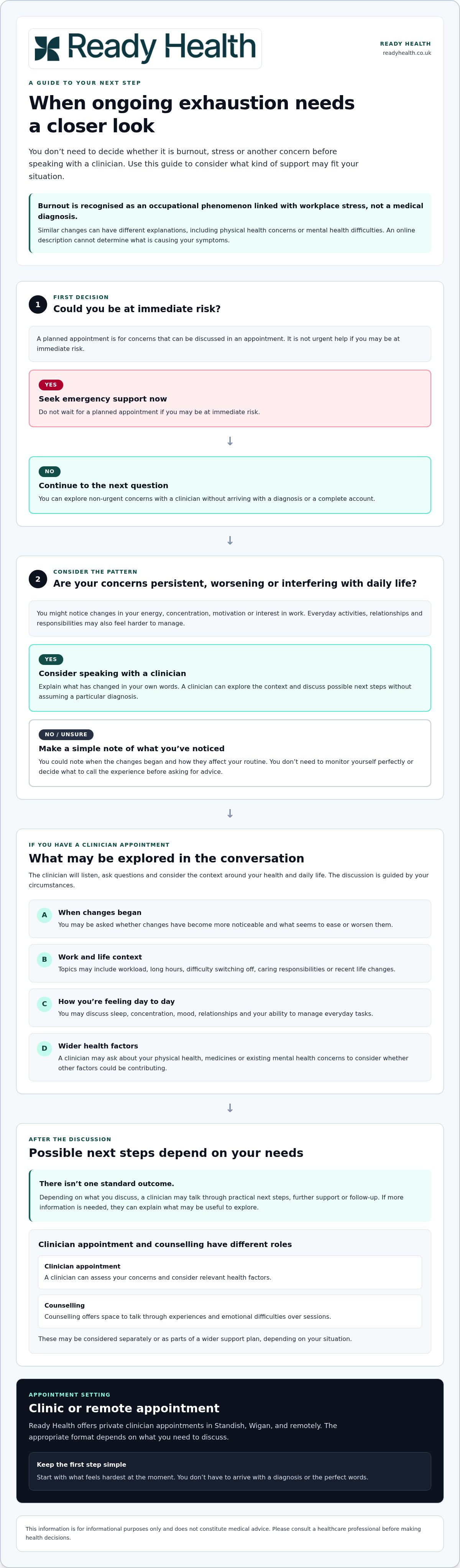
Consider speaking with a clinician if your concerns persist, worsen or begin to interfere with daily life. You don’t need a perfect label before asking for support. Describe what you’re experiencing in your own words, and the clinician can explore relevant context and discuss possible next steps.
For people seeking a specialist consultation for burnout, Wigan has a local option in Ready Health’s private clinic in Standish, with remote appointments also available. The appropriate format depends on what you need to discuss. A planned consultation is for concerns that can be discussed in an appointment, not urgent help if you may be at immediate risk. In that situation, seek emergency support now rather than waiting for a planned appointment.
If you feel ready to discuss persistent exhaustion, you can book a clinician appointment to talk through your concerns. Start with what feels hardest at the moment. You don’t have to arrive with a diagnosis.
What Happens in a Burnout Consultation with a Clinician?
A consultation is a chance to explain what you’ve noticed and what concerns you. The clinician will listen, ask questions and consider the context around your health and daily life. You don’t need to arrive with a diagnosis or a complete account of everything that has happened.
The conversation is guided by your circumstances. A specialist consultation for burnout Wigan residents arrange can help clarify what needs attention, but an appointment doesn’t guarantee a particular diagnosis, medication, referral or treatment plan. Assessment and recommendations depend on what you share and the clinician’s judgement.
Topics a clinician may explore with you
You may be asked when the changes began, whether they have become more noticeable, and what seems to ease or worsen them. This helps build a clearer picture of the pattern rather than focusing on a single difficult day.
The discussion may include work pressures and routines, such as changes in workload, long hours or difficulty switching off. Caring responsibilities, recent life changes and sleep may also be relevant. You could be asked how things affect your concentration, mood, relationships and ability to manage everyday tasks.
A clinician may also ask about your physical health, medicines or existing mental health concerns. This doesn’t mean your experience will be reduced to one cause. It helps the clinician consider whether other factors could be contributing and what support may be appropriate.
Possible next steps after the conversation
There isn’t one standard outcome. Depending on what you discuss, the clinician may talk through practical next steps, further support or follow-up. If more information is needed, they can explain what may be useful to explore. Recommendations should reflect your needs rather than assume that one approach suits everyone.
A clinician appointment and counselling can play different roles. A clinician can assess your concerns and consider relevant health factors. Counselling offers space to talk through experiences and emotional difficulties over sessions. They may be considered separately or as parts of a wider support plan, depending on your situation.
If you’re wondering whether a broader mental health assessment may be relevant, raise this during your consultation. The clinician can discuss your concerns and possible next steps without assuming that you need a particular assessment.
Ready Health provides private clinician appointments and mental health support, including counselling. You can book a clinician appointment to discuss what you’re experiencing and what support may suit you.
Burnout, Stress or Another Concern? Addressing a Common Worry
You don’t need to work out exactly what’s wrong before booking an appointment. It’s common to feel unsure whether ongoing strain is connected with work, a period of stress, low mood or something else. A clinician can help explore your concerns. Describing what you’ve noticed is enough to begin the conversation.
These experiences can overlap, but they aren’t interchangeable labels. Stress may feel closely tied to current demands, while burnout-related concerns are often described in connection with prolonged work pressure and feeling emotionally or mentally drained. Low mood may involve changes in how you feel or function that aren’t limited to work. These descriptions can help frame a discussion, but they can’t identify the cause for you.
Why burnout and other concerns can feel similar
Fatigue, disrupted sleep, difficulty concentrating and feeling low can have more than one possible explanation. Work stress might be part of the picture, but physical health, other pressures or mental health concerns may also matter. Symptoms alone don’t confirm burnout, and a self-checklist can’t replace an individual assessment.
Share what has changed and how it affects your work, relationships or ordinary routines. Context can help a clinician understand your experience without reducing it to a label.
A considered assessment looks at the whole person, including symptoms, health, circumstances and the effect on daily life.
Experience: Pressure or tension around current demands.
Possible context: A busy period, a difficult task or competing responsibilities.
Why discuss it: If it persists, feels hard to manage or begins affecting your wellbeing, a clinician can help you consider what support may be appropriate.
Experience: Ongoing exhaustion or reduced engagement that seems linked with work.
Possible context: A sustained pattern of workplace demands, though other factors may also be relevant.
Why discuss it: The clinician can explore the pattern and its impact without assuming burnout is the only explanation.
Experience: Low mood or reduced interest that affects different parts of life.
Possible context: This can arise for various reasons and may not be limited to work.
Why discuss it: A conversation may help clarify what you’re experiencing and whether further assessment or support should be considered.
Will a consultation take your concerns seriously?
Uncertainty doesn’t make your concern less valid. Explain it in your own words, such as, “I’m finding it harder to recover after work,” or “My concentration and motivation have changed.” You don’t need clinical language or proof that you have a particular condition.
A specialist consultation for burnout Wigan can provide space to talk through what’s happening and consider possible next steps. It may not lead to a specific diagnosis or intervention, because recommendations depend on your circumstances and clinical judgement. The purpose is to understand your concern more clearly and discuss an appropriate way forward.
How to Prepare for a Burnout Consultation in Wigan
You don’t need to complete a form or work out what is causing your concerns before an appointment. A few brief notes can help organise your thoughts, especially if tiredness or stress makes it difficult to remember details during a conversation. Keep it simple and focus on what you’d most like the clinician to understand.
What to note before your appointment
Use these prompts as a guide, not a test. You can write a few words for each or simply think them through beforehand.
- When it began: Note roughly when you first noticed a change and whether it has been steady, improving or getting harder to manage.
- What feels different: Consider changes in your energy, sleep, mood or concentration over time. A specific example, such as struggling to focus on a familiar task, may help explain the impact.
- What may be contributing: You could note work pressures, caring responsibilities or other recent changes. Share only what you feel comfortable discussing; there’s no need to prepare a full account.
- How daily life is affected: Think about whether the changes influence work, relationships, household tasks or time outside work.
- Relevant health details and questions: If applicable, bring a list of medicines and note any health concerns you think may be relevant. Write down questions, including what support options might suit your circumstances.
Your notes don’t need to be complete or polished. The clinician can guide the discussion, ask follow-up questions and help identify what information matters. If you don’t know an exact date or can’t remember a detail, say so.
Choosing an appointment format in Standish or remotely
Ready Health is based in Standish, Wigan, and offers clinician appointments in the clinic and remotely. The right format depends on the concern you want to discuss and the clinical conversation needed. You can raise any questions about the format when arranging your appointment.
A private GP consultation may be a practical starting point if you want to discuss persistent exhaustion alongside other health concerns. Explain the main issue you’d like help exploring. A consultation can consider your circumstances and possible next steps, but it can’t promise a particular diagnosis or plan.
If you’re facing immediate danger or may be at risk of harming yourself, don’t wait for a routine appointment. Call 999 or go to A&E. For urgent mental health support in Wigan that isn’t an immediate emergency, refer to Wigan Council’s current urgent support guidance for up-to-date local contact routes.
When you’re ready to discuss your concerns, book a clinician appointment with Ready Health.
Arrange a Burnout Consultation with Ready Health in Wigan
If persistent exhaustion is affecting your work or everyday life, discussing it with a clinician can be a measured next step. Ready Health is a private clinic in Standish, Wigan, offering clinician appointments and mental health support. A specialist consultation for burnout Wigan residents arrange gives you space to explain what’s concerning you and consider possible next steps, without assuming a diagnosis or promising a particular outcome.
What local support can look like
A clinician appointment and counselling are different forms of support. A clinician can discuss your health concerns and consider what further steps may be appropriate. Counselling offers an opportunity to talk through experiences and emotional difficulties. Depending on your circumstances, one option may feel more relevant than the other, or they may form parts of a wider support plan.
Ready Health appointments are available at the Standish clinic and remotely. The suitable format depends on your concern and the clinical discussion needed, so there isn’t one option that will fit everyone. When arranging an appointment, explain what you’re hoping to discuss and consider which practical format suits you.
Ready Health offers people in Wigan a local route to discuss persistent exhaustion with a clinician, in Standish or remotely, and consider suitable support.
Private appointments are one part of the wider support landscape. They don’t replace emergency care or other services you may need. If you’re in immediate danger or need urgent help, use the appropriate urgent support route rather than waiting for a routine appointment.
Book a conversation when you feel ready
You can arrange an appointment online through Ready Health’s booking page. You don’t need to be certain that burnout is the right description or prepare a complete explanation in advance. Begin with what has changed and what you would like help discussing.
Taking this step doesn’t commit you to a particular diagnosis or plan. It gives you an opportunity to speak with a clinician, ask questions and consider what may be appropriate for your circumstances. If you’d like to talk through your concerns, book a clinician appointment with Ready Health.
Take a Practical Next Step at Your Own Pace
You don’t have to wait until you can explain everything clearly. Talking with someone can make space for your concerns and help you decide what feels appropriate next. A specialist consultation for burnout Wigan can begin with what you’re noticing now, even if you’re still unsure how to describe it.
Ready Health provides private clinician appointments and mental health support, including counselling. The clinic is based in Standish, Wigan, with remote appointment options. Your clinician can explore your concerns and discuss possible next steps based on your circumstances, without promising a particular diagnosis or outcome.
If you feel ready to talk things through, book a consultation with Ready Health. Ready Health serves people across Standish, Wigan, Shevington, Standish Lower Ground, Boar's Head, Wrightington, Appley Bridge, Chorley, Skelmersdale, Orrell, Ashton-in-Makerfield, Bolton, Leigh, Preston, Southport and St Helens.
Frequently Asked Questions
Can a GP help if I think I may be experiencing burnout?
Yes. A GP can discuss your symptoms, general health and how you’re managing day to day. You might mention that you’re struggling to recover after work, or that your sleep or concentration has changed. A specialist consultation for burnout Wigan gives you a chance to explain these concerns and consider possible next steps. The clinician may explore other relevant factors rather than assuming work stress is the only cause.
Is burnout the same as stress?
No, they’re related ideas but not identical. Stress often describes a response to pressure, while burnout is used for a pattern associated with prolonged workplace stress and exhaustion. These descriptions aren’t diagnoses, and people’s experiences can differ. If pressure feels persistent or is affecting your wellbeing, explain what you’re experiencing rather than deciding which term fits. A clinician can consider your circumstances and discuss whether further assessment may be appropriate.
Can burnout affect your sleep or concentration?
It may be associated with changes in sleep or concentration, but these experiences can have other causes too. You might find it harder to switch off at night, wake feeling unrested or lose track of tasks you usually manage. Note whether the changes happen at particular times or affect activities outside work as well. If they persist or interfere with everyday life, discuss them with a clinician rather than relying on symptoms alone to identify a cause.
Do I need to know that it is burnout before booking a consultation?
No, you can book without deciding what condition explains how you feel. Begin with an observation, such as finding it difficult to cope with your usual workload or feeling unlike yourself. You can also say what you’re worried about and what you hope to understand. The clinician can ask questions to clarify the picture. The appointment may help identify appropriate next steps, but it doesn’t guarantee a diagnosis or specific intervention.
What should I tell a clinician about feeling burned out?
Start with the changes that concern you most. For example, explain when you began feeling unusually tired, whether your sleep has changed, or how your mood affects work or home life. Mention relevant medicines or health conditions, and say if anything has made the situation better or worse. You don’t need a prepared speech. If a question feels difficult, take a moment or explain only what you’re comfortable sharing.
Can I discuss burnout concerns in a remote appointment?
Ready Health offers remote appointments, and you can raise burnout concerns with a clinician through this route. Whether remote or in-clinic care is suitable depends on the concern and what the clinician needs to discuss. Before the appointment, choose a private place where you can speak freely, and keep any notes or medicine details nearby if useful. Explain your main concern at the start and ask if another format would better suit the discussion.
Where can I get urgent mental health help in Wigan?
If you or someone else is in immediate danger, call 999 or go to A&E. For urgent mental health support that isn’t an immediate emergency, use Wigan Council’s current mental health guidance to find the relevant local contact route, as contact details can change. A routine private consultation is not an emergency service. If you’re unsure what to do and the situation feels unsafe, seek urgent help rather than waiting for a booked appointment.
If you’re ready to discuss your concerns, book a consultation with Ready Health.
This content is for informational purposes only and does not constitute medical advice. Consult a qualified professional before making health decisions.

Article by
Shamir Patel
Shamir Patel is a UK-based Clinical Pharmacist and Independent Prescriber with a specialist focus on ADHD and weight management.
He is the Registered CQC Manager at Ready Health Medical Clinic, where he leads the development and delivery of safe, patient-centred services across ADHD assessment and treatment, weight loss programmes, and general medical care.
With a career spanning nearly three decades since qualifying in 1995, Shamir brings extensive clinical and operational experience across both community pharmacy and private healthcare.
He also serves as Deputy Superintendent Pharmacist and Lead Prescriber at PillSorted. He oversees high-volume prescribing services. He focuses on GLP-1 weight loss treatments and clinical governance.
Shamir is a SCOPE-accredited obesity specialist and has a strong interest in improving access to evidence-based ADHD care. He is known for his structured, guideline-driven approach, aligning his clinical practice with NICE recommendations and regulatory standards set by the GPhC and CQC.
Alongside his clinical work, Shamir is actively involved in mentoring prescribing pharmacists, developing standard operating procedures, and contributing to service innovation within digital and community healthcare settings. His work reflects a commitment to safe prescribing, patient education, and improving outcomes through practical, accessible care.
Disclaimer
The information on this website is provided for general educational and informational purposes only and is not intended as medical advice, diagnosis, or treatment. Articles reflect general guidance and may not be suitable for your individual circumstances. You should always seek advice from a qualified healthcare professional before starting, stopping, or changing any treatment, medication, or healthcare plan. While we aim to keep our content accurate and up to date, Ready Health makes no guarantees about the completeness, accuracy, or suitability of the information provided. Reliance on any information on this site is entirely at your own risk. If you have concerns about your health, please book an appointment with a suitably qualified clinician. In an emergency, contact 999 or attend your nearest A&E department.
Frequently asked questions
What might burnout feel like in everyday life?
Your energy, concentration, motivation or interest in work may shift. For example, you might struggle to focus in meetings, put off tasks that once felt manageable, or feel emotionally distant from colleagues. Everyday activities outside work may also become harder to keep up with. These are examples, not a checklist that proves you have burnout. Notice how long the changes have been present and how they affect your routine, relationships and ability to manage responsibilities. A few brief notes can help you explain the pattern. You don’t need to monitor yourself perfectly or reach a conclusion before seeking advice.
When could a clinician’s perspective be useful?
Consider speaking with a clinician if your concerns persist, worsen or begin to interfere with daily life. You don’t need a perfect label before asking for support. Describe what you’re experiencing in your own words, and the clinician can explore relevant context and discuss possible next steps. For people seeking a specialist consultation for burnout, Wigan has a local option in Ready Health’s private clinic in Standish, with remote appointments also available. The appropriate format depends on what you need to discuss. A planned consultation is for concerns that can be discussed in an appointment, not urgent help if you may be at immediate risk. In that situation, seek emergency support now rather than waiting for a planned appointment. If you feel ready to discuss persistent exhaustion, you can book a clinician appointment to talk through your concerns. Start with what feels hardest at the moment. You don’t have to arrive with a diagnosis. A consultation is a chance to explain what you’ve noticed and what concerns you. The clinician will listen, ask questions and consider the context around your health and daily life. You don’t need to arrive with a diagnosis or a complete account of everything that has happened. The conversation is guided by your circumstances. A specialist consultation for burnout Wigan residents arrange can help clarify what needs attention, but an appointment doesn’t guarantee a particular diagnosis, medication, referral or treatment plan. Assessment and recommendations depend on what you share and the clinician’s judgement.
Will a consultation take your concerns seriously?
Uncertainty doesn’t make your concern less valid. Explain it in your own words, such as, “I’m finding it harder to recover after work,” or “My concentration and motivation have changed.” You don’t need clinical language or proof that you have a particular condition. A specialist consultation for burnout Wigan can provide space to talk through what’s happening and consider possible next steps. It may not lead to a specific diagnosis or intervention, because recommendations depend on your circumstances and clinical judgement. The purpose is to understand your concern more clearly and discuss an appropriate way forward. You don’t need to complete a form or work out what is causing your concerns before an appointment. A few brief notes can help organise your thoughts, especially if tiredness or stress makes it difficult to remember details during a conversation. Keep it simple and focus on what you’d most like the clinician to understand.
Can a GP help if I think I may be experiencing burnout?
Yes. A GP can discuss your symptoms, general health and how you’re managing day to day. You might mention that you’re struggling to recover after work, or that your sleep or concentration has changed. A specialist consultation for burnout Wigan gives you a chance to explain these concerns and consider possible next steps. The clinician may explore other relevant factors rather than assuming work stress is the only cause.
Is burnout the same as stress?
No, they’re related ideas but not identical. Stress often describes a response to pressure, while burnout is used for a pattern associated with prolonged workplace stress and exhaustion. These descriptions aren’t diagnoses, and people’s experiences can differ. If pressure feels persistent or is affecting your wellbeing, explain what you’re experiencing rather than deciding which term fits. A clinician can consider your circumstances and discuss whether further assessment may be appropriate.
Can burnout affect your sleep or concentration?
It may be associated with changes in sleep or concentration, but these experiences can have other causes too. You might find it harder to switch off at night, wake feeling unrested or lose track of tasks you usually manage. Note whether the changes happen at particular times or affect activities outside work as well. If they persist or interfere with everyday life, discuss them with a clinician rather than relying on symptoms alone to identify a cause.
Do I need to know that it is burnout before booking a consultation?
No, you can book without deciding what condition explains how you feel. Begin with an observation, such as finding it difficult to cope with your usual workload or feeling unlike yourself. You can also say what you’re worried about and what you hope to understand. The clinician can ask questions to clarify the picture. The appointment may help identify appropriate next steps, but it doesn’t guarantee a diagnosis or specific intervention.
What should I tell a clinician about feeling burned out?
Start with the changes that concern you most. For example, explain when you began feeling unusually tired, whether your sleep has changed, or how your mood affects work or home life. Mention relevant medicines or health conditions, and say if anything has made the situation better or worse. You don’t need a prepared speech. If a question feels difficult, take a moment or explain only what you’re comfortable sharing.
Can I discuss burnout concerns in a remote appointment?
Ready Health offers remote appointments, and you can raise burnout concerns with a clinician through this route. Whether remote or in-clinic care is suitable depends on the concern and what the clinician needs to discuss. Before the appointment, choose a private place where you can speak freely, and keep any notes or medicine details nearby if useful. Explain your main concern at the start and ask if another format would better suit the discussion.
Where can I get urgent mental health help in Wigan?
If you or someone else is in immediate danger, call 999 or go to A&E. For urgent mental health support that isn’t an immediate emergency, use Wigan Council’s current mental health guidance to find the relevant local contact route, as contact details can change. A routine private consultation is not an emergency service. If you’re unsure what to do and the situation feels unsafe, seek urgent help rather than waiting for a booked appointment. If you’re ready to discuss your concerns, book a consultation with Ready Health. This content is for informational purposes only and does not constitute medical advice. Consult a qualified professional before making health decisions.

Related articles...

Oct 16, 2026
Wegovy Injections in Wigan: Understand Your Options and Clinical SupportCould the most important first step with Wegovy be finding...

Oct 16, 2026
Poor, intermediate and rapid metabolisers: What do they mean for your medication?Two people taking the same medication at the same dose...

Oct 15, 2026
Private Abdominal Ultrasound in Skelmersdale: What to ExpectWhat can an abdominal ultrasound show, and what should you...