October 2, 2026
TRT Blood Tests in St Helens: A Guide to Ongoing Monitoring

URL slug: trt-blood-tests-st-helens-ongoing-monitoring
If you’re looking into TRT blood tests St Helens, you may be wondering which tests could be relevant and what happens after you receive your results. A screening result is only one part of the picture, and needs to be considered alongside your symptoms and health history.
A clinical discussion can help you understand what testing before or during TRT may involve and why ongoing monitoring matters. This guide explains the role of blood tests, why results shouldn’t be treated as a diagnosis on their own, and what to expect from a clinician-led review. Ready Health, based in Standish, Wigan, serves St Helens and offers private men’s health, TRT and blood-testing services.
Key Takeaways
- TRT blood tests St Helens can form part of a wider assessment, but results need to be considered alongside your symptoms and medical history.
- A clinician may discuss testosterone and other blood markers depending on your circumstances and whether you’re being assessed or monitored.
- Private and NHS testing can differ in how you arrange testing and access follow-up. Understand who will review your results and discuss next steps.
- Before testing, confirm the plan and follow the clinician’s instructions. Don’t change your treatment based on an online result alone.
- Ready Health’s men’s health and TRT service offers a private route to discuss testing and follow-up, serving St Helens from Standish, Wigan.
Table of Contents
- Why TRT blood tests near St Helens are part of a wider clinical assessment
- Which blood markers may be discussed during TRT assessment and monitoring?
- Private TRT blood tests or NHS blood tests in St Helens: what is the difference?
- How to prepare for a TRT blood test and understand your results
- Arrange a clinician-led TRT blood test discussion near St Helens
Why TRT blood tests near St Helens are part of a wider clinical assessment
If you’re considering TRT or already receiving it, blood tests can provide useful information. They’re one part of assessment and monitoring, not a diagnosis on their own. A clinician considers your results alongside your symptoms, medical history and treatment context before discussing what they may mean.
Testosterone Replacement Therapy (TRT) describes treatment that uses testosterone to address deficiency in appropriate clinical circumstances. If you’re searching for TRT blood tests St Helens, it’s important to treat testing as part of a clinical conversation, not a standalone answer.
This video discusses changes people may experience during TRT. Individual experiences vary, so it shouldn’t be taken as a prediction of your own response.
When might a clinician consider blood tests for TRT?
Before treatment, testing may help a clinician assess whether your hormone levels are relevant to the concerns you’ve described and whether further evaluation is appropriate. Symptoms such as changes in libido or energy can have different causes, so symptoms alone don’t establish a diagnosis or confirm that TRT is suitable for you.
During treatment, tests may help review your response and inform decisions about ongoing care. The tests selected and when they’re taken depend on your treatment and personal circumstances. There isn’t one plan for everyone, so ask your clinician to explain the reason for each recommended test.
What can a blood test tell you, and what can it not tell you?
A blood test measures particular substances in your blood at the time the sample is taken. It gives your clinician information to consider as part of an assessment or follow-up, but it can’t describe your whole health or explain every symptom by itself.
One laboratory result is a snapshot, not a diagnosis. Its meaning depends on your symptoms, history and clinical context. Results may need further discussion or assessment. Testing can’t guarantee that a cause will be identified or that a particular treatment will improve how you feel.
Ready Health is based in Standish, Wigan, and serves people from St Helens. You can read more about the clinic’s testosterone replacement therapy service and discuss assessment, testing and follow-up with a clinician.
Which blood markers may be discussed during TRT assessment and monitoring?
Testosterone measurement may form part of an assessment before treatment or a review while you’re receiving TRT. Your clinician considers the result alongside your symptoms, health history and treatment details. They can explain what the test is intended to clarify and whether other checks may be relevant to you.
There isn’t one blood-test panel or schedule that suits everyone. Test selection should be individualised to your health, symptoms and treatment context. This keeps testing focused on the clinical questions that matter to you, rather than treating a long list of results as a diagnosis.
Why testosterone results need context
A testosterone result shows a measured level at the time your blood was taken. Its interpretation may depend on factors such as your symptoms, medical history, current treatment and when the sample was collected. Your clinician may also consider whether further testing is appropriate before drawing conclusions.
Laboratories provide reference ranges to help interpret results, but these aren’t a self-diagnosis tool. The NHS testosterone blood test information explains why timing can matter. Follow the instructions for your own test. Advice about sample timing or repeat testing should be based on current clinical guidance and your circumstances.
Why a clinician may consider tests beyond testosterone
Depending on your health and whether you’re starting or continuing treatment, a clinician may consider checks for general health or treatment safety. For example, a full blood count measures different types of blood cells and includes haematocrit, the proportion of your blood made up of red cells. Other tests, such as a prostate-related marker or liver and cholesterol checks, may be relevant in some situations.
These examples aren’t a required checklist. Your age, medical history, medicines and treatment plan can affect which tests are suitable and how results are followed up. Ask what each recommended test is intended to assess, and discuss any result you don’t understand with a clinician rather than changing treatment yourself.
Ready Health serves St Helens from its clinic in Standish, Wigan. Explore the testosterone replacement therapy service to learn more about discussing assessment and care.
Private TRT blood tests or NHS blood tests in St Helens: what is the difference?
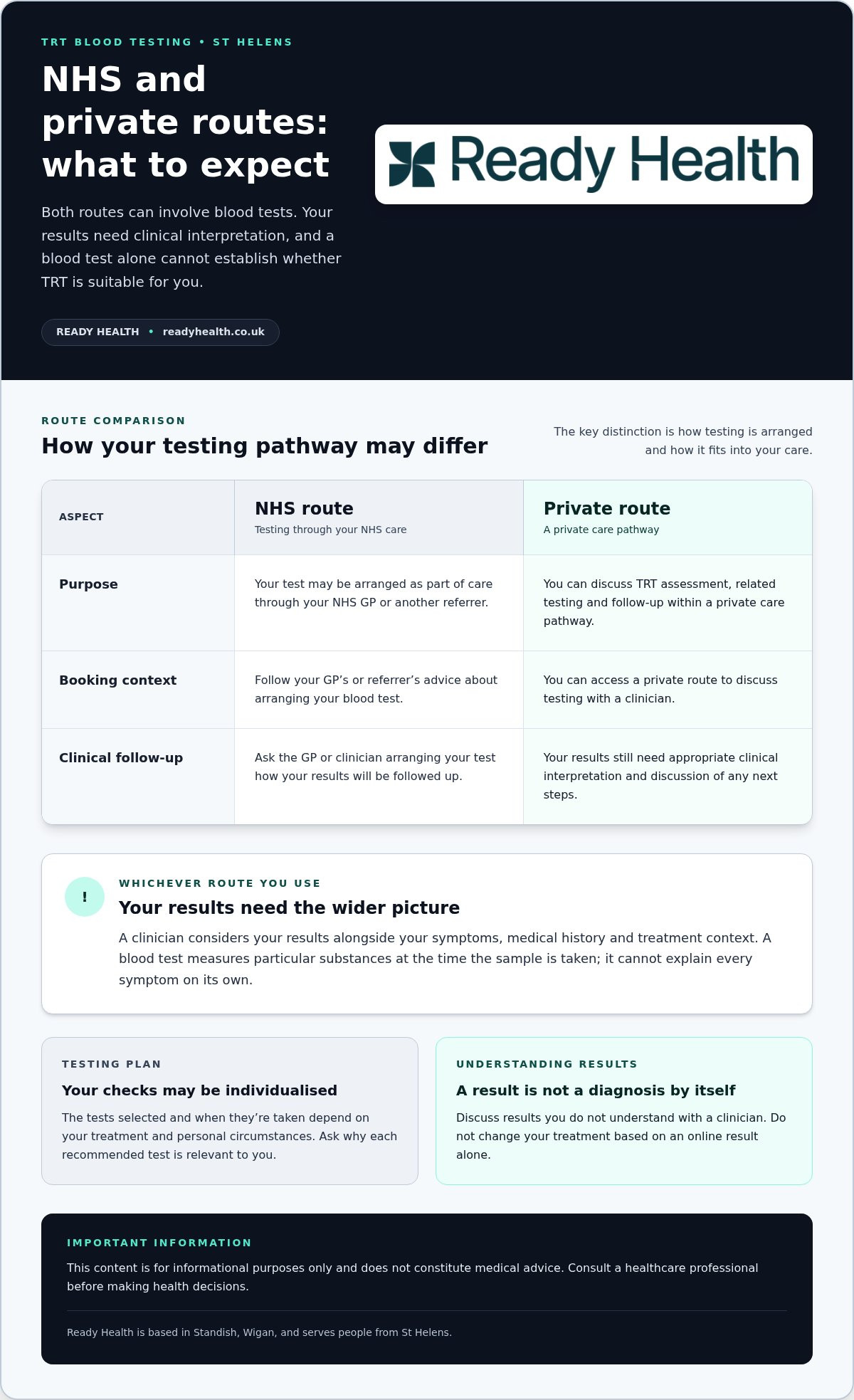
Both NHS and private routes can involve blood testing, but the booking context and how testing fits into your wider care may differ. A blood test alone doesn’t establish whether TRT is suitable. Whichever route you use, understand who will interpret the result and discuss any next steps with you.
| Aspect | NHS route | Private route |
|---|---|---|
| Purpose | Testing may be arranged as part of care through your NHS GP or another referrer. | You can discuss TRT assessment, related testing and follow-up within a private care pathway. |
| Booking context | Local NHS information says to follow advice from your GP or referrer about blood testing. | You can access a private route to discuss testing with a clinician. |
| Clinical follow-up | Discuss how results will be followed up with the GP or clinician arranging your test. | Results need appropriate clinical interpretation. A clinician can consider them alongside your health and treatment context. |
What to expect from the local NHS blood-test route
The local NHS blood-test information directs patients to follow advice from their GP or referrer. For TRT-related testing, the booking service takes a requested sample, while decisions about which tests you need and what the results mean belong in your clinical care. Refer to the local page for its current booking details.
When might a private, clinician-led route suit you?
A private route may suit you if you want to discuss TRT assessment, testing and results within a private care pathway. It doesn’t make a test result a diagnosis or replace the need to consider your symptoms and medical history. Make sure you understand how the test fits into your care and who will explain the findings.
Ready Health is based in Standish, Wigan, and serves people from St Helens. Its testosterone replacement therapy service gives you a private route to discuss men’s health and TRT with a clinician. When comparing options for TRT blood tests St Helens, consider both the sample and the clinical discussion around it.
How to prepare for a TRT blood test and understand your results
A little preparation can make your blood test and follow-up discussion more useful. Before your appointment, confirm which tests have been requested, follow the instructions given for those tests and plan how you’ll discuss the results with a clinician.
What to do before your appointment
Preparation depends on the tests being taken, so don’t assume you need to fast or attend at a particular time unless you’ve been told to. If the instructions are unclear, clarify them before your appointment rather than relying on general advice you’ve found online.
Bring your referral or test information, if you’ve been given any, and a current list of medicines. Be ready to describe your symptoms, relevant treatment history and any previous test results. This context can help your clinician understand the purpose of testing and interpret the findings.
Ready Health provides private blood-testing services, including sample collection. If you’re arranging TRT blood tests St Helens, find out how your results will be discussed as well as how the sample will be taken.
How to approach results without self-diagnosing
Your report may show a reference range, which is a guide used by the laboratory to help interpret a result. A reading outside that range doesn’t explain the cause by itself, and a reading within it doesn’t necessarily answer every question about your symptoms. Your clinician can consider the result alongside your health history, treatment and the reason for testing.
If a result concerns you, arrange a clinical discussion to understand what it may mean and whether any next steps are appropriate. Don’t start, stop or change medication or TRT based on an online result without clinical advice. If you’re receiving treatment, speak to the clinician overseeing your care before making changes.
- Confirm the plan: know which tests are being taken and why.
- Follow your instructions: only fast or adjust the timing of your test if specifically advised.
- Bring useful context: share relevant medicines, symptoms and previous results.
- Arrange a review: discuss findings with a clinician before acting on them.
Book a consultation with Ready Health for clinician-led support with testing and follow-up.
Arrange a clinician-led TRT blood test discussion near St Helens
If you’re considering testosterone replacement therapy or already receiving treatment, a conversation with a clinician can help you understand what to discuss next. Ready Health offers men’s health and TRT services from its clinic in Standish, Wigan, serving people from St Helens. Your symptoms, health history and test results can be considered together, rather than treating a laboratory reading as the whole answer.
What to discuss in a TRT consultation
To make the discussion useful, bring together the details that explain your situation. You may want to note:
- the symptoms you’ve noticed and when they began;
- relevant health conditions and medicines you take;
- any previous testosterone results, including when the samples were taken;
- whether you’re considering TRT or already receiving treatment.
This information can help the clinician understand your concerns and discuss whether further assessment or blood tests may be appropriate. Testing and consultation don’t guarantee a diagnosis, a TRT prescription or a particular outcome. Your next steps depend on your individual clinical circumstances.
Choose a clear next step with Ready Health
For information about the clinic’s approach to men’s health and TRT, explore the Ready Health TRT service. It’s a local private route for discussing assessment, testing and follow-up with a clinician.
If you’re ready to talk through your situation, you can book a consultation. Bring any previous results and relevant health information so you can discuss what the findings may mean and whether further steps could be suitable.
Ready Health’s Standish clinic serves patients from St Helens and nearby communities, including Standish, Wigan, Shevington, Standish Lower Ground, Boar’s Head, Wrightington, Appley Bridge, Chorley, Skelmersdale, Orrell, Ashton-in-Makerfield, Bolton, Leigh, Preston and Southport.
Explore Ready Health’s TRT and men’s health service to learn more.
This content is for informational purposes only and does not constitute medical advice. Consult a qualified healthcare professional before making decisions about your health or treatment.
Take a considered next step with TRT monitoring
TRT blood tests St Helens are most useful when they’re part of a wider clinical assessment. Your symptoms, medical history and treatment context all matter, and the right tests may differ from person to person. Before acting on a result, arrange a discussion with a clinician who can explain what it may mean and whether follow-up is appropriate.
Ready Health is a CQC-regulated private medical clinic in Standish, Wigan, serving St Helens and surrounding communities. Its men’s health and testosterone replacement therapy services offer a local private route to discuss assessment and care.
Explore Ready Health’s TRT service to learn more and consider your next step. A clear, informed conversation can help you feel more prepared to make decisions about your health.
Disclaimer: This content is for informational purposes only and does not constitute medical advice. Consult a healthcare professional before making decisions about your health or treatment.
Frequently Asked Questions
Is a blood test enough to diagnose low testosterone?
No, a blood test alone doesn’t establish a diagnosis. A clinician considers the result alongside your symptoms, medical history and other relevant information, including the circumstances of testing. Assessment and interpretation may vary between individuals and should follow current clinical guidance. Don’t diagnose yourself or make treatment decisions based on an isolated result. If you’re concerned about symptoms or a test result, discuss them with a qualified clinician.
What blood tests might be considered before starting TRT?
Testosterone testing may form part of an assessment, and a clinician may consider other health or safety markers depending on your circumstances. There isn’t one universal panel that’s suitable for everyone. Your clinician should explain which tests may be relevant and any preparation instructions to follow. Bring previous results, a list of medicines and relevant health information so these can be considered as part of the discussion.
Do you need blood tests while taking TRT?
Clinicians may use blood tests to support reviews while you’re taking TRT, but the plan depends on your individual circumstances and current clinical guidance. The same tests or schedule may not suit everyone. Monitoring can inform a wider discussion about your treatment and health, but results shouldn’t be used alone to manage care. Tell the clinician overseeing your treatment about symptoms or concerns, and ask how your test findings relate to your care plan.
Can I arrange a private TRT blood test in St Helens?
Ready Health serves people from St Helens and is based in Standish, Wigan. The clinic offers men’s health and TRT services alongside private blood testing. Explore the clinic’s TRT service to learn about discussing assessment and testing with a clinician. A clinician can discuss whether assessment or testing may be appropriate for you.
Do I need to fast before a TRT blood test?
Not necessarily. Preparation depends on the specific tests requested, so don’t assume you need to fast. Follow the instructions provided for your appointment, and ask the clinician responsible for the test if anything is unclear. Timing advice can also depend on the test and your circumstances. Don’t stop or change medication for a blood test unless a clinician has specifically advised you to do so.
Can I use an NHS blood test for TRT monitoring?
You may be able to have testing through the NHS when it forms part of your care. Access is arranged through the relevant GP or referrer and local service instructions. The local booking information advises patients to book only when a GP or referrer has recommended testing. Whether an NHS test is suitable for your TRT monitoring depends on your care arrangements. Follow current local NHS information and discuss your needs with your clinician.
What should I do if my TRT blood test result is outside the reference range?
Arrange a discussion with the clinician overseeing your care, and don’t change your treatment or draw conclusions from the result alone. A reference range helps with interpretation, but the finding needs to be considered alongside your symptoms, medical history, test circumstances and any other relevant results. If the result worries you, speak with your clinician about what it may mean and whether follow-up is appropriate. Avoid relying on online comparisons to guide treatment decisions.
Ready to discuss your health with a clinician? Book a consultation with Ready Health or explore services at readyhealth.co.uk.
Disclaimer: This content is for informational purposes only and does not constitute medical advice. Consult a healthcare professional before making decisions about your health or treatment.

Article by
Shamir Patel
Shamir Patel is a UK-based Clinical Pharmacist and Independent Prescriber with a specialist focus on ADHD and weight management.
He is the Registered CQC Manager at Ready Health Medical Clinic, where he leads the development and delivery of safe, patient-centred services across ADHD assessment and treatment, weight loss programmes, and general medical care.
With a career spanning nearly three decades since qualifying in 1995, Shamir brings extensive clinical and operational experience across both community pharmacy and private healthcare.
He also serves as Deputy Superintendent Pharmacist and Lead Prescriber at PillSorted. He oversees high-volume prescribing services. He focuses on GLP-1 weight loss treatments and clinical governance.
Shamir is a SCOPE-accredited obesity specialist and has a strong interest in improving access to evidence-based ADHD care. He is known for his structured, guideline-driven approach, aligning his clinical practice with NICE recommendations and regulatory standards set by the GPhC and CQC.
Alongside his clinical work, Shamir is actively involved in mentoring prescribing pharmacists, developing standard operating procedures, and contributing to service innovation within digital and community healthcare settings. His work reflects a commitment to safe prescribing, patient education, and improving outcomes through practical, accessible care.
Disclaimer
The information on this website is provided for general educational and informational purposes only and is not intended as medical advice, diagnosis, or treatment. Articles reflect general guidance and may not be suitable for your individual circumstances. You should always seek advice from a qualified healthcare professional before starting, stopping, or changing any treatment, medication, or healthcare plan. While we aim to keep our content accurate and up to date, Ready Health makes no guarantees about the completeness, accuracy, or suitability of the information provided. Reliance on any information on this site is entirely at your own risk. If you have concerns about your health, please book an appointment with a suitably qualified clinician. In an emergency, contact 999 or attend your nearest A&E department.
Frequently asked questions
When might a clinician consider blood tests for TRT?
Before treatment, testing may help a clinician assess whether your hormone levels are relevant to the concerns you’ve described and whether further evaluation is appropriate. Symptoms such as changes in libido or energy can have different causes, so symptoms alone don’t establish a diagnosis or confirm that TRT is suitable for you. During treatment, tests may help review your response and inform decisions about ongoing care. The tests selected and when they’re taken depend on your treatment and personal circumstances. There isn’t one plan for everyone, so ask your clinician to explain the reason for each recommended test.
What can a blood test tell you, and what can it not tell you?
A blood test measures particular substances in your blood at the time the sample is taken. It gives your clinician information to consider as part of an assessment or follow-up, but it can’t describe your whole health or explain every symptom by itself. One laboratory result is a snapshot, not a diagnosis. Its meaning depends on your symptoms, history and clinical context. Results may need further discussion or assessment. Testing can’t guarantee that a cause will be identified or that a particular treatment will improve how you feel. Ready Health is based in Standish, Wigan, and serves people from St Helens. You can read more about the clinic’s testosterone replacement therapy service and discuss assessment, testing and follow-up with a clinician. Testosterone measurement may form part of an assessment before treatment or a review while you’re receiving TRT. Your clinician considers the result alongside your symptoms, health history and treatment details. They can explain what the test is intended to clarify and whether other checks may be relevant to you. There isn’t one blood-test panel or schedule that suits everyone. Test selection should be individualised to your health, symptoms and treatment context. This keeps testing focused on the clinical questions that matter to you, rather than treating a long list of results as a diagnosis.
When might a private, clinician-led route suit you?
A private route may suit you if you want to discuss TRT assessment, testing and results within a private care pathway. It doesn’t make a test result a diagnosis or replace the need to consider your symptoms and medical history. Make sure you understand how the test fits into your care and who will explain the findings. Ready Health is based in Standish, Wigan, and serves people from St Helens. Its testosterone replacement therapy service gives you a private route to discuss men’s health and TRT with a clinician. When comparing options for TRT blood tests St Helens, consider both the sample and the clinical discussion around it. A little preparation can make your blood test and follow-up discussion more useful. Before your appointment, confirm which tests have been requested, follow the instructions given for those tests and plan how you’ll discuss the results with a clinician.
Is a blood test enough to diagnose low testosterone?
No, a blood test alone doesn’t establish a diagnosis. A clinician considers the result alongside your symptoms, medical history and other relevant information, including the circumstances of testing. Assessment and interpretation may vary between individuals and should follow current clinical guidance. Don’t diagnose yourself or make treatment decisions based on an isolated result. If you’re concerned about symptoms or a test result, discuss them with a qualified clinician.
What blood tests might be considered before starting TRT?
Testosterone testing may form part of an assessment, and a clinician may consider other health or safety markers depending on your circumstances. There isn’t one universal panel that’s suitable for everyone. Your clinician should explain which tests may be relevant and any preparation instructions to follow. Bring previous results, a list of medicines and relevant health information so these can be considered as part of the discussion.
Do you need blood tests while taking TRT?
Clinicians may use blood tests to support reviews while you’re taking TRT, but the plan depends on your individual circumstances and current clinical guidance. The same tests or schedule may not suit everyone. Monitoring can inform a wider discussion about your treatment and health, but results shouldn’t be used alone to manage care. Tell the clinician overseeing your treatment about symptoms or concerns, and ask how your test findings relate to your care plan.
Can I arrange a private TRT blood test in St Helens?
Ready Health serves people from St Helens and is based in Standish, Wigan. The clinic offers men’s health and TRT services alongside private blood testing. Explore the clinic’s TRT service to learn about discussing assessment and testing with a clinician. A clinician can discuss whether assessment or testing may be appropriate for you.
Do I need to fast before a TRT blood test?
Not necessarily. Preparation depends on the specific tests requested, so don’t assume you need to fast. Follow the instructions provided for your appointment, and ask the clinician responsible for the test if anything is unclear. Timing advice can also depend on the test and your circumstances. Don’t stop or change medication for a blood test unless a clinician has specifically advised you to do so.
Can I use an NHS blood test for TRT monitoring?
You may be able to have testing through the NHS when it forms part of your care. Access is arranged through the relevant GP or referrer and local service instructions. The local booking information advises patients to book only when a GP or referrer has recommended testing. Whether an NHS test is suitable for your TRT monitoring depends on your care arrangements. Follow current local NHS information and discuss your needs with your clinician.
What should I do if my TRT blood test result is outside the reference range?
Arrange a discussion with the clinician overseeing your care, and don’t change your treatment or draw conclusions from the result alone. A reference range helps with interpretation, but the finding needs to be considered alongside your symptoms, medical history, test circumstances and any other relevant results. If the result worries you, speak with your clinician about what it may mean and whether follow-up is appropriate. Avoid relying on online comparisons to guide treatment decisions. Ready to discuss your health with a clinician? Book a consultation with Ready Health or explore services at readyhealth.co.uk. Disclaimer: This content is for informational purposes only and does not constitute medical advice. Consult a healthcare professional before making decisions about your health or treatment.

Related articles...

Oct 01, 2026
Low Testosterone Treatment in Bolton: Your Guide to Assessment and TRTWhat if the symptoms prompting you to consider testosterone have...

Sep 30, 2026
Adult ADHD Treatment Clinic in Chorley: How to Choose the Right SupportThe nearest clinic may not offer the support you need,...

Sep 29, 2026
Testosterone Replacement Therapy in Chorley: A Guide to Your OptionsCould the changes you’ve noticed be linked to low testosterone,...