November 11, 2026
Fit to Drive Medical Assessment in Leigh

A clear view of the road is only one part of being fit to drive. If you need a fit-to-drive medical assessment in Leigh, checks may include your medical history, vision and blood pressure. The DVLA makes the licensing decision based on the information it receives.
It’s understandable to want a clear picture of what’s involved, particularly if you drive for work or a change in your health has prompted questions. Group 2 licences, which cover large lorries and buses, require renewal at age 45 and every five years after that, then annually from age 65. This guide explains how fitness to drive is assessed, which health factors may be considered and when you or a healthcare professional should notify the DVLA. You’ll also learn what an assessment can cover and how the licensing decision relates to the medical information provided, so you can approach the next steps with greater confidence.
Key Takeaways
- Know how licence group and age affect renewal; Group 1 drivers renew every 3 years after age 70, according to the Driver and Vehicle Licensing Agency (DVLA).
- Understand when a health condition may need to be reported to the DVLA and the possible consequences of failing to notify it.
- Learn how medical history, vision, blood pressure and other health factors may contribute to a fitness-to-drive assessment.
- See how Ready Health’s fit-to-drive and occupational medical assessments may support your next step when you need a medical assessment.
Table of Contents
Fitness-to-drive duties for drivers and healthcare professionals
Your responsibilities depend on your licence group, health and reason for the assessment. A doctor reviews relevant medical information, but the Driver and Vehicle Licensing Agency (DVLA) decides whether to issue or renew a licence.
Group 1 covers cars and motorcycles; Group 2 covers large lorries and buses. According to the Driver and Vehicle Licensing Agency (DVLA), Group 1 licence holders must renew their licences every 3 years after age 70. Group 2 licences have separate renewal and medical requirements, so check which group applies to your driving.
Drivers must tell the DVLA about an injury or illness likely to affect safe driving, except certain short-term conditions unlikely to continue beyond 3 months. A doctor should explain relevant medical concerns and confidentiality. The GMC’s revised confidentiality and fitness-to-drive guidance took effect in April 2017. If you are concerned about another driver, encourage them to seek medical advice; a doctor can discuss their responsibilities without disclosing confidential information unnecessarily.
Workplace screening and fitness standards
The Health and Safety Executive suggests screening existing and potential workplace transport operators before employment, then every five years from age 45. Workplace operators continuing after age 65 should have annual fitness assessments. DVLA medical standards consider whether health could affect safe driving; requirements depend on licence group and condition.
For a Leigh assessment, choose a clinic offering fit-to-drive medical assessments. For Group 2, ask about the D4 medical examination. Taxi and private hire licensing requirements can vary by local authority, so check what documentation your licensing authority requires. An online ADHD assessment addresses a different clinical need, not driving fitness.
Assessment costs and outcomes
The cost depends on the assessment required and the information or examination involved; request a quote for your specific case. There is no single assessment outcome for every driver. If findings raise concerns, the DVLA considers the medical information and may request further details or testing. The examining doctor does not decide whether you may drive; the DVLA makes that licensing decision. Follow its instructions before driving again.
Medical conditions and DVLA notification
A DVLA medical case focuses on how a health condition affects driving and what evidence is needed. The process may involve medical enquiries and requests for further information, rather than relying on a diagnosis alone.
Diabetes and heart conditions may lead to requests for additional medical information or tests. If you receive a request, check what evidence is needed and provide relevant details from your treating clinician. Clear, complete information can help address the questions raised about your case. Keep copies of correspondence and reports for your records.
According to the Driver and Vehicle Licensing Agency (DVLA), drivers who fail to tell it about a medical condition affecting their ability to drive could be fined up to £1,000 or lose their driving licence. A medical case may involve a two-stage enquiry process. If further reports or tests are requested, respond to the specific request rather than sending unrelated records.
Some drivers with relevant medical conditions may receive a shorter-duration licence, lasting between one and five years. The period depends on the medical circumstances and licensing requirements. Check the expiry date and any conditions on your licence, and follow the instructions in DVLA correspondence.
Can you drive while waiting for a DVLA medical decision or assessment? In England, Scotland and Wales, Section 88 of the Road Traffic Act 1988 may allow you to drive during medical enquiries, subject to exceptions. It does not apply automatically in every case; establish whether its conditions apply to you before driving.
If a diagnosis leaves you unsure about the next step, discuss your health concerns with a healthcare professional and follow the instructions relevant to your case.
Health factors considered during assessments
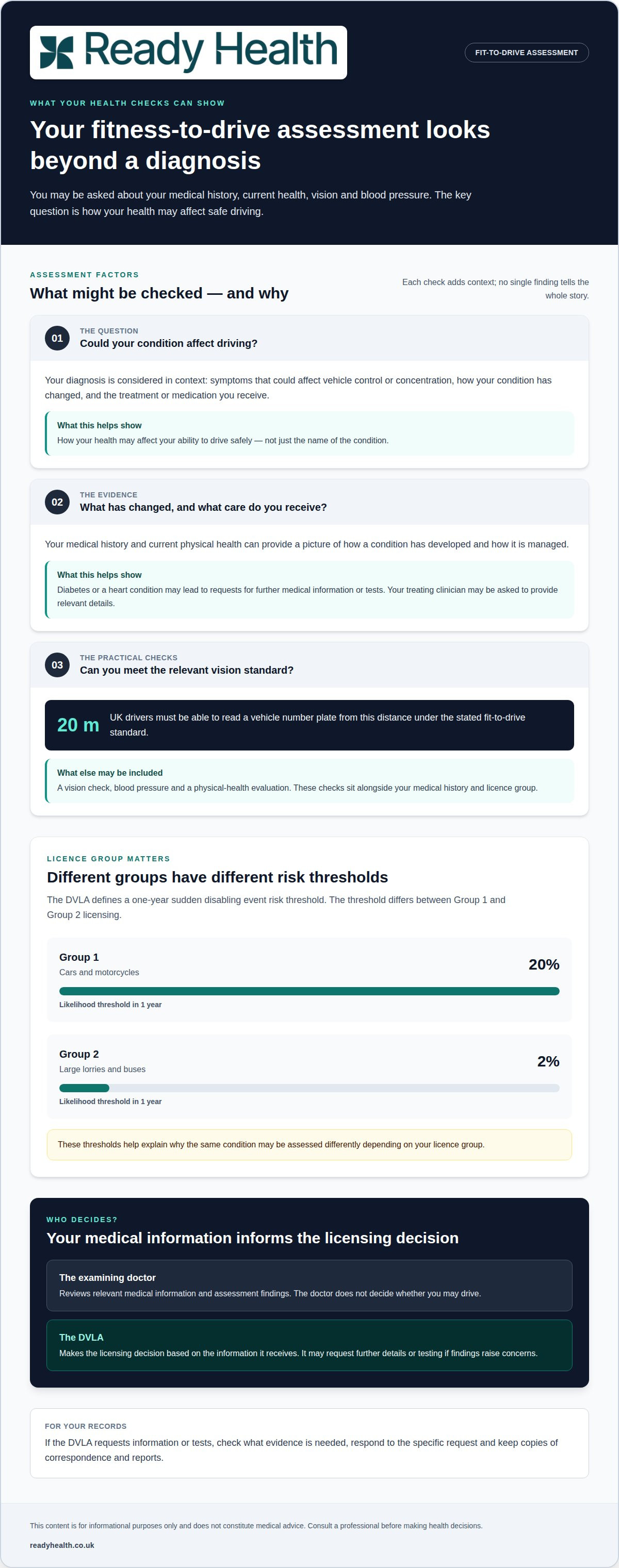
A fitness assessment considers how your health affects your ability to drive, not just the name of a diagnosis. The examination may cover your medical history, current physical health, vision and blood pressure. These findings help show how you manage the demands of driving and whether further information is needed.
Your medical history can show how a condition has changed and what treatment you receive. For example, diabetes or a heart condition may lead to requests for more information or testing. The key issue is how the condition affects your ability to drive safely, including whether symptoms could interfere with vehicle control or concentration. Details of your medication also provide useful context.
Vision is another practical factor. UK drivers must be able to read a vehicle number plate from 20 metres under the stated fit-to-drive standard. An assessment may include a vision check, alongside blood pressure and a physical-health evaluation. These checks contribute to the overall picture; they are not a substitute for considering your medical history or the relevant licensing group.
The medical standards differ between Group 1, covering cars and motorcycles, and Group 2, covering large lorries and buses. The DVLA defines a sudden disabling event risk threshold of 20% likelihood in 1 year for Group 1 licensing, compared with 2% likelihood in 1 year for Group 2. These thresholds help explain why the same condition may be assessed differently across licence groups.
A diagnosis such as dementia can prompt questions about safe driving and whether further assessment is needed. A driving assessment may help explore whether you can continue driving safely after diagnosis. The clinician reviews relevant health evidence, while the licensing process determines how it affects your driving entitlement.
Medical history, vision and blood pressure checks
A driver medical is a structured review of your health information and the required paperwork. For a D4 assessment, the completed form and clinical findings help provide a clear record for the licensing process.
Medical History Review
Prepare a concise account of your medical history, including diagnoses, treatment and recent changes. Dates and sequence can help the doctor understand how your health has developed, especially if your symptoms or treatment have changed since earlier records were made.
Bring details of your medication and existing conditions. If you take several medicines, a written list can help you give accurate names and describe recent changes. Mention any relevant reports or letters you already have so the doctor can consider them alongside your account.
Be open about symptoms that could affect driving, even if they happen only occasionally. Explain when they occur and whether they affect tasks such as concentrating or responding promptly. Clear information helps the clinician document what is relevant to your assessment.
Vision Checks
If you wear glasses or contact lenses for driving, bring them to your appointment. Explain whether you use them all the time or only in particular situations, and mention any recent change in your vision or prescription.
A medical assessment does not replace ongoing eye care. If you have a concern about your sight outside the driver medical, seek appropriate advice from an eye-care professional. Describe any visual symptoms to the clinician conducting the assessment, including when you notice them and how they affect everyday activities.
Before attending, organise your photo identification, required DVLA paperwork, medication details and relevant health information. This can make it easier to complete the assessment accurately and avoid overlooking useful records. If you need to arrange an appointment, book a driver medical assessment and bring the details that relate to your case.
Ready Health: Medical Reports & Occupational Assessments
Ready Health provides Fit to Drive Assessments for people who need a medical assessment related to driving or licensing. Its medical reports and occupational services also include Pre-Employment Medicals, Taxi Medicals, Visa Medicals and PIP Reports, so you can choose an assessment suited to your purpose.
If you need broader clinical support alongside a report, you can book a Private GP Consultation (15 Minutes) or Private GP Consultation (30 Minutes). A GP consultation can give you an opportunity to discuss your health concerns and the next appropriate step.
Contact Ready Health to discuss a fit-to-drive assessment or another relevant medical report.
Take a considered next step
A fit-to-drive medical assessment in Leigh can provide medical information for a driving or licensing decision. Before booking, consider the purpose of the assessment and gather any relevant documents. A clear reason for the appointment helps you discuss the right details with the healthcare professional.
If you’d like to talk through your next step, contact Ready Health to discuss an assessment. You can also raise wider health concerns during a suitable private GP consultation.
This content is for informational purposes only and does not constitute medical advice. Consult a healthcare professional before making health decisions, so you can move forward with informed support.
Frequently Asked Questions
How can you check if you’re fit to drive?
Notice whether a change in your health is affecting everyday driving tasks, such as staying focused or reacting smoothly. If you have a physical disability or have become less able after a stroke, a driving assessment may help explore whether vehicle modifications could support your needs. This helps assess your ability behind the wheel using practical tasks, rather than relying only on how you feel at home.
Group 1 and Group 2 driving standards: what’s the difference?
Check the vehicle categories on your driving licence to identify the entitlement you hold. Category C relates to lorries, while category D relates to buses; both fall within Group 2. If you drive more than one vehicle type, note each relevant category when preparing for an application or renewal, so the medical paperwork corresponds to the entitlement you need.
What does “fit to drive” mean?
Fitness to drive concerns whether your health allows you to manage the practical demands of driving, not whether you have a particular diagnosis. For example, a physical change may affect how you operate a vehicle, while a suitable modification could be worth exploring. Fitness is considered in relation to driving tasks and the relevant licence requirements, not as a general measure of health.
What job roles require a driver medical?
Driver medicals are relevant to some professional driving roles, including driving lorries, buses, coaches or taxis. A separate situation arises if police offer you an alternative to prosecution that involves a Fitness to Drive assessment. In that case, you need a police incident number before the police contact you about booking the assessment.
What medical conditions can stop you from driving?
A diagnosis does not, by itself, explain how someone manages every driving task. The practical question is whether its effects interfere with safe vehicle use. For instance, a physical disability or reduced ability after a stroke may prompt consideration of vehicle modifications, rather than an assumption that driving must stop. Discuss changes in function with a healthcare professional and follow any instructions relevant to your licence.
Which documents and medical records should I bring to a driver medical assessment?
If your assessment follows a police offer of an alternative to prosecution, have your police incident number available. The police use it before contacting you about booking. For other appointments, bring paperwork relevant to your assessment and organise records that explain its purpose. Keeping documents together makes it easier to provide the right information during your appointment.

Article by
Shamir Patel
Shamir Patel is a UK-based Clinical Pharmacist and Independent Prescriber with a specialist focus on ADHD and weight management.
He is the Registered CQC Manager at Ready Health Medical Clinic, where he leads the development and delivery of safe, patient-centred services across ADHD assessment and treatment, weight loss programmes, and general medical care.
With a career spanning nearly three decades since qualifying in 1995, Shamir brings extensive clinical and operational experience across both community pharmacy and private healthcare.
He also serves as Deputy Superintendent Pharmacist and Lead Prescriber at PillSorted. He oversees high-volume prescribing services. He focuses on GLP-1 weight loss treatments and clinical governance.
Shamir is a SCOPE-accredited obesity specialist and has a strong interest in improving access to evidence-based ADHD care. He is known for his structured, guideline-driven approach, aligning his clinical practice with NICE recommendations and regulatory standards set by the GPhC and CQC.
Alongside his clinical work, Shamir is actively involved in mentoring prescribing pharmacists, developing standard operating procedures, and contributing to service innovation within digital and community healthcare settings. His work reflects a commitment to safe prescribing, patient education, and improving outcomes through practical, accessible care.
Disclaimer
The information on this website is provided for general educational and informational purposes only and is not intended as medical advice, diagnosis, or treatment. Articles reflect general guidance and may not be suitable for your individual circumstances. You should always seek advice from a qualified healthcare professional before starting, stopping, or changing any treatment, medication, or healthcare plan. While we aim to keep our content accurate and up to date, Ready Health makes no guarantees about the completeness, accuracy, or suitability of the information provided. Reliance on any information on this site is entirely at your own risk. If you have concerns about your health, please book an appointment with a suitably qualified clinician. In an emergency, contact 999 or attend your nearest A&E department.
Frequently asked questions
How can you check if you’re fit to drive?
Notice whether a change in your health is affecting everyday driving tasks, such as staying focused or reacting smoothly. If you have a physical disability or have become less able after a stroke, a driving assessment may help explore whether vehicle modifications could support your needs. This helps assess your ability behind the wheel using practical tasks, rather than relying only on how you feel at home.
Group 1 and Group 2 driving standards: what’s the difference?
Check the vehicle categories on your driving licence to identify the entitlement you hold. Category C relates to lorries, while category D relates to buses; both fall within Group 2. If you drive more than one vehicle type, note each relevant category when preparing for an application or renewal, so the medical paperwork corresponds to the entitlement you need.
What does “fit to drive” mean?
Fitness to drive concerns whether your health allows you to manage the practical demands of driving, not whether you have a particular diagnosis. For example, a physical change may affect how you operate a vehicle, while a suitable modification could be worth exploring. Fitness is considered in relation to driving tasks and the relevant licence requirements, not as a general measure of health.
What job roles require a driver medical?
Driver medicals are relevant to some professional driving roles, including driving lorries, buses, coaches or taxis. A separate situation arises if police offer you an alternative to prosecution that involves a Fitness to Drive assessment. In that case, you need a police incident number before the police contact you about booking the assessment.
What medical conditions can stop you from driving?
A diagnosis does not, by itself, explain how someone manages every driving task. The practical question is whether its effects interfere with safe vehicle use. For instance, a physical disability or reduced ability after a stroke may prompt consideration of vehicle modifications, rather than an assumption that driving must stop. Discuss changes in function with a healthcare professional and follow any instructions relevant to your licence.
Which documents and medical records should I bring to a driver medical assessment?
If your assessment follows a police offer of an alternative to prosecution, have your police incident number available. The police use it before contacting you about booking. For other appointments, bring paperwork relevant to your assessment and organise records that explain its purpose. Keeping documents together makes it easier to provide the right information during your appointment.

Related articles...

Nov 10, 2026
HGV driver medical near Bolton: what to bring and expectWhat matters most at an HGV medical is arriving prepared...

Nov 09, 2026
Cost of private TRT UK: treatment prices and follow-up costsHow often will you need blood tests and reviews while...

Nov 08, 2026
Private Mole Check in Skelmersdale: Prices and What to ExpectCould a closer look at a changing mole help you...