October 18, 2026
Medical Weight Loss Clinic in Wigan: Understand Your Options and Next Steps

Could the right next step be a conversation, not a prescription? If you’re weighing conflicting advice and wondering whether clinical support may suit you, a medical weight loss clinic Wigan can help you explore your options with a clinician. At Ready Health in Standish, you can discuss your circumstances and learn what an assessment may involve.
This guide explains how medical weight management works, what information to prepare and how to approach your next steps with confidence.
Key Takeaways
- A medical weight loss clinic Wigan can help you discuss your health, daily routines and possible support with a clinician.
- Preparing details about your medical history, current medicines and previous approaches can make an assessment more useful.
- Lifestyle guidance, private clinical assessment and NHS support are different routes. The right option depends on your circumstances.
- An assessment is separate from deciding whether to use medication. Suitability should be discussed with a clinician.
- Ready Health provides weight-management consultations at its Standish clinic for people in Wigan and nearby communities.
Table of Contents
- What does a medical weight loss clinic in Wigan do?
- What happens during a medical weight loss assessment?
- Lifestyle support, medicines or NHS care: how do the options differ?
- How can you prepare for safe, sustainable weight-management support?
- Explore weight management support at Ready Health in Standish
What does a medical weight loss clinic in Wigan do?
A medical weight loss clinic Wigan provides clinician-led assessment and support, rather than a guaranteed result or a one-size-fits-all diet plan. A consultation gives you time to discuss your health and circumstances with a clinician and consider suitable next steps. The conversation can include your activity, daily routines and any weight-related health concerns, as well as food choices.
That wider context matters. Eating patterns and activity are part of weight management, but they sit alongside factors such as your health history and lifestyle. A clinician can help you explore how these areas relate to your goals and discuss possible approaches. Medication may be considered as part of a wider plan for some people, but an appointment does not guarantee a prescription or a particular outcome.
Weight loss can refer to intentional or unintentional changes in body weight, and may involve different methods, including medical treatment. A clinic consultation focuses on your circumstances rather than assuming general guidance applies equally to everyone. It can also help you distinguish a considered clinical discussion from online claims that make quick results sound certain.
How is medical weight management different from a diet plan?
A general diet plan may offer useful ideas, and self-guided habits can be a meaningful part of your approach. A clinical discussion adds an opportunity to talk through your personal health context and consider what support may be appropriate for you. Suitability and next steps depend on individual assessment, so the conversation should not begin with an assumption that medication is needed.
Who might consider a weight-management consultation in Wigan?
You might consider a consultation if you’re looking for structured support or want to discuss how your weight may relate to your health. Ready Health’s weight-management service is aimed at people with obesity and refers to a BMI over 30. BMI, or body mass index, is a measure based on height and weight; it is not a complete assessment of health or personal circumstances.
This service focus can help you understand who the consultation is intended for, but BMI alone does not determine the outcome of an assessment. Medical intervention is not suitable for everyone. A clinician can discuss your situation and whether further support may be appropriate, without treating a single measurement as the whole picture.
Ready Health provides weight-management consultations at its clinic in Standish, serving people in Wigan and nearby communities. You can use the appointment to talk through your concerns and explore possible approaches with a clinician. The aim is an individual discussion, not pressure to follow a particular plan.
What happens during a medical weight loss assessment?
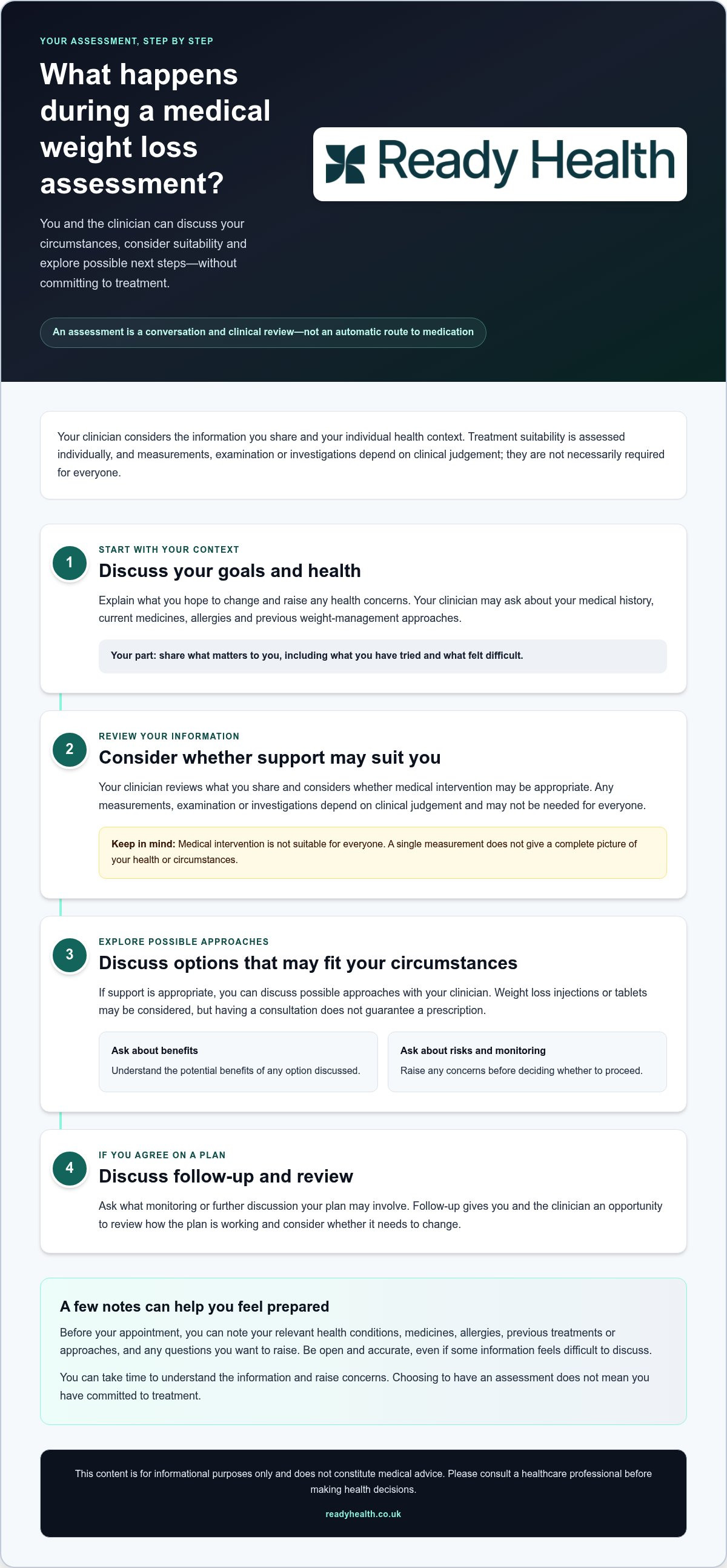
An assessment gives you and the clinician time to understand what you’re looking for and consider possible next steps. It is a conversation and clinical review, not an automatic route to medication. Treatment suitability is determined through individual clinical assessment.
The discussion may follow a clear sequence:
- Discuss your goals and health context. Explain what you hope to change and raise any health concerns. The clinician may ask about your medical history, current medicines, allergies and previous weight-management approaches.
- Consider suitability. The clinician reviews the information you share and considers whether medical intervention may be appropriate. Any measurements, examination or investigations depend on clinical judgement and are not necessarily required for everyone.
- Explore possible options. If support is appropriate, you can discuss approaches that may fit your circumstances. Weight loss injections or tablets may be considered, but a consultation does not guarantee a prescription.
- Discuss follow-up. If you agree on a plan, ask what monitoring or further discussion it may involve. Follow-up gives you and the clinician an opportunity to review how the plan is working and consider whether it needs to change.
This considered approach reflects the need to look at more than one factor. The NICE guidelines on obesity management cover assessment and different forms of support. Your clinician can discuss how relevant guidance and your own health context inform the options available to you.
What information should you prepare before the appointment?
A few notes can help you feel prepared. Record relevant health conditions, medicines, allergies and previous treatments or approaches you’ve tried. If you’re comfortable, note what felt manageable and what proved difficult.
It can also help to write down your questions and what you hope to achieve. Be open and accurate, even if some information feels difficult to discuss. This gives the clinician a clearer basis for considering options safely and helps ensure the conversation reflects your needs rather than assumptions.
How does a clinician discuss eligibility and treatment choices?
The clinician may explain whether medical intervention appears appropriate and what factors inform that view. If injections or tablets are discussed, ask about potential benefits, risks and monitoring before making a decision. You can take time to understand the information and raise concerns; choosing to have an assessment does not mean you’ve committed to treatment.
If you’re considering an assessment, you can book a weight-management consultation with Ready Health. The appointment is an opportunity to discuss your circumstances and explore suitable next steps with a clinician.
Lifestyle support, medicines or NHS care: how do the options differ?
These routes can offer different kinds of support, and they are not interchangeable or suitable for everyone. You can seek an assessment to understand your options without deciding in advance to use medication. A clinician can help you consider how your health, preferences and circumstances may shape the next step.
| Route | What it may involve | What to keep in mind |
|---|---|---|
| Lifestyle guidance | Practical ideas for eating, movement and everyday habits, which may be self-guided or offered through a support service. | It can help you explore routine changes, but general advice will not account for every person’s health context. |
| Private clinical assessment | A clinician discusses your health and goals, assesses whether medical intervention may be appropriate, and explores possible options. | An assessment is a discussion, not a commitment to take medicine or a promise of a particular result. |
| NHS support | Support may be available through NHS services, depending on current guidance and local pathways. | Access criteria and arrangements can change. Use current NHS and local information for the latest details. |
The table is a starting point, not a ranking. Your next step might be lifestyle guidance, a clinical conversation, NHS support, or a combination discussed with a healthcare professional. The NHS weight management advice includes information on daily habits and NHS support. For current eligibility and local routes, use up-to-date official guidance rather than relying on older online summaries.
What role can nutrition, activity and behaviour changes play?
Everyday routines can be part of a wider discussion, whether or not medicine is considered. You might talk about planning meals around your usual week, finding movement that feels manageable, or setting a realistic goal such as building a consistent routine. These are examples to explore, not a prescribed diet or exercise plan. A clinician can help you consider what may suit your health and circumstances.
How should you think about weight-loss medicines?
Medicines are not a shortcut or a standalone promise. A clinician needs to assess whether a medicine may be suitable for you and discuss possible benefits, risks, side effects and monitoring. Mounjaro, Wegovy and semaglutide are named in Ready Health’s weight-management information; this does not mean a particular medicine is suitable for you or will be prescribed. Treatment decisions should be based on an individual discussion.
If medicine is being considered, ask what monitoring may involve and what the plan would be if treatment needs to change or stop. You can explore a weight-management consultation with Ready Health as a first step to discuss your circumstances and possible support.
How can you prepare for safe, sustainable weight-management support?
A little preparation can help you make good use of an appointment and leave with a clearer understanding of your options. You do not need to have a perfect plan or know which treatment you want. Be ready to describe what matters to you and ask for explanations if anything is unclear.
Before you meet the clinician, make a short note of:
- Your health history: relevant conditions, allergies and any previous weight-management treatment.
- Your medicines: current prescribed medicines and any other treatments or supplements you use.
- Your goals: what you hope to work towards, including health or everyday-life concerns.
- Your questions: anything you want to understand about possible options, risks or follow-up.
Share information as accurately as you can, including details you may feel unsure about raising. This helps the clinician consider your circumstances safely. Progress and care plans vary, so be cautious of anyone promising a specific result or a quick fix. A useful plan should be discussed with you and reviewed in light of how your health and circumstances develop.
What questions can you ask at your appointment?
You could ask which options may fit your circumstances and why, what benefits and risks are relevant, and what monitoring or follow-up might involve. If medicine is discussed, ask what to expect if you experience side effects or your treatment needs to change. You can also raise concerns about eating patterns, mood or weight-related health, even if you’re not sure how they connect.
There’s no need to leave with every answer at once. Ask the clinician to explain unfamiliar terms in plain language, and make sure you understand any agreed next steps. If you need time to consider a recommendation, say so. A decision about treatment should follow the clinical discussion, not pressure or assumptions.
How can you make a plan realistic for everyday life?
A plan is more likely to feel manageable if it reflects your actual week. Think about work hours, family responsibilities, mobility, food preferences and the routines you already have. For example, a small change to how you plan meals may feel more practical than a complete overhaul. Your clinician can discuss approaches that account for your circumstances rather than relying on a one-size-fits-all target.
Setbacks can be part of working out what is sustainable. A disrupted routine does not automatically mean support has failed; it may be a reason to review what’s getting in the way and adjust the plan with your clinician. Success need not be defined only by a number on the scales. Your priorities and progress should be discussed in a way that reflects your health and wellbeing.
Safety reminder: Do not obtain weight-loss medicines from unregulated sellers. Discuss any medicine you’re considering with a clinician, including potential side effects, monitoring and what to do if treatment changes. If you’d like to talk through your circumstances and prepare a suitable plan, book a weight-management consultation with Ready Health.
Explore weight management support at Ready Health in Standish
If you’re looking for a medical weight loss clinic Wigan, Ready Health provides weight-management consultations at its Standish clinic for people in Wigan and nearby communities. The clinic serves people across the local area, including Shevington, Standish Lower Ground, Boar's Head, Wrightington, Appley Bridge, Chorley, Skelmersdale, Orrell, Ashton-in-Makerfield, Bolton, Leigh, Preston, Southport and St Helens. You can discuss your concerns with a clinician, understand what an assessment may involve and explore potential next steps in a private clinical setting.
The consultation is a chance to talk through your health and circumstances, not a commitment to use medication. The clinician considers whether medical intervention may be appropriate for you. It is not suitable for everyone, and no particular treatment or result is guaranteed.
What can you expect from Ready Health’s local service?
Your consultation takes place face-to-face at the Standish clinic. You can explain what you’re hoping to address and discuss the options that may be relevant to you. Ready Health provides weight-management consultations and medical weight-management support, with the approach shaped around your clinical needs.
Weight loss injections and tablets may be discussed where clinically appropriate. Examples named in the service information include Mounjaro, Wegovy and semaglutide. These are possibilities for clinical discussion, not a guaranteed prescription; suitability depends on an individual assessment, and treatment is not a promise of a particular outcome.
If you’re also considering support for other health concerns, explore how Ready Health’s private healthcare may fit alongside your wider care. Your weight-management appointment can focus on your questions and the options relevant to your circumstances.
How do you take the next step?
You do not need to decide on a treatment before arranging an assessment. You can book a consultation to discuss whether weight-management support may suit you and what the clinician may recommend as a next step. It may help to bring notes on your health history, current medicines, previous approaches and questions you want answered.
Before making a decision, take time to understand the proposed plan, any relevant risks and how progress may be reviewed. You can also review Ready Health’s service fees as part of planning your care. The consultation is an opportunity to make an informed choice with a clinician, whether or not medical intervention is considered appropriate.
Take your next step with confidence
You do not have to settle every question before speaking to a clinician. A conversation can help you clarify what matters to you, understand whether an assessment may be appropriate and decide what feels like a manageable next step. Choosing to explore support does not mean you’ve committed to a particular treatment.
If you’re considering a medical weight loss clinic Wigan, use your appointment to ask questions and share what you want your care to take into account. The aim is to make an informed decision that reflects your health and everyday life, with professional guidance rather than pressure to pursue a quick fix.
Ready to explore your options? Book a weight-management consultation with Ready Health and start a considered conversation about support that may suit you.
Frequently Asked Questions
Who is eligible for a medical weight loss clinic?
Eligibility depends on the service criteria and your individual circumstances, so a general checklist cannot confirm whether treatment is right for you. Ready Health’s weight-management service is aimed at people with obesity and refers to a BMI over 30. BMI is only one measure, so discuss how the criteria relate to you with a clinician rather than self-diagnosing or ruling yourself out based on online advice.
Can a private clinic prescribe weight loss injections?
A private clinic may prescribe an injection if a clinician considers it appropriate after assessment. A prescription is not automatic. Before agreeing to treatment, ask who will oversee your care, how you can raise concerns and what happens if the treatment plan needs review. These questions can help you understand the clinical support around a prescription, not just the medicine being considered.
What happens at a weight loss consultation?
The appointment is a clinical discussion, and you do not need to arrive knowing which treatment you want. Explain what prompted you to seek support and what you’d like help understanding. If you have a particular concern, such as how your weight affects an everyday activity, mention it. The clinician can help focus the conversation on what matters most to you.
Is medical weight management only about medication?
No. Medication is only one possible element of medical weight management. The wider discussion may include your health priorities and what kind of support feels relevant to them. You can ask about approaches that do not involve medicine, or discuss how a treatment option might fit with other changes you’re considering. The aim is to understand the options, not assume that a prescription is the goal.
Can I access weight loss support through the NHS in Wigan?
NHS support may be available, but the route depends on current local arrangements and your circumstances. Your GP can help you find out which pathway applies. You could ask whether a service accepts self-referrals or requires a referral, and where to find current eligibility information. This helps you identify the appropriate route without relying on outdated descriptions of local provision.
How do I choose a medical weight loss clinic in Wigan?
Ready Health is a CQC-regulated private clinic in Standish, Wigan. When considering whether its service fits your needs, look at what the consultation involves and whether it gives you space to discuss your circumstances before treatment decisions are made. You can also review the clinic’s service and fee information before deciding whether to book.
Are weight loss injections suitable for everyone?
No. An injection may not be suitable for every person, and only a clinician can assess whether it may be appropriate for you. If you’re already using a weight-loss medicine, tell the clinician which one and how you’re taking it. Do not start, stop or change treatment based only on online information; discuss any change with a healthcare professional.
Ready to discuss your options? Book a weight-management consultation with Ready Health.
This content is for informational purposes only and does not constitute medical advice. Consult a professional before making health decisions.

Article by
Shamir Patel
Shamir Patel is a UK-based Clinical Pharmacist and Independent Prescriber with a specialist focus on ADHD and weight management.
He is the Registered CQC Manager at Ready Health Medical Clinic, where he leads the development and delivery of safe, patient-centred services across ADHD assessment and treatment, weight loss programmes, and general medical care.
With a career spanning nearly three decades since qualifying in 1995, Shamir brings extensive clinical and operational experience across both community pharmacy and private healthcare.
He also serves as Deputy Superintendent Pharmacist and Lead Prescriber at PillSorted. He oversees high-volume prescribing services. He focuses on GLP-1 weight loss treatments and clinical governance.
Shamir is a SCOPE-accredited obesity specialist and has a strong interest in improving access to evidence-based ADHD care. He is known for his structured, guideline-driven approach, aligning his clinical practice with NICE recommendations and regulatory standards set by the GPhC and CQC.
Alongside his clinical work, Shamir is actively involved in mentoring prescribing pharmacists, developing standard operating procedures, and contributing to service innovation within digital and community healthcare settings. His work reflects a commitment to safe prescribing, patient education, and improving outcomes through practical, accessible care.
Disclaimer
The information on this website is provided for general educational and informational purposes only and is not intended as medical advice, diagnosis, or treatment. Articles reflect general guidance and may not be suitable for your individual circumstances. You should always seek advice from a qualified healthcare professional before starting, stopping, or changing any treatment, medication, or healthcare plan. While we aim to keep our content accurate and up to date, Ready Health makes no guarantees about the completeness, accuracy, or suitability of the information provided. Reliance on any information on this site is entirely at your own risk. If you have concerns about your health, please book an appointment with a suitably qualified clinician. In an emergency, contact 999 or attend your nearest A&E department.
Frequently asked questions
How is medical weight management different from a diet plan?
A general diet plan may offer useful ideas, and self-guided habits can be a meaningful part of your approach. A clinical discussion adds an opportunity to talk through your personal health context and consider what support may be appropriate for you. Suitability and next steps depend on individual assessment, so the conversation should not begin with an assumption that medication is needed.
Who might consider a weight-management consultation in Wigan?
You might consider a consultation if you’re looking for structured support or want to discuss how your weight may relate to your health. Ready Health’s weight-management service is aimed at people with obesity and refers to a BMI over 30. BMI, or body mass index, is a measure based on height and weight; it is not a complete assessment of health or personal circumstances. This service focus can help you understand who the consultation is intended for, but BMI alone does not determine the outcome of an assessment. Medical intervention is not suitable for everyone. A clinician can discuss your situation and whether further support may be appropriate, without treating a single measurement as the whole picture. Ready Health provides weight-management consultations at its clinic in Standish, serving people in Wigan and nearby communities. You can use the appointment to talk through your concerns and explore possible approaches with a clinician. The aim is an individual discussion, not pressure to follow a particular plan. An assessment gives you and the clinician time to understand what you’re looking for and consider possible next steps. It is a conversation and clinical review, not an automatic route to medication. Treatment suitability is determined through individual clinical assessment. The discussion may follow a clear sequence: This considered approach reflects the need to look at more than one factor. The NICE guidelines on obesity management cover assessment and different forms of support. Your clinician can discuss how relevant guidance and your own health context inform the options available to you.
What information should you prepare before the appointment?
A few notes can help you feel prepared. Record relevant health conditions, medicines, allergies and previous treatments or approaches you’ve tried. If you’re comfortable, note what felt manageable and what proved difficult. It can also help to write down your questions and what you hope to achieve. Be open and accurate, even if some information feels difficult to discuss. This gives the clinician a clearer basis for considering options safely and helps ensure the conversation reflects your needs rather than assumptions.
How does a clinician discuss eligibility and treatment choices?
The clinician may explain whether medical intervention appears appropriate and what factors inform that view. If injections or tablets are discussed, ask about potential benefits, risks and monitoring before making a decision. You can take time to understand the information and raise concerns; choosing to have an assessment does not mean you’ve committed to treatment. If you’re considering an assessment, you can book a weight-management consultation with Ready Health. The appointment is an opportunity to discuss your circumstances and explore suitable next steps with a clinician. These routes can offer different kinds of support, and they are not interchangeable or suitable for everyone. You can seek an assessment to understand your options without deciding in advance to use medication. A clinician can help you consider how your health, preferences and circumstances may shape the next step. The table is a starting point, not a ranking. Your next step might be lifestyle guidance, a clinical conversation, NHS support, or a combination discussed with a healthcare professional. The NHS weight management advice includes information on daily habits and NHS support. For current eligibility and local routes, use up-to-date official guidance rather than relying on older online summaries.
What role can nutrition, activity and behaviour changes play?
Everyday routines can be part of a wider discussion, whether or not medicine is considered. You might talk about planning meals around your usual week, finding movement that feels manageable, or setting a realistic goal such as building a consistent routine. These are examples to explore, not a prescribed diet or exercise plan. A clinician can help you consider what may suit your health and circumstances.
How should you think about weight-loss medicines?
Medicines are not a shortcut or a standalone promise. A clinician needs to assess whether a medicine may be suitable for you and discuss possible benefits, risks, side effects and monitoring. Mounjaro, Wegovy and semaglutide are named in Ready Health’s weight-management information; this does not mean a particular medicine is suitable for you or will be prescribed. Treatment decisions should be based on an individual discussion. If medicine is being considered, ask what monitoring may involve and what the plan would be if treatment needs to change or stop. You can explore a weight-management consultation with Ready Health as a first step to discuss your circumstances and possible support. A little preparation can help you make good use of an appointment and leave with a clearer understanding of your options. You do not need to have a perfect plan or know which treatment you want. Be ready to describe what matters to you and ask for explanations if anything is unclear. Before you meet the clinician, make a short note of: Share information as accurately as you can, including details you may feel unsure about raising. This helps the clinician consider your circumstances safely. Progress and care plans vary, so be cautious of anyone promising a specific result or a quick fix. A useful plan should be discussed with you and reviewed in light of how your health and circumstances develop.
What questions can you ask at your appointment?
You could ask which options may fit your circumstances and why, what benefits and risks are relevant, and what monitoring or follow-up might involve. If medicine is discussed, ask what to expect if you experience side effects or your treatment needs to change. You can also raise concerns about eating patterns, mood or weight-related health, even if you’re not sure how they connect. There’s no need to leave with every answer at once. Ask the clinician to explain unfamiliar terms in plain language, and make sure you understand any agreed next steps. If you need time to consider a recommendation, say so. A decision about treatment should follow the clinical discussion, not pressure or assumptions.
How can you make a plan realistic for everyday life?
A plan is more likely to feel manageable if it reflects your actual week. Think about work hours, family responsibilities, mobility, food preferences and the routines you already have. For example, a small change to how you plan meals may feel more practical than a complete overhaul. Your clinician can discuss approaches that account for your circumstances rather than relying on a one-size-fits-all target. Setbacks can be part of working out what is sustainable. A disrupted routine does not automatically mean support has failed; it may be a reason to review what’s getting in the way and adjust the plan with your clinician. Success need not be defined only by a number on the scales. Your priorities and progress should be discussed in a way that reflects your health and wellbeing. Safety reminder: Do not obtain weight-loss medicines from unregulated sellers. Discuss any medicine you’re considering with a clinician, including potential side effects, monitoring and what to do if treatment changes. If you’d like to talk through your circumstances and prepare a suitable plan, book a weight-management consultation with Ready Health. If you’re looking for a medical weight loss clinic Wigan, Ready Health provides weight-management consultations at its Standish clinic for people in Wigan and nearby communities. The clinic serves people across the local area, including Shevington, Standish Lower Ground, Boar's Head, Wrightington, Appley Bridge, Chorley, Skelmersdale, Orrell, Ashton-in-Makerfield, Bolton, Leigh, Preston, Southport and St Helens. You can discuss your concerns with a clinician, understand what an assessment may involve and explore potential next steps in a private clinical setting. The consultation is a chance to talk through your health and circumstances, not a commitment to use medication. The clinician considers whether medical intervention may be appropriate for you. It is not suitable for everyone, and no particular treatment or result is guaranteed.
What can you expect from Ready Health’s local service?
Your consultation takes place face-to-face at the Standish clinic. You can explain what you’re hoping to address and discuss the options that may be relevant to you. Ready Health provides weight-management consultations and medical weight-management support, with the approach shaped around your clinical needs. Weight loss injections and tablets may be discussed where clinically appropriate. Examples named in the service information include Mounjaro, Wegovy and semaglutide. These are possibilities for clinical discussion, not a guaranteed prescription; suitability depends on an individual assessment, and treatment is not a promise of a particular outcome. If you’re also considering support for other health concerns, explore how Ready Health’s private healthcare may fit alongside your wider care. Your weight-management appointment can focus on your questions and the options relevant to your circumstances.
How do you take the next step?
You do not need to decide on a treatment before arranging an assessment. You can book a consultation to discuss whether weight-management support may suit you and what the clinician may recommend as a next step. It may help to bring notes on your health history, current medicines, previous approaches and questions you want answered. Before making a decision, take time to understand the proposed plan, any relevant risks and how progress may be reviewed. You can also review Ready Health’s service fees as part of planning your care. The consultation is an opportunity to make an informed choice with a clinician, whether or not medical intervention is considered appropriate. You do not have to settle every question before speaking to a clinician. A conversation can help you clarify what matters to you, understand whether an assessment may be appropriate and decide what feels like a manageable next step. Choosing to explore support does not mean you’ve committed to a particular treatment. If you’re considering a medical weight loss clinic Wigan, use your appointment to ask questions and share what you want your care to take into account. The aim is to make an informed decision that reflects your health and everyday life, with professional guidance rather than pressure to pursue a quick fix. Ready to explore your options? Book a weight-management consultation with Ready Health and start a considered conversation about support that may suit you.
Who is eligible for a medical weight loss clinic?
Eligibility depends on the service criteria and your individual circumstances, so a general checklist cannot confirm whether treatment is right for you. Ready Health’s weight-management service is aimed at people with obesity and refers to a BMI over 30. BMI is only one measure, so discuss how the criteria relate to you with a clinician rather than self-diagnosing or ruling yourself out based on online advice.
Can a private clinic prescribe weight loss injections?
A private clinic may prescribe an injection if a clinician considers it appropriate after assessment. A prescription is not automatic. Before agreeing to treatment, ask who will oversee your care, how you can raise concerns and what happens if the treatment plan needs review. These questions can help you understand the clinical support around a prescription, not just the medicine being considered.
What happens at a weight loss consultation?
The appointment is a clinical discussion, and you do not need to arrive knowing which treatment you want. Explain what prompted you to seek support and what you’d like help understanding. If you have a particular concern, such as how your weight affects an everyday activity, mention it. The clinician can help focus the conversation on what matters most to you.
Is medical weight management only about medication?
No. Medication is only one possible element of medical weight management. The wider discussion may include your health priorities and what kind of support feels relevant to them. You can ask about approaches that do not involve medicine, or discuss how a treatment option might fit with other changes you’re considering. The aim is to understand the options, not assume that a prescription is the goal.
Can I access weight loss support through the NHS in Wigan?
NHS support may be available, but the route depends on current local arrangements and your circumstances. Your GP can help you find out which pathway applies. You could ask whether a service accepts self-referrals or requires a referral, and where to find current eligibility information. This helps you identify the appropriate route without relying on outdated descriptions of local provision.
How do I choose a medical weight loss clinic in Wigan?
Ready Health is a CQC-regulated private clinic in Standish, Wigan. When considering whether its service fits your needs, look at what the consultation involves and whether it gives you space to discuss your circumstances before treatment decisions are made. You can also review the clinic’s service and fee information before deciding whether to book.
Are weight loss injections suitable for everyone?
No. An injection may not be suitable for every person, and only a clinician can assess whether it may be appropriate for you. If you’re already using a weight-loss medicine, tell the clinician which one and how you’re taking it. Do not start, stop or change treatment based only on online information; discuss any change with a healthcare professional. Ready to discuss your options? Book a weight-management consultation with Ready Health. This content is for informational purposes only and does not constitute medical advice. Consult a professional before making health decisions.

Related articles...

Oct 20, 2026
Hyaluronic acid injection for knee arthritis in Leigh: reliefA hyaluronic acid injection for knee arthritis in Leigh is...

Oct 19, 2026
Fast MRI Referral in Wigan: How to Arrange a Private ScanWhat if the first step towards an MRI isn’t booking...

Oct 17, 2026
Specialist Consultation for Burnout in Wigan: Your Next StepsCould ongoing exhaustion be burnout, or might another health concern...