November 19, 2026
Endometriosis specialist referral in Chorley

People in the UK may wait an average of 7 to 10 years from their first endometriosis symptoms to diagnosis. If you’re looking for an endometriosis specialist referral in Chorley, understanding the referral route can help you take a clear next step.
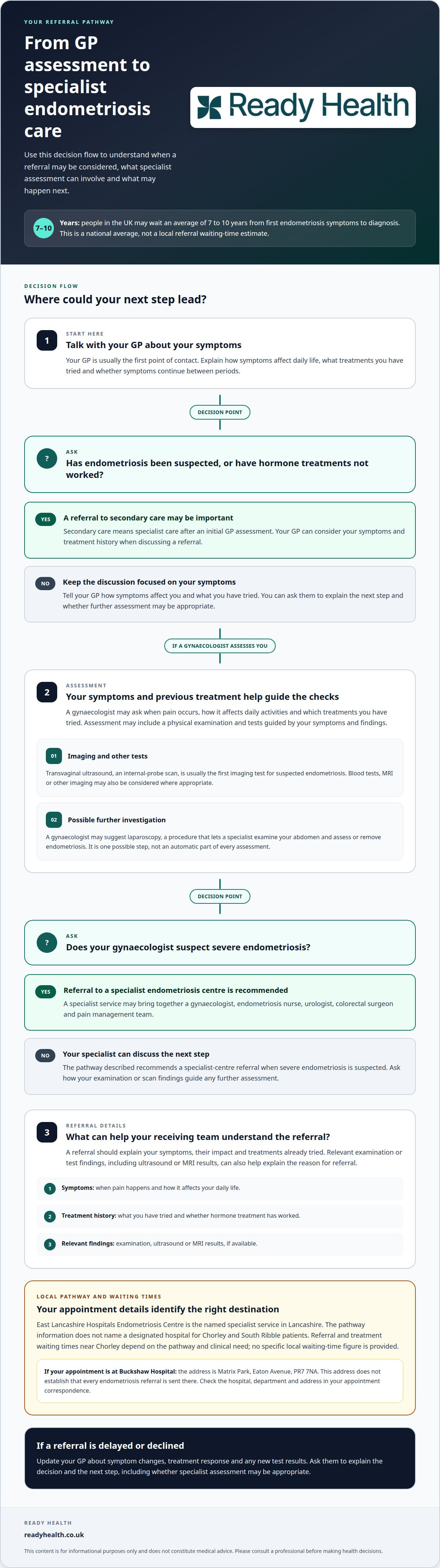
Your GP is usually the first point of contact if endometriosis is suspected. A referral for specialist care may be important when your doctor suspects endometriosis or hormone treatments have not worked. Assessment may include an examination and imaging, such as an ultrasound or MRI, depending on your symptoms.
This guide explains what to expect from assessment and referral to an endometriosis centre, and how specialists serving Lancashire fit into the pathway. You’ll also find information about the local clinic location and how a private GP consultation or referral letter may support your next step. The aim is to help you understand the options, prepare for a conversation about your symptoms and make a more informed decision about care.
Key Takeaways
- Your GP is usually the first contact if you suspect endometriosis. Referral to specialist care may be considered when symptoms or treatment response indicate it.
- Assessment may include an examination and imaging, such as ultrasound or MRI, guided by your symptoms.
- If severe endometriosis is suspected, referral to a specialist centre can connect you with a broader team and specialist investigations.
- Find out where local appointments take place and which specialists serve Lancashire so you can understand the next steps in your care.
Table of Contents
Endometriosis diagnosis and specialist assessment
In the UK, people may wait an average of 7 to 10 years from first symptoms to diagnosis. At a specialist appointment, a gynaecologist may examine you, arrange tests and discuss treatment options such as pain relief or hormone treatments.
Diagnosis and assessment
Assessment starts with your symptoms, their effect on daily life and any previous treatment. A gynaecologist may carry out a physical examination and arrange blood tests, ultrasound, MRI or other imaging where appropriate. Transvaginal ultrasound, which uses an internal probe to create images, is usually the first imaging test for suspected endometriosis. Further tests depend on your symptoms and examination findings.
Specialist appointment
Your consultant may ask when pain occurs, how it affects daily activities and which treatments you have tried. Give specific examples, such as pain during periods or symptoms that continue between them. The specialist can explain examination findings, proposed tests and what each test aims to assess. This helps you discuss practical next steps.
Diagnosis and treatment are linked, but assessment also considers how symptoms affect you. A GP may recommend pain medicines such as paracetamol, ibuprofen or mefenamic acid. Hormone options may include the combined contraceptive pill, Mirena intra-uterine system, contraceptive injection or progesterone pills. The suitable approach depends on your symptoms and treatment history.
If further investigation is needed, a gynaecologist may suggest laparoscopy. This procedure allows the specialist to examine your abdomen and assess or remove endometriosis. It is one possible step, not an automatic part of every assessment. Ask how examination or scan findings will guide the next decision, including whether further investigation is appropriate.
Referral to a specialist endometriosis centre
For an endometriosis specialist referral in Chorley, the pathway usually begins with a GP. Referral to secondary care, meaning specialist care after an initial GP assessment, is important when endometriosis is suspected or hormone treatments have not worked. If a gynaecologist suspects severe endometriosis, referral to a specialist endometriosis centre is recommended.
East Lancashire Hospitals Endometriosis Centre is the named specialist service in Lancashire. The pathway information does not specify a designated hospital for Chorley and South Ribble patients, so it is not possible to name one assigned centre. Specialist services may bring together a gynaecologist, endometriosis nurse, urologist, colorectal surgeon and pain management team to coordinate assessment and care.
Referral and treatment waiting times near Chorley depend on the pathway and clinical need. Factors include suspected disease severity, response to hormone treatment and further assessment required. There is no specific local waiting-time figure for an endometriosis specialist referral in Chorley. Your GP can discuss how your symptoms and treatment history inform the referral decision.
The described pathway starts with a GP, rather than direct self-referral to specialist care. At Ready Health in Standish, Wigan, a private GP consultation gives you an opportunity to discuss symptoms and referral needs. The consultation is not specialist-centre care, but a GP can discuss whether a referral letter is appropriate.
A referral should explain your symptoms, their impact and treatments already tried. Relevant examination or test findings, including ultrasound or MRI results, can help the receiving team understand the reason for referral. Tell your GP about persistent symptoms or hormone treatments that have not worked.
If a referral is delayed or declined, update your GP about symptom changes, treatment response and new test results. Ask them to explain the decision and next step, including whether specialist assessment is appropriate. Suspected severe disease is the pathway trigger for referral to a specialist centre; worsening symptoms and ineffective treatment are also relevant to review.
Clinic location
For an appointment near Chorley, use the hospital and department named in your referral or appointment details. Buckshaw Hospital is at Matrix Park, Eaton Avenue, PR7 7NA. This is a specific local address, but it does not establish that every endometriosis referral is sent there. Your appointment correspondence identifies the destination relevant to your care.
A specialist clinic may be at a different hospital from your initial appointment. Before travelling, check the hospital name, department and address in your appointment correspondence. This matters if your care involves separate appointments, such as imaging and a consultant gynaecologist’s review. An assessment appointment does not mean surgery has been planned.
If your appointment is at this unit, include that charge when planning your journey. The Sharoe Green Unit and Buckshaw Hospital are separate destinations, so use the address given for your specific appointment rather than relying on the hospital name alone.
Referral details may involve several services, including imaging, pain management or fertility discussions. Each appointment letter should identify where that part of your care will take place. Keep the correspondence accessible while arranging travel, and use the department and location shown to avoid confusing hospital sites.
If you have information about more than one appointment, check each location separately. An ultrasound appointment and a later specialist review, for example, may have different destinations. Confirm the address printed for each visit and plan your journey accordingly. Clear location details help you reach the right clinic and follow the next step in your diagnosis pathway.
Another possible destination is The Alexandra Hospital, located at Mill Lane, Cheadle, Cheshire, SK8 2PX. Check your appointment correspondence to establish whether this is the site for your visit. Pain management options described for endometriosis include heat, dietary changes, holistic therapies, pain medicines, pelvic health physiotherapy and referral to a specialist pain clinic.
Endometriosis specialists in Lancashire
Highly specialised hospital care for endometriosis can involve several clinical disciplines, particularly when severe disease is suspected. The team may include a gynaecologist, an endometriosis nurse, a urologist, a colorectal surgeon and pain management specialists. It may also provide advanced tests, imaging equipment and fertility services.
East Lancashire Hospitals Endometriosis Centre lists Mr Adnan Ahmed Sheikh, Mr Louis Vitone and Mr Haytham Abudeep as colorectal surgeons. A colorectal surgeon specialises in conditions affecting the bowel and related organs. Their expertise may be relevant when endometriosis affects or involves the bowel, alongside assessment by the gynaecology team.
At an endometriosis centre, specialists consider your symptoms, test findings and the possible extent of disease. The team’s expertise may be relevant if imaging suggests involvement beyond the reproductive organs or symptoms remain difficult to manage. Pain management may form part of care, alongside discussion of surgical treatment where appropriate.
A gynaecologist may suggest laparoscopy, a procedure that uses small incisions and a camera to examine the abdomen. This keyhole operation may help assess endometriosis and allow affected tissue to be removed. Its purpose and scope depend on what the specialist needs to investigate; surgery is not an automatic step for every patient.
Before an appointment, note your symptoms and any treatments you have tried. Bring relevant imaging or test results if available, so the consultant can consider them during the discussion. You can ask which specialists may be involved, whether pelvic organs beyond the reproductive system need assessment, and what the proposed next step involves.
The right pathway depends on clinical findings. Referral to an endometriosis centre is particularly relevant when a gynaecologist suspects severe disease. Understanding the reason for referral can help you see why a particular specialist or investigation is being considered.
Ready Health: Private Referral Letter
Ready Health offers a Private Referral Letter when you need documentation to support a request for specialist assessment. A private GP consultation gives you time to discuss your symptoms, previous investigations and treatment history, and consider whether a referral letter is appropriate.
A consultation may help if you want to discuss ongoing symptoms or organise information for a referral. A letter supports communication about your care, but it does not provide specialist assessment or guarantee acceptance by a particular centre. The GP can explain the letter’s purpose and the next steps available to you.
If you’d like to discuss your referral needs, book an appointment with Ready Health.
Take a considered next step
If you’re considering an endometriosis specialist referral in Chorley, a focused conversation can help you decide what to do next. At Ready Health in Standish, Wigan, you can discuss your symptoms, previous care and referral questions with a GP, then consider whether a Private Referral Letter is appropriate for your circumstances.
Ready Health offers private GP consultations lasting 15 or 30 minutes, giving you time to raise the concerns most relevant to you. A Well Woman Blood Profile is also available, though it is not a substitute for specialist assessment or investigations for suspected endometriosis.
Choose the next step that feels manageable for you. Contact Ready Health to discuss referral options and the support available.
This content is for informational purposes only and does not constitute medical advice. Consult a qualified healthcare professional before making decisions about your health.
Frequently Asked Questions
Do I need a GP referral to see an endometriosis specialist in Chorley?
For NHS specialist care, the pathway usually starts with a GP assessment. If you’re under 18 and endometriosis is suspected, or hormone treatment hasn’t worked, referral may be to an adolescent gynaecologist with a specialist interest in endometriosis. For private care, the referral route depends on the service. A referral letter supports communication but doesn’t guarantee acceptance by a particular specialist.
How do I ask my GP in Chorley for an endometriosis referral?
Explain that you’re concerned about endometriosis and ask to discuss assessment and referral options. Describe how symptoms affect your routine, such as disrupting sleep or making it difficult to work. Ask what the proposed next step is and why. If you have tried treatment, mention what you used and whether it helped, so the discussion reflects your experience.
Can endometriosis symptoms begin with your first period?
Symptoms may appear from your first menstrual period, so you don’t need to wait until adulthood to raise concerns. If you’re a teenager, describe what you’re experiencing to a trusted adult and seek help speaking with a clinician. Suspected endometriosis in someone under 18 may lead to assessment by an adolescent gynaecologist with a specialist interest in the condition.
What should I do if symptoms continue after treatment?
Tell your clinician which symptoms remain and how they affect everyday activities. Explain whether treatment helped, caused problems or made no noticeable difference. This can support a discussion about what to consider next, including whether further assessment is appropriate. If your symptoms change, share the update rather than relying only on an earlier description.

Article by
Shamir Patel
Shamir Patel is a UK-based Clinical Pharmacist and Independent Prescriber with a specialist focus on ADHD and weight management.
He is the Registered CQC Manager at Ready Health Medical Clinic, where he leads the development and delivery of safe, patient-centred services across ADHD assessment and treatment, weight loss programmes, and general medical care.
With a career spanning nearly three decades since qualifying in 1995, Shamir brings extensive clinical and operational experience across both community pharmacy and private healthcare.
He also serves as Deputy Superintendent Pharmacist and Lead Prescriber at PillSorted. He oversees high-volume prescribing services. He focuses on GLP-1 weight loss treatments and clinical governance.
Shamir is a SCOPE-accredited obesity specialist and has a strong interest in improving access to evidence-based ADHD care. He is known for his structured, guideline-driven approach, aligning his clinical practice with NICE recommendations and regulatory standards set by the GPhC and CQC.
Alongside his clinical work, Shamir is actively involved in mentoring prescribing pharmacists, developing standard operating procedures, and contributing to service innovation within digital and community healthcare settings. His work reflects a commitment to safe prescribing, patient education, and improving outcomes through practical, accessible care.
Disclaimer
The information on this website is provided for general educational and informational purposes only and is not intended as medical advice, diagnosis, or treatment. Articles reflect general guidance and may not be suitable for your individual circumstances. You should always seek advice from a qualified healthcare professional before starting, stopping, or changing any treatment, medication, or healthcare plan. While we aim to keep our content accurate and up to date, Ready Health makes no guarantees about the completeness, accuracy, or suitability of the information provided. Reliance on any information on this site is entirely at your own risk. If you have concerns about your health, please book an appointment with a suitably qualified clinician. In an emergency, contact 999 or attend your nearest A&E department.
Frequently asked questions
Do I need a GP referral to see an endometriosis specialist in Chorley?
For NHS specialist care, the pathway usually starts with a GP assessment. If you’re under 18 and endometriosis is suspected, or hormone treatment hasn’t worked, referral may be to an adolescent gynaecologist with a specialist interest in endometriosis. For private care, the referral route depends on the service. A referral letter supports communication but doesn’t guarantee acceptance by a particular specialist.
How do I ask my GP in Chorley for an endometriosis referral?
Explain that you’re concerned about endometriosis and ask to discuss assessment and referral options. Describe how symptoms affect your routine, such as disrupting sleep or making it difficult to work. Ask what the proposed next step is and why. If you have tried treatment, mention what you used and whether it helped, so the discussion reflects your experience.
Can endometriosis symptoms begin with your first period?
Symptoms may appear from your first menstrual period, so you don’t need to wait until adulthood to raise concerns. If you’re a teenager, describe what you’re experiencing to a trusted adult and seek help speaking with a clinician. Suspected endometriosis in someone under 18 may lead to assessment by an adolescent gynaecologist with a specialist interest in the condition.
What should I do if symptoms continue after treatment?
Tell your clinician which symptoms remain and how they affect everyday activities. Explain whether treatment helped, caused problems or made no noticeable difference. This can support a discussion about what to consider next, including whether further assessment is appropriate. If your symptoms change, share the update rather than relying only on an earlier description.

Related articles...

Nov 18, 2026
What are heart rate zones and how can you use them during exercise?Heart rate zones are ranges of heartbeats per minute that...

Nov 18, 2026
Getting a private colonoscopy referral in SkelmersdaleA colonoscopy may be considered to investigate bowel symptoms or...

Nov 17, 2026
Food intolerance testing in St Helens with results and adviceAn IgG blood test can give you a list of...