November 18, 2026
Getting a private colonoscopy referral in Skelmersdale

A colonoscopy may be considered to investigate bowel symptoms or look more closely at a concern identified during other care. If you’re considering a private referral for colonoscopy in Skelmersdale, you can arrange one without a referral from your own GP, although a specialist consultation may form part of the process.
It’s understandable to want clear answers before deciding what to do next. This guide explains why a colonoscopy may be recommended, what happens during the procedure and how private referrals work. It also covers preparation, recovery, and what to consider about costs, insurance and payment plans, so you can approach the next step with greater confidence.
Key Takeaways
- A colonoscopy may help investigate bowel symptoms or examine a concern; learn what the procedure can assess and when a clinician may consider it.
- You can arrange a private colonoscopy without a referral from your own GP, though the provider’s referral process may include a consultation.
- Preparation usually involves specific diet instructions and bowel-clearing medication, so follow the guidance provided for your procedure.
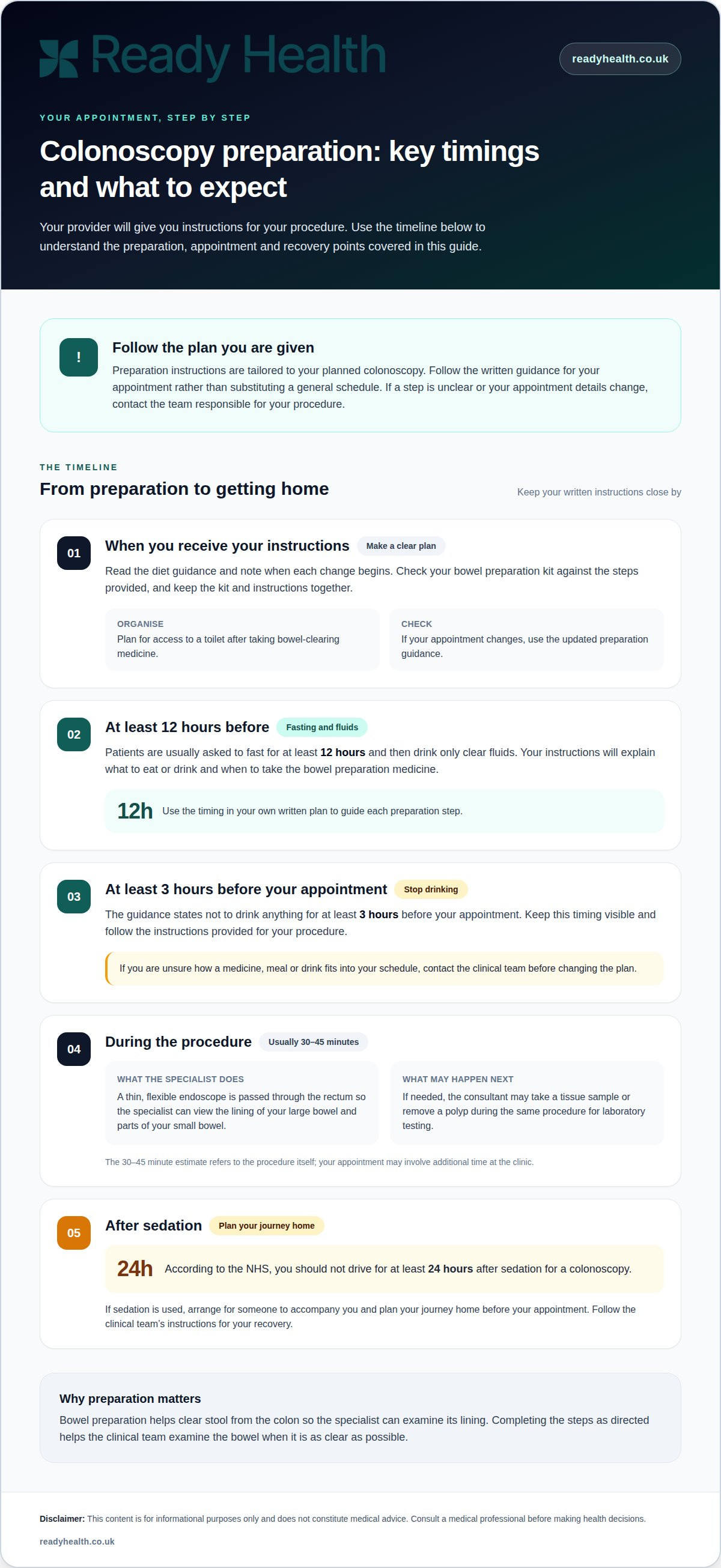
- A colonoscopy usually takes between 30 and 45 minutes. According to the NHS, you should not drive for at least 24 hours after sedation.
Table of Contents
Private colonoscopy and GP referral
A colonoscopy lets a consultant examine your large bowel and parts of your small bowel. The specialist passes a thin, flexible endoscope through the rectum to view the bowel lining. This diagnostic procedure can help investigate bowel concerns and identify changes such as polyps. If needed, the consultant may take a tissue sample or remove a polyp during the same procedure for laboratory testing.
The reason for considering a colonoscopy depends on your symptoms, health history and previous test results. Bowel polyps can take up to 10 years to progress, so finding them may allow assessment before further changes occur. Bowel cancer is the fourth most common cancer in the UK, and risk increases with age. Being over 50 is one of the most significant risk factors.
A GP referral can provide useful context, including the concern being investigated and relevant medical history. However, you can arrange a private colonoscopy without a referral from your own GP. A specialist consultation may still be part of the pathway, giving the clinician an opportunity to review your reasons for investigation and discuss what the procedure involves.
Before proceeding, the clinical team needs information to guide a safe and relevant assessment. Be ready to describe your symptoms, previous investigations, current medicines and relevant medical conditions. Details of your family history may also help the clinician understand your circumstances. This information supports a discussion about whether colonoscopy is an appropriate diagnostic step, rather than treating the referral itself as a diagnosis.
Sedation may be used during the procedure, so plan your journey home before your appointment. According to the NHS, you should not drive for at least 24 hours after sedation for a colonoscopy. Arrange for someone to accompany you if sedation is used, and follow the clinical team’s instructions for your own recovery.
Referral requirements for private colonoscopy
You can arrange a private colonoscopy without first obtaining a referral from your own GP. This lets you approach a private pathway directly, without waiting for your usual doctor to initiate it. However, providers may follow different assessment processes, and a specialist consultation may be part of the pathway before a procedure is planned.
Start by explaining why you’re seeking investigation. For example, describe the bowel symptoms or concern that prompted you to consider a colonoscopy. A clinician can use this information, alongside your medical history, to assess whether the procedure is a suitable next step. The consultation also gives you time to discuss the purpose of the test and what it can examine in your digestive system.
Useful information to have ready includes:
- Your current symptoms, when they began and whether they have changed.
- Relevant previous tests, investigations or treatment.
- Your current medicines and any known medical conditions.
- Family history of bowel or intestinal conditions, if relevant.
These details help the doctor understand your circumstances and the reason for referral. They can also identify information the specialist performing the colonoscopy may need before your appointment. If you already have a GP letter or test results, these may provide useful context. Share relevant documents through the pathway you’re given rather than assuming the specialist has access to your records.
A referral letter and a colonoscopy are separate steps. The letter communicates why specialist assessment is being sought; it does not itself confirm a diagnosis or determine the investigation. If you’re unsure whether a referral letter or an initial GP consultation fits your situation, discuss the options with a clinician. You can book a GP consultation to talk through your concerns and the appropriate next step.
How does a private provider guide you through colonoscopy preparation and bowel preparation?
Preparation usually starts with instructions tailored to your planned colonoscopy. These explain any dietary changes and the bowel preparation medicine used to empty the bowel. You’ll also be given a bowel preparation kit. Follow the instructions for your appointment, because the timing of each step affects how you prepare for the examination.
The bowel preparation helps clear stool from the colon, allowing the specialist to examine its lining. Your instructions will explain when to take the medicine and what to eat or drink beforehand. Before a colonoscopy, patients are usually asked to fast for at least 12 hours and then drink only clear fluids. On the procedure day, the guidance states not to drink anything for at least 3 hours before your appointment.
Use the written plan to organise the practical details:
- Read the diet instructions and note when each change begins.
- Check the bowel preparation kit against the steps provided.
- Keep the fasting and clear-fluid timings visible.
- Follow the instruction about when to stop drinking before the appointment.
Timing matters, so don’t substitute a general schedule for the instructions given for your procedure. If a step is unclear, contact the team responsible for your colonoscopy before changing the plan. This is especially useful if you’re unsure how a medicine, meal or drink fits into the preparation schedule. Clear guidance helps you understand what to do and when, rather than relying on guesswork.
Plan the preparation around your appointment time, including access to a toilet after taking bowel-clearing medicine. Keep the kit and instructions together so you can follow the right steps as the appointment approaches. If your appointment details change, use the updated guidance for the new timing. Completing the preparation as directed helps the clinical team examine the bowel when it is as clear as possible.
What happens during a colonoscopy, and how long does the appointment take?
A colonoscopy usually takes between 30 and 45 minutes, although this describes the procedure itself. The appointment may involve additional time for preparation at the clinic and recovery afterwards. A colonoscopy examines the colon and rectum using a thin, flexible tube with a camera at its end.
During the examination, the colonoscope is gently passed through the rectum and guided through the large bowel. Its camera sends images of the bowel lining to a screen, allowing the specialist to look for changes. Light sedation may be offered to support your comfort. Before the procedure begins, the clinical team can explain the available approach and what to expect.
If the specialist sees a polyp or an area needing closer assessment, they may take a tissue sample or remove a polyp during the same procedure. A biopsy is a small tissue sample sent for laboratory testing. These steps can provide information for a later diagnosis and decisions about follow-up. Whether a sample or polyp removal is needed depends on what the examination reveals.
After the procedure, the team can explain what they observed and whether a sample was taken. Laboratory analysis takes place after the appointment, so results may follow separately. Ask how and when your findings will be shared, and who will discuss any next steps with you. This helps distinguish an initial visual assessment from a final result based on tissue testing.
Allow time in your plans beyond the 30 to 45 minutes spent on the colonoscopy itself. If sedation is used, arrange your journey home in line with the clinical team’s instructions. For questions about whether investigation may be appropriate for your symptoms, you can book a GP consultation to discuss your concerns.
Ready Health: Private Referral Letter
Ready Health provides private GP consultations and private referral letters. During a consultation, you can discuss your bowel concerns, relevant medical history and previous test results. The clinician can assess your situation and explain whether a referral letter is an appropriate next step.
A referral letter explains why you’re seeking specialist care; it does not perform the colonoscopy or guarantee that one will be recommended. If you’re unsure how to proceed, a GP consultation can help you understand your options and prepare relevant information for discussion.
For a professional conversation about your referral needs, contact Ready Health.
Take the next step with confidence
Choosing a private referral for colonoscopy in Skelmersdale can be a practical way to seek specialist assessment. Before your consultation, note what you want clarified, such as the purpose of a referral letter, how your records will be shared, or what happens after a specialist reviews your case. Ready Health’s private GP consultations in Standish, Wigan, provide an opportunity to discuss these questions and decide how to proceed.
Ready Health offers private GP consultations lasting 15 or 30 minutes, giving you time to discuss your concerns and referral needs. The clinician can talk through your circumstances and whether a Private Referral Letter is an appropriate next step. You can take the process one decision at a time, with professional guidance focused on your individual needs.
This content is for informational purposes only and does not constitute medical advice. Consult a healthcare professional before making decisions about your health.
Contact Ready Health about a referral and take a considered next step for your health.
Frequently Asked Questions
Why might you need a colonoscopy?
A colonoscopy may be recommended to investigate bowel symptoms or examine a concern raised during other care. If you’re considering a private referral for colonoscopy in Skelmersdale, a clinician can discuss your symptoms, medical history and previous test results. These details help explain why further investigation may be considered and what the procedure could assess.
What conditions can a colonoscopy detect?
A colonoscopy can reveal bowel polyps and areas of unusual tissue that may need closer examination. If appropriate, the specialist can take a biopsy, meaning a small tissue sample, for laboratory testing. The procedure examines the colon and rectum, but its findings may not provide every answer. Your clinician can explain what the examination shows and whether further tests or follow-up are needed.
Is a colonoscopy painful?
People’s experiences can differ, so discuss comfort with the clinical team before the procedure. Light sedation may be offered to help you feel more comfortable. Ask what the available approach involves and share any concerns beforehand. The team can explain what to expect during the examination and how they’ll support you if you feel discomfort.
What kind of consultant performs a colonoscopy?
A consultant gastroenterologist, a doctor specialising in the digestive system, most commonly performs a colonoscopy. A colorectal surgeon may also carry it out, particularly when the examination forms part of a wider bowel investigation or treatment plan. The specialist examines the bowel and assesses any findings. Your referral pathway can clarify which clinician is responsible for your procedure.
Does private colonoscopy require a GP referral in the UK?
No, you can arrange a private colonoscopy without a referral from your own GP. This also applies if you’re exploring a private referral for colonoscopy in Skelmersdale. A private provider may include a specialist consultation before the procedure, allowing the clinician to understand your reasons for seeking investigation and consider relevant health information. A GP letter can provide context, but isn’t required to start arranging a private pathway.
This content is for informational purposes only and does not constitute medical advice. Consult a healthcare professional before making decisions about your health.
Contact Ready Health about a referral to discuss your next step.

Article by
Shamir Patel
Shamir Patel is a UK-based Clinical Pharmacist and Independent Prescriber with a specialist focus on ADHD and weight management.
He is the Registered CQC Manager at Ready Health Medical Clinic, where he leads the development and delivery of safe, patient-centred services across ADHD assessment and treatment, weight loss programmes, and general medical care.
With a career spanning nearly three decades since qualifying in 1995, Shamir brings extensive clinical and operational experience across both community pharmacy and private healthcare.
He also serves as Deputy Superintendent Pharmacist and Lead Prescriber at PillSorted. He oversees high-volume prescribing services. He focuses on GLP-1 weight loss treatments and clinical governance.
Shamir is a SCOPE-accredited obesity specialist and has a strong interest in improving access to evidence-based ADHD care. He is known for his structured, guideline-driven approach, aligning his clinical practice with NICE recommendations and regulatory standards set by the GPhC and CQC.
Alongside his clinical work, Shamir is actively involved in mentoring prescribing pharmacists, developing standard operating procedures, and contributing to service innovation within digital and community healthcare settings. His work reflects a commitment to safe prescribing, patient education, and improving outcomes through practical, accessible care.
Disclaimer
The information on this website is provided for general educational and informational purposes only and is not intended as medical advice, diagnosis, or treatment. Articles reflect general guidance and may not be suitable for your individual circumstances. You should always seek advice from a qualified healthcare professional before starting, stopping, or changing any treatment, medication, or healthcare plan. While we aim to keep our content accurate and up to date, Ready Health makes no guarantees about the completeness, accuracy, or suitability of the information provided. Reliance on any information on this site is entirely at your own risk. If you have concerns about your health, please book an appointment with a suitably qualified clinician. In an emergency, contact 999 or attend your nearest A&E department.
Frequently asked questions
Why might you need a colonoscopy?
A colonoscopy may be recommended to investigate bowel symptoms or examine a concern raised during other care. If you’re considering a private referral for colonoscopy in Skelmersdale, a clinician can discuss your symptoms, medical history and previous test results. These details help explain why further investigation may be considered and what the procedure could assess.
What conditions can a colonoscopy detect?
A colonoscopy can reveal bowel polyps and areas of unusual tissue that may need closer examination. If appropriate, the specialist can take a biopsy, meaning a small tissue sample, for laboratory testing. The procedure examines the colon and rectum, but its findings may not provide every answer. Your clinician can explain what the examination shows and whether further tests or follow-up are needed.
Is a colonoscopy painful?
People’s experiences can differ, so discuss comfort with the clinical team before the procedure. Light sedation may be offered to help you feel more comfortable. Ask what the available approach involves and share any concerns beforehand. The team can explain what to expect during the examination and how they’ll support you if you feel discomfort.
What kind of consultant performs a colonoscopy?
A consultant gastroenterologist, a doctor specialising in the digestive system, most commonly performs a colonoscopy. A colorectal surgeon may also carry it out, particularly when the examination forms part of a wider bowel investigation or treatment plan. The specialist examines the bowel and assesses any findings. Your referral pathway can clarify which clinician is responsible for your procedure.
Does private colonoscopy require a GP referral in the UK?
No, you can arrange a private colonoscopy without a referral from your own GP. This also applies if you’re exploring a private referral for colonoscopy in Skelmersdale. A private provider may include a specialist consultation before the procedure, allowing the clinician to understand your reasons for seeking investigation and consider relevant health information. A GP letter can provide context, but isn’t required to start arranging a private pathway. This content is for informational purposes only and does not constitute medical advice. Consult a healthcare professional before making decisions about your health. Contact Ready Health about a referral to discuss your next step.

Related articles...

Nov 18, 2026
What are heart rate zones and how can you use them during exercise?Heart rate zones are ranges of heartbeats per minute that...

Nov 17, 2026
Food intolerance testing in St Helens with results and adviceAn IgG blood test can give you a list of...

Nov 16, 2026
Rapid access physiotherapy in Bolton and how to bookPreparing for physiotherapy starts with knowing how to book and...