November 17, 2026
Food intolerance testing in St Helens with results and advice

An IgG blood test can give you a list of food reactions, but that doesn’t necessarily identify what’s causing your symptoms. If you’re considering food intolerance testing in St Helens, it’s also natural to want to know how soon results may arrive and what they can tell you.
Food intolerance symptoms can overlap with other conditions, so test results need careful interpretation. Guts UK says there’s no strong evidence that IgG blood tests accurately identify food intolerance. Before changing what you eat, understand what the test measures and what its results can show.
This guide explains what food intolerance means, how IgG tests work and what can affect the time it takes to receive results. It also covers dietary advice, why restricting foods without professional guidance can be unhelpful, and when to speak with a clinician.
Key Takeaways
- Track what you eat and when symptoms occur to help identify patterns worth discussing with a clinician.
- Understand what an IgG test measures and why its results need careful interpretation.
- Get professional guidance before removing foods or trying them again, particularly if allergy is suspected.
- Speak to a GP about recurring or concerning symptoms; according to the NHS, call 999 for sudden swelling of the lips, mouth, throat or tongue, or difficulty breathing.
Table of Contents
Will I receive dietary advice after getting my results?
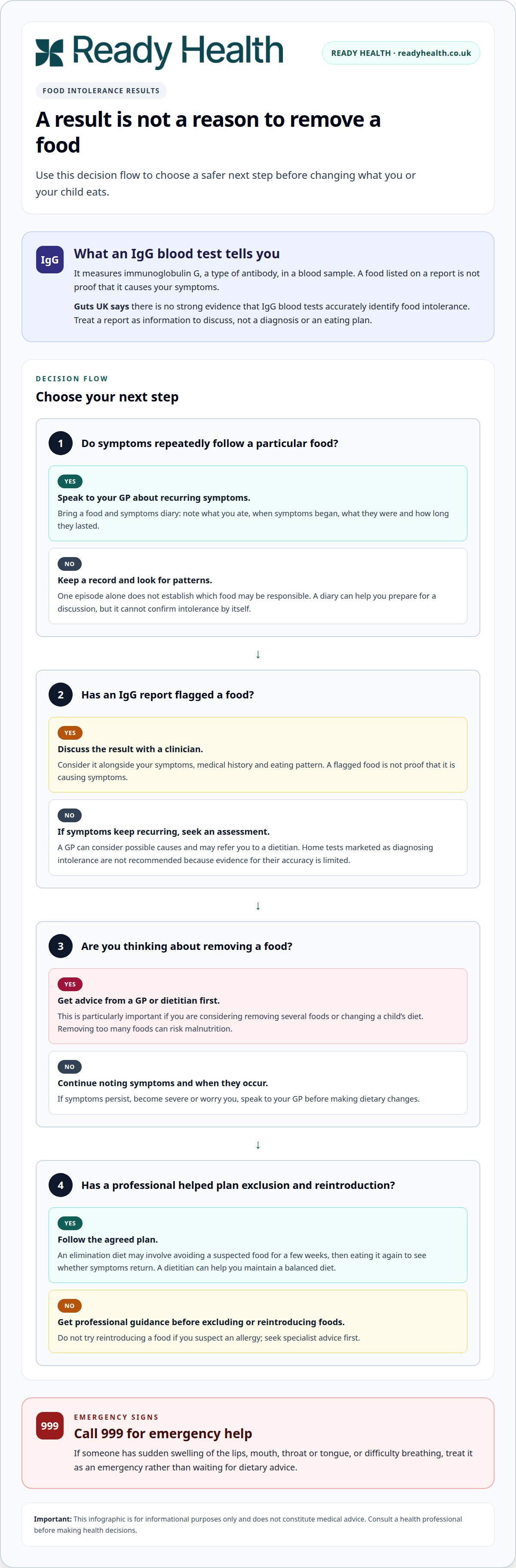
A result may prompt a discussion about possible food triggers, but it shouldn’t automatically lead to removing foods. A positive commercial IgG result may come with advice to exclude a food. Before changing your diet, discuss the result with a doctor or dietitian, particularly if several foods are involved.
For recurring symptoms you think may relate to food, the NHS advises seeing your GP. In St Helens, you can request an NHS GP appointment and explain your symptoms, when they occur and any test results. Your GP can assess possible causes and may refer you to a dietitian.
An elimination diet involves avoiding a suspected food for a few weeks, then eating it again to see whether symptoms return. A dietitian can help plan this process and maintain a balanced diet. Don’t try reintroducing a food if you suspect an allergy; seek specialist advice first.
Get medical advice before excluding foods from your own or your child’s diet. Removing too many foods can risk malnutrition, and a dietitian can guide exclusion and reintroduction. If symptoms persist, become severe or worry you, speak to your GP before making dietary changes.
For signs of a serious allergic reaction, the NHS advises calling 999 for emergency help if someone has sudden swelling of the lips, mouth, throat or tongue, or difficulty breathing. Treat these symptoms as an emergency rather than waiting for dietary advice.
Before treating a test result as a reason to change your meals, consider whether a clinician has assessed your symptoms and whether the suspected intolerance is the cause. Guts UK advises seeing a doctor before changing your diet to identify the true cause of symptoms. The NHS also advises people with recurring symptoms that may be food intolerance to see a GP, who may refer them to a dietitian.
If you exclude a food, plan the period without it and its reintroduction with professional guidance. Guts UK advises seeking a dietitian’s advice during exclusion and reintroduction. Don’t remove foods from your or your child’s diet without advice from a GP or dietitian. Overly restricting your diet can risk malnutrition, so professional guidance can help avoid unnecessary changes.
What Is A Food Intolerance?
Food intolerance means difficulty digesting a particular food or ingredient. The NHS explains that intolerance doesn’t involve an immune system overreaction, unlike allergy. Lactose intolerance is one example: lactose, a sugar found mainly in milk and dairy products, can be difficult to digest. People with IBS may also have trouble with lactose or fructans in wheat.
Symptoms may prompt assessment when they repeatedly follow eating a particular food. The NHS says symptoms usually appear a few hours after eating a trigger food. They may last a few hours or days. For example, note whether symptoms follow milk, wheat or another ingredient. One episode alone doesn’t establish which food may be responsible.
A food and symptoms diary may help you spot patterns. For each meal, record what you ate, including ingredients such as milk or wheat, and when you ate it. Note when symptoms began, what they were and how long they lasted. Add useful context, such as whether you ate the same food again and whether symptoms followed. Clear entries give your GP practical details to discuss.
Look for a repeated link, not a conclusion based on one meal. A diary cannot confirm intolerance or distinguish it from allergy on its own. If recurring symptoms seem connected with eating, the NHS advises seeing your GP. Bring your notes on foods, timing and symptoms. These examples can help your GP decide whether further assessment is appropriate.
A food and symptoms diary may help you identify possible triggers. Use it to look for patterns, not to treat a suspected link as confirmed.
IgG blood tests for food intolerance
An IgG intolerance test measures immunoglobulin G, a type of antibody, in a blood sample. Commercial panels may test your blood against foods such as milk, wheat or eggs and report reactions to each. The result is a measurement, not a diagnosis that explains your symptoms. A food listed on a report isn’t proof that it causes them.
Guts UK says there’s no strong evidence that IgG blood tests accurately identify food intolerance. Home tests marketed as diagnosing intolerance aren’t recommended because evidence for their accuracy is limited. A long list of results may not show which foods are genuinely linked to your symptoms or which foods are safe to remove.
Are private food intolerance tests scientifically reliable, according to the NHS and allergy specialists? Guts UK says there’s no strong evidence that IgG tests accurately identify intolerance, and evidence for home-test accuracy is limited. An IgG result therefore isn’t an established reliable diagnosis.
For example, if a panel flags milk, don’t assume it explains bloating or discomfort. Discuss the result with a clinician alongside your symptoms, medical history and eating pattern. A positive IgG result may prompt advice to remove a food, but excluding several foods can narrow your diet unnecessarily. Ask what the result can and cannot show before acting on it.
Treat an IgG report as information to discuss, not as a stand-alone eating plan. If symptoms recur after particular meals, share the foods involved and their timing with your GP. A clinician can consider whether another assessment is more appropriate and whether a dietitian should guide any food exclusion. Don’t use an IgG panel as a test for food allergy.
What types of food intolerance tests are offered near St Helens, such as IgG blood tests or elimination diets?
Food intolerance testing in St Helens may involve a GP assessment, an elimination diet or a commercial IgG blood test. These approaches provide different information. A GP considers your symptoms and health history; an elimination diet looks for changes after a suspected food is removed and later reintroduced; an IgG test measures antibodies in a blood sample.
According to the NHS, an assessment may involve avoiding a suspected food for a few weeks, then eating it again to see whether symptoms return. For example, a clinician may help you consider one suspected ingredient at a time rather than removing several foods together. A dietitian can guide exclusion and reintroduction and help you maintain a balanced diet.
Commercial IgG panels report antibody reactions to selected foods. However, Guts UK says there’s no strong evidence that these tests accurately identify food intolerance. If you’re considering food intolerance testing in St Helens, remember that a report listing milk or wheat reactions cannot, by itself, show that either food causes your symptoms.
Other marketed approaches include hair analysis, applied kinesiology and leukocytotoxic testing. Guts UK says there’s no good evidence that hair analysis identifies food intolerance, and available evidence does not support applied kinesiology or leukocytotoxic testing as reliable ways to identify it. Before acting on a result, consider what the test measures and whether its findings relate to your symptoms. If you suspect an allergy, seek specialist advice before trying food reintroduction.
How Ready Health can support you
Ready Health can help you consider a next step when food-related symptoms keep returning. A private GP consultation gives you time to discuss what happens after meals, your health history and any test results you already have. This can help guide a conversation about whether further assessment may be appropriate.
Bring clear examples, such as which foods you suspect, when symptoms begin and how they affect you. Your GP can consider this information alongside your overall health and discuss suitable next steps. If you have an IgG report, talk through what it measures rather than treating its food list as a diagnosis.
Ready Health offers private GP consultations lasting 15 or 30 minutes. You can use an appointment to discuss recurring symptoms, questions about a commercial test or concerns about changing your diet. A consultation can help you understand whether another type of medical assessment may be appropriate.
If your symptoms suggest a possible food allergy rather than an intolerance, raise this during your consultation. Ready Health offers allergy testing, which may be relevant when allergy is being considered. Sudden swelling or difficulty breathing needs emergency help, not a routine appointment.
For ongoing symptoms, a clinician can discuss the information you’ve gathered and help you consider a measured plan. This can be useful before excluding several foods or making a substantial change to your diet. The right next step depends on your symptoms and health history.
Book a consultation with Ready Health to discuss your symptoms and possible next steps.
Frequently Asked Questions
What food intolerance testing services are available in St Helens, Merseyside?
For food intolerance testing in St Helens, Ready Health offers private GP consultations to discuss symptoms and suitable next steps. Allergy testing is also available when an allergy is suspected, but it does not establish food intolerance. Bring any commercial test report to your appointment so a clinician can consider it alongside your health concerns.
What is the difference between food intolerance, food allergy and coeliac disease?
These are distinct conditions, so a test or dietary change aimed at one may not address another. Intolerance involves difficulty digesting a food; allergy involves an immune reaction. Coeliac disease is a separate condition linked to gluten. If wheat or another food seems connected to your symptoms, explain the pattern to a clinician rather than assuming which condition is responsible.
What symptoms warrant a GP referral or urgent medical attention rather than a private intolerance test?
Choose a GP assessment rather than relying on a private intolerance test if symptoms keep disrupting meals, persist, feel severe or cause concern. For a sudden reaction involving swelling of the lips, mouth, throat or tongue, or difficulty breathing, call 999 for emergency help, as the NHS advises. Emergency symptoms need urgent help, not a routine test appointment.
What should I bring to a food intolerance consultation?
Bring any test reports you have, along with a clear account of your main concern and the foods you suspect. Product packaging or ingredient lists can help identify what a food contained, especially in prepared meals. You might also note questions you want answered, such as whether a result supports further assessment or whether dietary changes need professional guidance.
This content is for informational purposes only and does not constitute medical advice. Consult a healthcare professional before making health decisions.
To discuss your concerns, book a consultation with Ready Health.

Article by
Shamir Patel
Shamir Patel is a UK-based Clinical Pharmacist and Independent Prescriber with a specialist focus on ADHD and weight management.
He is the Registered CQC Manager at Ready Health Medical Clinic, where he leads the development and delivery of safe, patient-centred services across ADHD assessment and treatment, weight loss programmes, and general medical care.
With a career spanning nearly three decades since qualifying in 1995, Shamir brings extensive clinical and operational experience across both community pharmacy and private healthcare.
He also serves as Deputy Superintendent Pharmacist and Lead Prescriber at PillSorted. He oversees high-volume prescribing services. He focuses on GLP-1 weight loss treatments and clinical governance.
Shamir is a SCOPE-accredited obesity specialist and has a strong interest in improving access to evidence-based ADHD care. He is known for his structured, guideline-driven approach, aligning his clinical practice with NICE recommendations and regulatory standards set by the GPhC and CQC.
Alongside his clinical work, Shamir is actively involved in mentoring prescribing pharmacists, developing standard operating procedures, and contributing to service innovation within digital and community healthcare settings. His work reflects a commitment to safe prescribing, patient education, and improving outcomes through practical, accessible care.
Disclaimer
The information on this website is provided for general educational and informational purposes only and is not intended as medical advice, diagnosis, or treatment. Articles reflect general guidance and may not be suitable for your individual circumstances. You should always seek advice from a qualified healthcare professional before starting, stopping, or changing any treatment, medication, or healthcare plan. While we aim to keep our content accurate and up to date, Ready Health makes no guarantees about the completeness, accuracy, or suitability of the information provided. Reliance on any information on this site is entirely at your own risk. If you have concerns about your health, please book an appointment with a suitably qualified clinician. In an emergency, contact 999 or attend your nearest A&E department.
Frequently asked questions
What food intolerance testing services are available in St Helens, Merseyside?
For food intolerance testing in St Helens, Ready Health offers private GP consultations to discuss symptoms and suitable next steps. Allergy testing is also available when an allergy is suspected, but it does not establish food intolerance. Bring any commercial test report to your appointment so a clinician can consider it alongside your health concerns.
What is the difference between food intolerance, food allergy and coeliac disease?
These are distinct conditions, so a test or dietary change aimed at one may not address another. Intolerance involves difficulty digesting a food; allergy involves an immune reaction. Coeliac disease is a separate condition linked to gluten. If wheat or another food seems connected to your symptoms, explain the pattern to a clinician rather than assuming which condition is responsible.
What symptoms warrant a GP referral or urgent medical attention rather than a private intolerance test?
Choose a GP assessment rather than relying on a private intolerance test if symptoms keep disrupting meals, persist, feel severe or cause concern. For a sudden reaction involving swelling of the lips, mouth, throat or tongue, or difficulty breathing, call 999 for emergency help, as the NHS advises. Emergency symptoms need urgent help, not a routine test appointment.
What should I bring to a food intolerance consultation?
Bring any test reports you have, along with a clear account of your main concern and the foods you suspect. Product packaging or ingredient lists can help identify what a food contained, especially in prepared meals. You might also note questions you want answered, such as whether a result supports further assessment or whether dietary changes need professional guidance. This content is for informational purposes only and does not constitute medical advice. Consult a healthcare professional before making health decisions. To discuss your concerns, book a consultation with Ready Health.

Related articles...

Nov 18, 2026
What are heart rate zones and how can you use them during exercise?Heart rate zones are ranges of heartbeats per minute that...

Nov 18, 2026
Getting a private colonoscopy referral in SkelmersdaleA colonoscopy may be considered to investigate bowel symptoms or...

Nov 16, 2026
Rapid access physiotherapy in Bolton and how to bookPreparing for physiotherapy starts with knowing how to book and...