November 16, 2026
Rapid access physiotherapy in Bolton and how to book

Preparing for physiotherapy starts with knowing how to book and whether you need a referral. This guide explains how rapid access physiotherapy in Bolton may fit your situation.
You’ll learn what eligibility can depend on and which details about your symptoms and daily activities can help shape the first assessment.
We’ll also help you think through your next step, so you can approach an appointment with a clearer idea of what you want to discuss and what support may suit you.
Key Takeaways
- Learn how to arrange physiotherapy directly and what information can help make your first appointment more focused.
- Understand which factors may affect your eligibility and whether a referral is needed for your situation.
- See how patient confidentiality is addressed, including the relevance of the UK Data Protection Act 2018.
- Find out how private physiotherapy or a GP consultation may fit into your next step.
Table of Contents
Direct booking without a GP referral
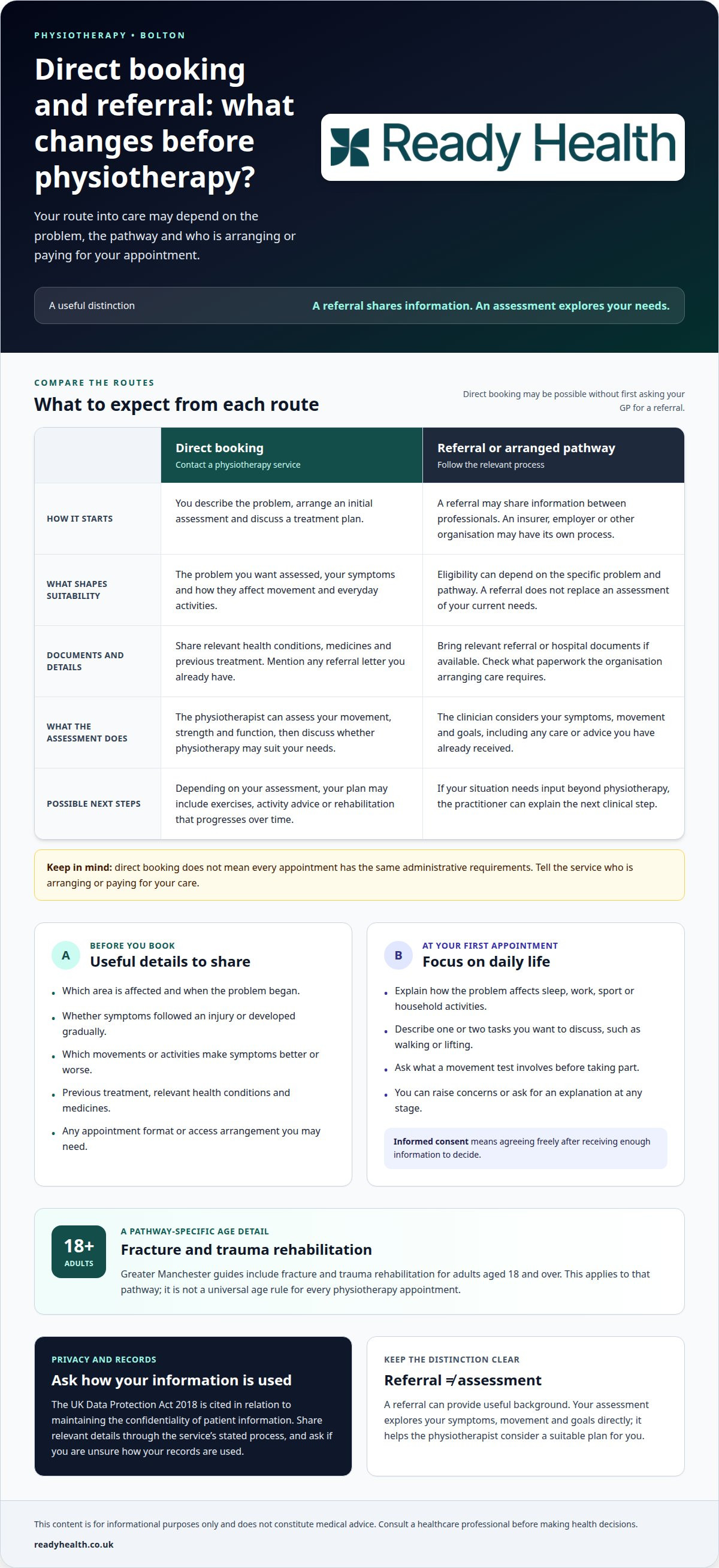
Rapid access physiotherapy in Bolton usually means contacting a physiotherapy service directly. You describe the problem, arrange an initial assessment and discuss a treatment plan without first asking your GP for a referral. This can suit you when pain, stiffness or an injury affects everyday activities such as walking, lifting or returning to work.
Start by explaining what has changed and what you want help doing. For example, say that a knee injury makes stairs difficult or shoulder discomfort limits reaching overhead. A specific example helps the physiotherapist understand how the problem affects your activities, not just where it hurts.
When arranging an appointment, share the details that can help the service understand your needs:
- The affected area and when the problem began.
- Whether symptoms followed an injury or developed gradually.
- Which movements or activities make symptoms better or worse.
- Any previous treatment, relevant health conditions or medicines.
- Whether you need an appointment format or access arrangement discussed in advance.
These details help with the initial conversation, but they don’t replace an assessment or determine treatment on their own. A physiotherapist can ask follow-up questions, assess your movement and discuss whether physiotherapy suits your needs.
What happens after you book?
At the first appointment, expect to describe your symptoms and priorities in more detail. The physiotherapist may ask how the problem affects sleep, work, sport or household activities. If bending, walking or lifting is difficult, explain what happens during that movement and how it affects your day.
The assessment helps the physiotherapist consider your movement, strength and function. You can ask what each test involves before taking part. Informed consent means agreeing freely after receiving enough information to decide. Raise any concerns or ask for an explanation at any stage.
After the assessment, the physiotherapist can discuss suitable treatment and rehabilitation, a planned approach to rebuilding movement and function. Depending on your assessment, this may include exercises, activity advice or a programme that progresses over time. The plan should relate to your goals, such as returning to an activity or managing a task at work.
Referral letters, privacy and clinical records
Direct booking doesn’t mean every appointment has the same administrative requirements. An insurer, employer or other organisation may have its own process and document requirements. Tell the physiotherapy service who is arranging or paying for your care, and mention any referral letter you already have.
Patient information also needs careful handling. The UK Data Protection Act 2018 is cited in relation to maintaining the confidentiality of patient information, according to UK legislation. During booking, share relevant information through the service’s stated process, and ask how your records are used if you are unsure.
A GP referral and a physiotherapy assessment have different purposes. A referral shares information between professionals; an assessment explores your symptoms, movement and goals directly. If your situation needs input beyond physiotherapy, the practitioner can explain the next clinical step. This helps keep care appropriate instead of assuming that exercises or treatment suit every injury.
Before your appointment, note one or two activities you want to discuss, such as walking to the shops or lifting a child. Bring relevant referral documents and a list of your current medicines, if available. This gives the physiotherapist useful context and helps you focus the appointment on practical priorities.
For drivers approaching via the M61, exit at Junction 5 for Bolton. Before travelling, confirm the exact appointment address and any arrival instructions with the physiotherapy service, since a route to Bolton does not identify a particular practice. Check that the location is the one listed in your booking, and contact the service if anything is unclear. If you have explained an access need when booking, you can also confirm any arrangements before setting out. This can help you plan the journey around the appointment rather than making assumptions about where to go.
Keep your booking details handy while travelling. Allow time to find the address and get settled, particularly if pain or restricted movement could make the journey harder. If your plans change or you expect to arrive late, contact the service as soon as possible. Use the appointment to ask about assessment, treatment options and next steps, and make sure the plan reflects the activities you want to resume.
Eligibility and referral criteria
Eligibility for physiotherapy depends on the problem you need assessed and the pathway you’re considering. A direct appointment may suit a musculoskeletal concern, meaning a problem affecting muscles, joints, bones or movement. Examples include a sprain, restricted shoulder movement or reduced strength after an injury.
During the assessment, the physiotherapist considers your symptoms and how they affect mobility and daily activities. Describe a practical difficulty, such as struggling to stand from a chair or walk to the local shops. This gives a clearer picture than naming a painful area alone. Your goals, medical history and previous treatment also help shape a suitable plan.
Age and the type of rehabilitation
Age criteria can depend on the specific rehabilitation pathway. Greater Manchester guides include fracture and trauma rehabilitation for adults aged 18 and over. This detail applies to that pathway, rather than acting as a universal age rule for every physiotherapy appointment.
If you’re arranging care after a fracture or traumatic injury, explain what happened, any hospital treatment and your current mobility. Mention whether you had surgery and received discharge instructions or a rehabilitation plan. This helps the clinician understand what care you’ve already had and what support you need now.
Bring relevant documents if you have them, such as a hospital letter or previous assessment. If another professional has recommended treatment, explain what they advised and why. A referral can provide useful background, but it doesn’t replace an assessment of your current movement, strength and goals.
When a hospital pathway may be more suitable
Not every urgent need for support follows a self-booked clinic route. The Home First Team assesses medically optimised patients in urgent care to support independence, rapid discharge and avoid unnecessary hospital admissions. “Medically optimised” means a person has received the medical care needed at that stage of treatment.
If returning home isn’t considered safe, the Home First Team may refer someone to a community step-up bed or intermediate care bed. These options support people who need a different level of care before managing at home. They’re separate from booking a routine physiotherapy appointment directly.
If you’re already in hospital or urgent care, tell the team about your mobility and support needs before discharge planning is complete. For example, explain if you can’t manage stairs safely or need help moving from a bed to a chair. These details matter for independence and discharge planning, not just for booking a clinic appointment.
Useful checks before arranging an appointment
Use these steps to identify the right route:
- Describe the problem and how it affects movement, strength or everyday activities.
- Explain whether it followed an injury, fracture, hospital stay or surgery.
- Share relevant discharge advice, previous treatment and referral documents.
- Ask whether the service assesses your type of concern and age group.
- State any practical preference, such as a Monday appointment, without assuming a particular day is available.
When booking, ask about the practitioner’s role, the service’s eligibility criteria and what the assessment involves. Check whether your concern fits the service’s remit. If the route isn’t suitable, the reason should relate to your symptoms, care needs or the pathway’s criteria, not just an assumption based on where you feel pain.
For a movement concern that may suit a private assessment, you can explore physiotherapy support as a next step. If you’re weighing up a referral, have your injury history, current limitations and any hospital guidance ready. Those details help clarify which appointment or care pathway is relevant.
Ready Health: Private Consultants Cardiology (Dr Ashish Dhawan), Neurology (Dr Nasir Mirza), Physiotherapy, Dermatology
Ready Health offers private physiotherapy for clinical assessment and support with movement, strength and everyday activities. A physiotherapist can discuss your concerns, assess your needs and explain possible next steps. If you’re unsure whether physiotherapy is right for you, a private GP consultation can help you discuss your symptoms and whether a referral is appropriate.
Ready Health also offers private consultant services in cardiology, neurology and dermatology. These are separate clinical pathways, so the right option depends on what you need assessed. Choose the service that best matches your needs, or start with a GP consultation if you’d like help deciding.
To discuss your next step, contact Ready Health.
Take a considered next step towards better movement
Choose a practical goal for your next conversation, such as moving more comfortably at work or returning to an activity you value. Sharing that goal can help you discuss whether rapid access physiotherapy in Bolton suits your needs. If you’re unsure which appointment to choose, explain what you’re experiencing and what you hope to address.
Start by considering the main change you’ve noticed and the support you’re looking for, then discuss the options available for your care.
Contact Ready Health to discuss booking.
Frequently Asked Questions
Do I need a GP referral for physiotherapy in Bolton?
You can usually book private physiotherapy directly without first getting a GP referral. The service may ask about your symptoms and what you want help with to understand your needs. If a GP, hospital team or other clinician has already given you relevant advice, mention it at your appointment.
Can I book physiotherapy for a problem that developed gradually?
You can discuss gradual changes as well as a specific injury. For example, explain if stiffness has built up over time or a movement has become harder during everyday tasks. Saying when you first noticed the change and how it has progressed can help the physiotherapist understand your concerns and decide what to explore during the assessment.
What should I wear to a physiotherapy appointment?
Wear comfortable clothing that lets you move and makes the area you want assessed accessible, where practical. Loose clothing, for example, may make it easier to show how your knee bends or shoulder moves. If you’re unsure what to wear for your concern, mention this when arranging the appointment.
Can I ask the physiotherapist to explain an exercise?
If an exercise is suggested, ask what it’s intended to address and how to do it. Explain if a movement feels difficult or doesn’t fit your routine. A clear discussion helps you understand the advice and raise concerns before deciding how it fits into your daily activities.
This content is for informational purposes only and does not constitute medical advice. Consult a healthcare professional before making health decisions.

Article by
Shamir Patel
Shamir Patel is a UK-based Clinical Pharmacist and Independent Prescriber with a specialist focus on ADHD and weight management.
He is the Registered CQC Manager at Ready Health Medical Clinic, where he leads the development and delivery of safe, patient-centred services across ADHD assessment and treatment, weight loss programmes, and general medical care.
With a career spanning nearly three decades since qualifying in 1995, Shamir brings extensive clinical and operational experience across both community pharmacy and private healthcare.
He also serves as Deputy Superintendent Pharmacist and Lead Prescriber at PillSorted. He oversees high-volume prescribing services. He focuses on GLP-1 weight loss treatments and clinical governance.
Shamir is a SCOPE-accredited obesity specialist and has a strong interest in improving access to evidence-based ADHD care. He is known for his structured, guideline-driven approach, aligning his clinical practice with NICE recommendations and regulatory standards set by the GPhC and CQC.
Alongside his clinical work, Shamir is actively involved in mentoring prescribing pharmacists, developing standard operating procedures, and contributing to service innovation within digital and community healthcare settings. His work reflects a commitment to safe prescribing, patient education, and improving outcomes through practical, accessible care.
Disclaimer
The information on this website is provided for general educational and informational purposes only and is not intended as medical advice, diagnosis, or treatment. Articles reflect general guidance and may not be suitable for your individual circumstances. You should always seek advice from a qualified healthcare professional before starting, stopping, or changing any treatment, medication, or healthcare plan. While we aim to keep our content accurate and up to date, Ready Health makes no guarantees about the completeness, accuracy, or suitability of the information provided. Reliance on any information on this site is entirely at your own risk. If you have concerns about your health, please book an appointment with a suitably qualified clinician. In an emergency, contact 999 or attend your nearest A&E department.
Frequently asked questions
What happens after you book?
At the first appointment, expect to describe your symptoms and priorities in more detail. The physiotherapist may ask how the problem affects sleep, work, sport or household activities. If bending, walking or lifting is difficult, explain what happens during that movement and how it affects your day. The assessment helps the physiotherapist consider your movement, strength and function. You can ask what each test involves before taking part. Informed consent means agreeing freely after receiving enough information to decide. Raise any concerns or ask for an explanation at any stage. After the assessment, the physiotherapist can discuss suitable treatment and rehabilitation, a planned approach to rebuilding movement and function. Depending on your assessment, this may include exercises, activity advice or a programme that progresses over time. The plan should relate to your goals, such as returning to an activity or managing a task at work.
Do I need a GP referral for physiotherapy in Bolton?
You can usually book private physiotherapy directly without first getting a GP referral. The service may ask about your symptoms and what you want help with to understand your needs. If a GP, hospital team or other clinician has already given you relevant advice, mention it at your appointment.
Can I book physiotherapy for a problem that developed gradually?
You can discuss gradual changes as well as a specific injury. For example, explain if stiffness has built up over time or a movement has become harder during everyday tasks. Saying when you first noticed the change and how it has progressed can help the physiotherapist understand your concerns and decide what to explore during the assessment.
What should I wear to a physiotherapy appointment?
Wear comfortable clothing that lets you move and makes the area you want assessed accessible, where practical. Loose clothing, for example, may make it easier to show how your knee bends or shoulder moves. If you’re unsure what to wear for your concern, mention this when arranging the appointment.
Can I ask the physiotherapist to explain an exercise?
If an exercise is suggested, ask what it’s intended to address and how to do it. Explain if a movement feels difficult or doesn’t fit your routine. A clear discussion helps you understand the advice and raise concerns before deciding how it fits into your daily activities. This content is for informational purposes only and does not constitute medical advice. Consult a healthcare professional before making health decisions.

Related articles...

Nov 18, 2026
What are heart rate zones and how can you use them during exercise?Heart rate zones are ranges of heartbeats per minute that...

Nov 18, 2026
Getting a private colonoscopy referral in SkelmersdaleA colonoscopy may be considered to investigate bowel symptoms or...

Nov 17, 2026
Food intolerance testing in St Helens with results and adviceAn IgG blood test can give you a list of...