November 2, 2026
Private child ADHD assessment in Wigan, with NHS shared care

For a private child ADHD assessment in Wigan, one local clinic aims to see patients within 24 hours. That gives you a clear starting point when you’re weighing up a private assessment for your child.
Waiting is only part of the decision. You’ll also want to understand what the assessment involves and how shared care with an NHS GP may fit into follow-up care.
This guide explains what to expect from an initial assessment, what to consider when choosing a private pathway, and how shared care may work after diagnosis. It will help you understand the next steps and prepare questions that matter for your family.
Key Takeaways
- Compare the expected wait for a private first assessment with the NHS referral route so you can decide which pathway suits your family’s needs.
- Check that the assessor’s qualifications and professional registration are relevant to assessing children with ADHD.
- Gather information from home and school about your child’s experiences, symptoms and day-to-day needs to support a thorough assessment.
- Look for a clear explanation of the assessment process, written findings and follow-up arrangements, including how shared care with an NHS GP may work.
Table of Contents
- Waiting times for a first assessment
- What qualifications and registration should a child ADHD assessor have in the UK?
- What evidence and documents are needed for a child ADHD assessment?
- What are the risks of choosing a private ADHD assessment provider, and how can families check its quality?
- Ready Health: Private GP Consultation (15 Minutes)
Waiting times for a first assessment
A private child ADHD assessment in Wigan may offer a faster first appointment than waiting for an NHS pathway. One private assessment service in Standish aims to see patients within 24 hours. Treat this as the service’s stated aim, not a guaranteed appointment time. Ask about the next available slot and whether gathering information from home and school affects your booking.
The NHS route works differently. In Greater Manchester, you can seek an ADHD assessment through NHS Right to Choose, using a provider funded by Greater Manchester Integrated Care Board. Before starting, check that the provider accepts referrals for children and young people under 18. A provider’s waiting list is held by that provider, so your GP surgery cannot tell you where your referral sits.
If you’ve submitted a Right to Choose referral and need an update, contact your chosen provider directly. Follow its instructions for the screening questionnaire and referral form. The form asks for the name of the GP you discussed your concerns with. Once the provider receives the referral, it sends a confirmation email and may get in touch if it needs more information.
Use these steps to compare pathways and keep the process moving:
- Ask the private service for its earliest first-assessment appointment and what documents to prepare.
- For Right to Choose, confirm the provider accepts under-18 referrals and is funded by Greater Manchester Integrated Care Board.
- Complete the provider’s screening questionnaire and referral paperwork, then submit them using its stated method.
- For referral progress, contact the chosen provider rather than your GP surgery.
These routes have different referral steps, funding arrangements and appointment queues. If you’re considering an online assessment, review the online ADHD assessment information alongside the pathway you’re comparing. Knowing who manages the referral, and who can provide a progress update, helps you plan the next step without mistaking an appointment aim for a confirmed booking.
What qualifications and registration should a child ADHD assessor have in the UK?
When choosing a child ADHD assessment, look for a clinician whose training and professional background are relevant to child mental health or neurodevelopment. Ask who will conduct the appointment, their role and their experience assessing children. A service name or ADHD qualification alone doesn’t tell you who is responsible for the clinical assessment.
Check the assessor’s professional registration. Ask which register applies to their profession and how to verify their registration by name or registration number. Read the entry carefully, including any published restrictions. If the clinician works in a team, clarify who makes the diagnostic decision and signs the report.
Ask how the assessment follows recognised diagnostic guidance. DSM-5 criteria are used by some ADHD assessors. Some also use DIVA-5, a structured diagnostic interview that explores ADHD symptoms and their impact. These methods support a wider clinical assessment; a questionnaire or interview score alone shouldn’t be treated as a diagnosis.
Before booking, ask these questions to understand the assessor’s credentials and approach:
- What is the assessor’s professional role and relevant training?
- Which professional register are they on, and how can you check their entry?
- What experience do they have assessing children of your child’s age?
- Who reviews the evidence and provides the final clinical findings?
A thorough assessment should include a clinical interview, validated questionnaires and personalised feedback about next steps. Ask whether the clinician will consider information from home and school, and how they’ll explain the findings to you and your child. For an online appointment, clarify how the assessor gathers this information and involves a parent or guardian. Clear answers help you decide whether the clinician’s qualifications, assessment process and report suit your family’s needs.
What evidence and documents are needed for a child ADHD assessment?
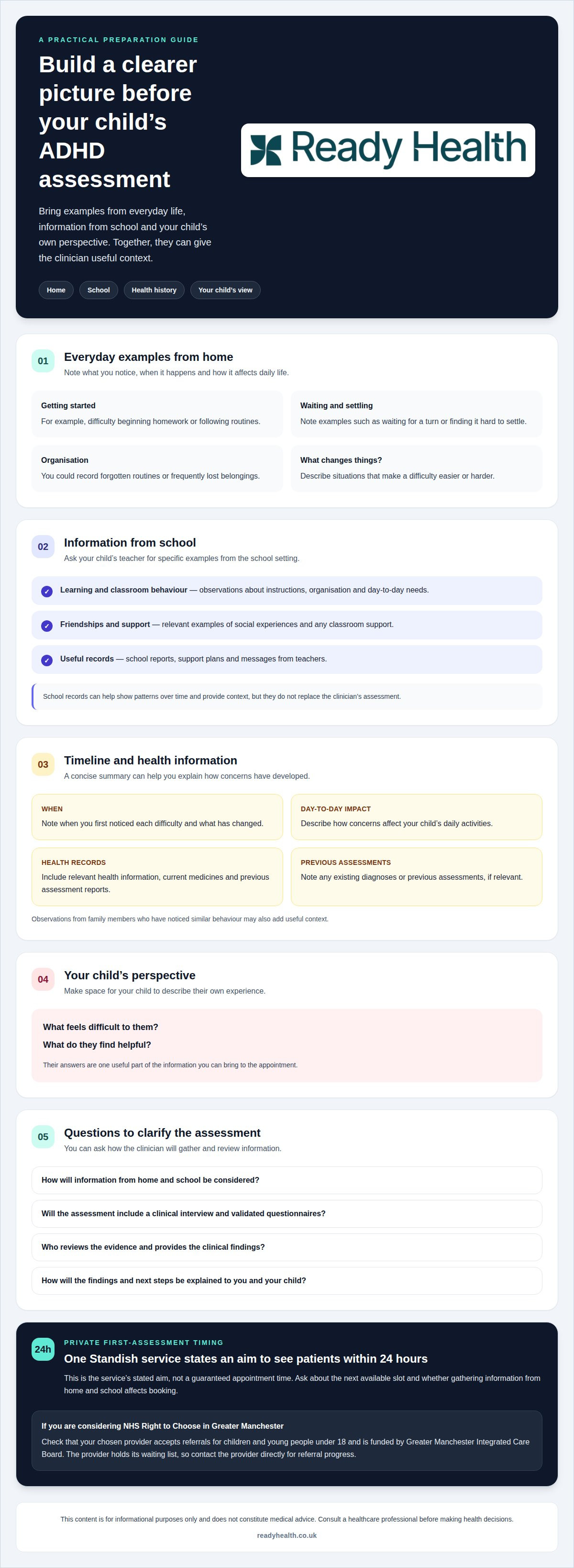
No single document proves that a child has ADHD. A thorough assessment combines a clinical interview, validated questionnaires and personalised feedback. Before the appointment, gather examples of what you notice, when it happens and how it affects daily life. You might note difficulties starting homework, waiting for a turn or following classroom instructions.
Include observations from different settings. ADHD-related difficulties can vary between home and school, so ask your child’s teacher for specific examples involving learning, friendships, organisation and behaviour. School reports, support plans and messages from teachers can help show patterns over time. These records provide context, but don’t replace the clinician’s assessment.
Prepare a brief timeline of your concerns and bring relevant health information. Note when you first noticed each difficulty, what has changed and which situations make it easier or harder. Include current medicines, previous assessments and any existing diagnoses, if relevant. Observations from family members who have noticed similar behaviour can also add useful context.
Use this preparation list to organise information for the appointment:
- Examples from home, such as losing belongings, forgetting routines or struggling to settle.
- School information, such as teacher observations, reports or details of classroom support.
- A concise timeline showing when concerns began and how they affect daily activities.
- Relevant health records, current medicines and previous assessment reports.
- Your child’s own perspective, including what feels difficult and what helps.
For an NHS Right to Choose assessment, complete the screening questionnaire provided by your chosen provider. Follow its instructions for supporting paperwork and submission. Keep copies of forms and reports together so you can refer to them during the clinical interview.
You don’t need to create a perfect file. Clear, dated examples are more useful than broad descriptions such as “often distracted”. Share what you have, explain any gaps and ask how the clinician will gather any additional information. The assessment should consider the whole picture and provide personalised feedback on next steps.
What are the risks of choosing a private ADHD assessment provider, and how can families check its quality?
A quick appointment is useful only if the assessment is thorough. A limited review that relies on a single questionnaire, for example, may miss important context from home, school or your child’s developmental history. Look for a process that includes a clinical interview, validated questionnaires and personalised feedback on next steps.
Before booking, ask who conducts the assessment and who makes the diagnostic decision. Check the clinician’s professional registration and relevant experience assessing children. Ask how the assessor gathers information from parents and school, and how they consider differences between accounts. A child, for instance, may manage classroom routines but struggle with homework and family activities.
A report that gives only a diagnosis, without explaining the evidence or practical next steps, may leave you unsure what happens afterwards. Ask what written findings you’ll receive, whether they explain how conclusions were reached, and whether you can share the report with your child’s GP or school. If you’re considering shared care, ask how the findings and follow-up information can support a discussion with your GP.
Use these checks to compare the assessment process:
- Confirm the assessor’s name, professional role, registration and child-assessment experience.
- Ask whether the process combines an interview, validated questionnaires and information from more than one setting.
- Find out what the written report covers and how findings are explained to your family.
- Clarify what follow-up is available and what information you can share with your GP.
Recognised methods can include DSM-5 criteria and the DIVA-5 diagnostic interview, but a named tool alone doesn’t demonstrate a complete assessment. Ask how the clinician uses it alongside interviews, questionnaires and your child’s individual history. Clear answers help you judge the quality of the process, not just the speed of booking. You can review the assessment information as you consider the practical details.
Ready Health: Private GP Consultation (15 Minutes)
Ready Health offers a Private GP Consultation (15 Minutes) if you want to discuss your child’s concerns and possible next steps with a GP. You can bring questions about assessment findings, referral routes or what to discuss with your NHS GP about shared care.
Prepare a brief summary of your child’s difficulties, how they affect daily life and any assessment documents you already have. This can help you focus the appointment on questions that matter to your family. A GP consultation is a place to discuss your concerns, not a substitute for a specialist ADHD assessment.
If you’d like to discuss your next steps, contact Ready Health or visit readyhealth.co.uk.
Take the next step with clarity
Choosing a private child ADHD assessment in Wigan is one part of supporting your child. Next, consider how to help them understand what happens after the assessment and involve them in conversations about their needs. For families looking into practical post-assessment therapies, specialized providers such as Autism & Brain Institute offer pediatric speech-language pathology and occupational therapy designed for children with neurodevelopmental differences.
Ready Health offers Private GP Consultation (15 Minutes) and Private GP Consultation (30 Minutes). A consultation may help you organise questions about your child’s care and prepare for a discussion with their NHS GP. It doesn’t replace a specialist ADHD assessment.
Contact Ready Health to discuss an assessment and consider the next step at a pace that feels right for your family.
This content is for informational purposes only and does not constitute medical advice. Consult a healthcare professional before making health decisions.
Frequently Asked Questions
Will the NHS, schools, or Wigan services accept a private ADHD diagnosis?
A private diagnosis can inform discussions with your child’s GP and school, but it doesn’t guarantee access to a particular NHS service or school adjustment. Share the report and ask how it will be considered in your child’s circumstances. In Wigan, Community Child Health referrals are made by GPs and other health professionals with parental consent.
Does a private diagnosis mean your child will automatically receive medication?
No. A diagnosis doesn’t mean medication will automatically be recommended or started. Medication decisions involve a separate clinical process, including consideration of your child’s needs and monitoring during titration, which means adjusting treatment and reviewing its effects. Ready Health says under-18s have a parent or guardian involved during medication titration.
What should you do if your NHS GP doesn’t agree to shared care?
Clarify who will continue prescribing and monitoring before assuming care has transferred. Shared care depends on an agreed arrangement, so discuss your GP’s position with the specialist service and ask what follow-up it can provide. Keep written details of the plan, including who to contact about medication reviews or concerns.
What happens when a young person moves on from children’s ADHD services?
Moving on from children’s services may involve a transition to adult ADHD support, so ask the current team how the handover will be managed. Ask the current team how it will manage the handover and what information will be passed to the adult service. A clear transition plan can help your young person understand who will support their ongoing care.
What is included in a private child ADHD assessment, and how many appointments are needed?
A full assessment includes a clinical interview, validated questionnaires and personalised feedback on next steps.
What age ranges do private ADHD assessment providers near Wigan accept?
Ready Health offers online and in-clinic child ADHD assessments in Standish for children aged 6 and over. For families seeking guidance for infants and toddlers under the age of three, services such as the Stars Assessment Program provide comprehensive developmental assessments to identify potential early delays.

Article by
Shamir Patel
Shamir Patel is a UK-based Clinical Pharmacist and Independent Prescriber with a specialist focus on ADHD and weight management.
He is the Registered CQC Manager at Ready Health Medical Clinic, where he leads the development and delivery of safe, patient-centred services across ADHD assessment and treatment, weight loss programmes, and general medical care.
With a career spanning nearly three decades since qualifying in 1995, Shamir brings extensive clinical and operational experience across both community pharmacy and private healthcare.
He also serves as Deputy Superintendent Pharmacist and Lead Prescriber at PillSorted. He oversees high-volume prescribing services. He focuses on GLP-1 weight loss treatments and clinical governance.
Shamir is a SCOPE-accredited obesity specialist and has a strong interest in improving access to evidence-based ADHD care. He is known for his structured, guideline-driven approach, aligning his clinical practice with NICE recommendations and regulatory standards set by the GPhC and CQC.
Alongside his clinical work, Shamir is actively involved in mentoring prescribing pharmacists, developing standard operating procedures, and contributing to service innovation within digital and community healthcare settings. His work reflects a commitment to safe prescribing, patient education, and improving outcomes through practical, accessible care.
Disclaimer
The information on this website is provided for general educational and informational purposes only and is not intended as medical advice, diagnosis, or treatment. Articles reflect general guidance and may not be suitable for your individual circumstances. You should always seek advice from a qualified healthcare professional before starting, stopping, or changing any treatment, medication, or healthcare plan. While we aim to keep our content accurate and up to date, Ready Health makes no guarantees about the completeness, accuracy, or suitability of the information provided. Reliance on any information on this site is entirely at your own risk. If you have concerns about your health, please book an appointment with a suitably qualified clinician. In an emergency, contact 999 or attend your nearest A&E department.
Frequently asked questions
Will the NHS, schools, or Wigan services accept a private ADHD diagnosis?
A private diagnosis can inform discussions with your child’s GP and school, but it doesn’t guarantee access to a particular NHS service or school adjustment. Share the report and ask how it will be considered in your child’s circumstances. In Wigan, Community Child Health referrals are made by GPs and other health professionals with parental consent.
Does a private diagnosis mean your child will automatically receive medication?
No. A diagnosis doesn’t mean medication will automatically be recommended or started. Medication decisions involve a separate clinical process, including consideration of your child’s needs and monitoring during titration, which means adjusting treatment and reviewing its effects. Ready Health says under-18s have a parent or guardian involved during medication titration.
What should you do if your NHS GP doesn’t agree to shared care?
Clarify who will continue prescribing and monitoring before assuming care has transferred. Shared care depends on an agreed arrangement, so discuss your GP’s position with the specialist service and ask what follow-up it can provide. Keep written details of the plan, including who to contact about medication reviews or concerns.
What happens when a young person moves on from children’s ADHD services?
Moving on from children’s services may involve a transition to adult ADHD support, so ask the current team how the handover will be managed. Ask the current team how it will manage the handover and what information will be passed to the adult service. A clear transition plan can help your young person understand who will support their ongoing care.
What is included in a private child ADHD assessment, and how many appointments are needed?
A full assessment includes a clinical interview, validated questionnaires and personalised feedback on next steps.
What age ranges do private ADHD assessment providers near Wigan accept?
Ready Health offers online and in-clinic child ADHD assessments in Standish for children aged 6 and over.

Related articles...

Nov 01, 2026
Private contraception consultation in Standish for method choicesYou don’t have to stay with a contraceptive method that...

Oct 31, 2026
Private Mental Health Assessment in St Helens: Your First VisitA private mental health assessment in St Helens begins with...

Oct 30, 2026
Cost of Wegovy privately near Preston and what prices includePrivate Wegovy prices near Preston vary, with the typical market...